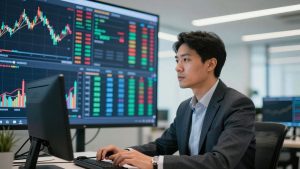
So, you’re thinking about getting into trading, or maybe you’re already doing it but want to make things easier? The future is basically here, and it’s all about the ai trader app. These aren’t your grandpa’s stock-picking tools. We’re talking about software that can actually learn, predict, and even make trades for you. It sounds like science fiction, but it’s real, and it’s changing how everyone, from beginners to pros, plays the market. Let’s look at what makes these apps so special in 2025.
Key Takeaways
- AI trading apps use machine learning to spot market patterns and suggest trades, making them different from traditional investing apps that focus on long-term planning.
- Look for ai trader app features like real-time market data, predictive analytics, and automated trading bots to help you make faster, smarter decisions.
- User-friendliness and cost are important; many apps offer free trials so you can test their tools before committing.
- Advanced features like sentiment analysis, NLP for news, and deep learning can give you an edge, but make sure the app fits your personal trading goals.
- As AI trading evolves, expect more integration with technologies like quantum computing and decentralized systems, alongside a growing focus on regulatory compliance and ethical AI practices.
Read More: schwab login id
1. Real-Time Market Movers And Smart Signals
Staying on top of the market is tough, right? Things move so fast. That’s where AI trading apps really shine in 2025. They’re not just showing you charts; they’re actively pointing out what’s happening now and what might happen next.
Think of it like having a super-fast assistant who’s constantly scanning the financial news, company reports, and trading volumes. This assistant then flags the big movers – the stocks or assets that are suddenly jumping or dropping significantly. These aren’t just random alerts; they’re often backed by AI analysis that suggests why it’s happening.
Here’s a breakdown of what these tools do:
- Identify Top Performers: Apps use AI to highlight stocks that are showing the most significant price action, whether up or down, in real-time. This helps you spot opportunities quickly.
- Generate Actionable Insights: Beyond just saying ‘this stock is moving,’ smart signals use AI to analyze trends, news sentiment, and historical data to suggest potential trading actions or highlight risks.
- Filter Noise: With so much information out there, AI helps cut through the clutter, focusing your attention on the most relevant market movements and potential trading setups.
For example, an app might notice a sudden surge in trading volume for a specific tech company, coupled with positive news about a new product launch. The AI could then generate a ‘smart signal’ indicating a potential upward trend, giving you a heads-up to investigate further.
These systems are designed to give you an edge by processing information at speeds and scales humans simply can’t match. They aim to translate raw market data into understandable alerts, helping you make more informed decisions without getting overwhelmed.
2. Predictive Analytics And Pattern Recognition
Think about how you spot trends when you’re watching the stock market. You look at past prices, maybe some news, and try to guess what’s next. AI does this, but on a massive scale and way faster. Predictive analytics uses historical data, like years of price charts and trading volumes, to find patterns that humans might miss. It’s not just about looking backward, though. These systems learn as they go, constantly updating their models with new information.
This ability to learn and adapt is what makes AI so powerful for trading.
Here’s a quick look at how it works:
- Data Ingestion: The AI pulls in tons of data – prices, news, economic reports, even social media chatter.
- Pattern Identification: It uses complex algorithms to find recurring sequences or relationships in that data.
- Forecasting: Based on identified patterns, it makes educated guesses about future price movements or market shifts.
- Strategy Adjustment: If the predictions aren’t panning out, the AI can tweak its approach.
It’s like having a super-powered detective who can sift through mountains of clues to predict the next move. For example, an AI might notice that a certain type of news event, combined with a specific price action, has historically led to a predictable outcome within a few hours. This allows traders to get ahead of the curve.
The real magic happens when these systems can spot subtle, non-obvious connections. It’s not just about simple “if this, then that” scenarios. AI can uncover intricate relationships between seemingly unrelated market factors, giving traders an edge that’s hard to replicate manually.
These tools can help identify potential trading opportunities or warn about upcoming risks. They can process information at speeds that are simply impossible for humans, making them invaluable in today’s fast-paced markets.
3. Automated Trading Bots
Automated trading bots are becoming a standard feature in AI trading apps, and for good reason. These bots can execute trades based on pre-set rules or AI-driven signals, taking the emotion out of trading and allowing for 24/7 market participation. Think of them as your tireless digital trading assistants. They can monitor markets, identify opportunities, and place trades faster than any human could.
The real power of these bots lies in their ability to follow complex strategies without deviation. Whether it’s executing a high-frequency trading strategy or a long-term investment plan, bots stick to the script.
Here’s a quick look at what makes them so useful:
- Speed and Efficiency: Bots can react to market changes in milliseconds, executing trades before human traders even notice the shift.
- Emotionless Execution: They don’t get greedy or fearful. Trades are made based purely on logic and data, avoiding common human trading pitfalls.
- Backtesting Capabilities: Many bots allow you to test your strategies on historical data, giving you an idea of how they might perform before risking real money. This is a huge step up from just guessing.
- 24/7 Operation: Markets don’t sleep, and neither do these bots. They can trade around the clock, catching opportunities you might miss.
Some platforms offer a variety of bots tailored for different needs, like arbitrage bots that exploit price differences across exchanges, or grid bots that automate buying and selling within a set price range. For instance, platforms like Cryptohopper provide a marketplace where you can find pre-built strategies or even develop your own.
It’s important to remember that while bots automate the execution, they still rely on the quality of the strategy and the data they’re fed. AI can help create these strategies, but human oversight and understanding of the underlying market dynamics remain key. Not all bots are created equal, and some might claim AI capabilities without truly offering advanced decision-making.
When choosing an app with automated trading bots, look for options that offer customization, clear performance metrics, and robust risk management features. This way, you can tailor the automation to your specific trading style and risk tolerance.
4. Sentiment Analysis Tools
Ever feel like the market’s mood swings are impossible to track? That’s where sentiment analysis tools come in. These apps are designed to gauge the overall feeling or opinion expressed in financial news, social media, and other text-based sources. They help you understand if the market is feeling optimistic or pessimistic about a particular stock, sector, or the economy as a whole.
Think of it like this: instead of just seeing a price go up or down, you get a sense of why it might be moving. Is it because of a wave of positive articles, or is there a growing unease bubbling up online? These tools process vast amounts of text data, often using natural language processing, to assign a sentiment score – usually bullish, neutral, or bearish.
Here’s a quick look at what they can do:
- Identify Trends: Spotting shifts in public opinion before they fully impact prices.
- Gauge News Impact: Determining how strongly a piece of news is likely to affect market sentiment.
- Filter Noise: Helping you focus on the most relevant opinions and discussions.
Some platforms even go a step further, categorizing sentiment by specific topics or companies. This allows for a more granular view, helping you pinpoint exactly what’s driving the sentiment. It’s a powerful way to add another layer to your research, moving beyond just the numbers on a chart. You can explore some of the top sentiment analysis tools for 2025 to see how they work in practice.
Understanding market sentiment isn’t just about reading headlines; it’s about interpreting the collective mood. These AI tools translate that mood into data, giving traders an edge by revealing the underlying emotional currents that often precede price action. It’s about getting a feel for the room, but on a global financial scale.
While not a crystal ball, sentiment analysis provides a valuable perspective. It helps traders make more informed decisions by considering the human element – the hopes, fears, and opinions – that inevitably influence financial markets.
5. Natural Language Processing For News Aggregation
In today’s fast-paced markets, keeping up with the news is a full-time job. That’s where Natural Language Processing (NLP) comes in for AI trading apps. Think of it as a super-smart assistant that can read and understand all the financial news out there, way faster than any human could.
NLP helps these apps sift through mountains of articles, reports, and even social media chatter. It figures out the main points and, importantly, the general feeling or sentiment behind the news. This means you get a quick grasp of whether the market is feeling optimistic or worried about a particular stock or trend.
Here’s how it typically works:
- Information Gathering: The AI scans news feeds from hundreds of sources, covering everything from major financial publications to industry-specific blogs.
- Sentiment Analysis: It assigns a score – like bullish, bearish, or neutral – to gauge the tone of the news related to specific assets.
- Impact Assessment: The system tries to figure out how significant the news might be, categorizing it as low, medium, or high impact.
- Summarization: Complex articles are boiled down into easy-to-digest summaries, highlighting the key takeaways.
This technology transforms raw text into structured data, making it easier for traders to spot potential market shifts before they become obvious in price charts. It’s about understanding the ‘why’ behind market movements, not just the ‘what’.
For example, an app might flag a series of articles about a new product launch by a tech company. NLP would not only identify the news but also determine if the overall tone is positive (bullish) and if the launch is considered a major event (high impact). This kind of insight helps traders make more informed decisions without spending hours reading every single report themselves.
6. Deep Learning And Neural Networks
You know, when we talk about AI in trading, deep learning and neural networks are kind of the big guns. These aren’t just simple algorithms; they’re inspired by how our own brains work, with layers of interconnected nodes that can figure out really complicated stuff. They’re particularly good at spotting patterns that are too subtle for humans, or even simpler AI, to catch.
Think about it like this: imagine trying to predict the stock market just by looking at a few charts. It’s tough, right? Deep learning models can process massive amounts of data – news articles, social media chatter, economic reports, you name it – and find hidden connections. They learn from this data, getting better over time without needing explicit programming for every single scenario. This ability to learn and adapt is what makes them so powerful for trading.
Here’s a simplified look at how they operate:
- Input Layer: This is where all the raw data comes in – prices, volumes, news sentiment scores, you get the idea.
- Hidden Layers: These are the ‘thinking’ parts. Each layer processes the information from the previous one, extracting more complex features and relationships.
- Output Layer: This layer gives you the final prediction, like whether a stock price is likely to go up or down, or a specific trading signal.
These networks are behind some of the most sophisticated trading tools out there, helping to make sense of the chaos in financial markets. They can analyze things like the nuances in earnings call transcripts or the subtle shifts in trading volume that might precede a big price move. It’s like having a super-powered analyst who never sleeps and can process information at lightning speed. This is a big part of why artificial intelligence is revolutionizing trading [1deb].
The complexity of deep learning models means they can uncover non-linear relationships in market data that traditional statistical methods might miss. This allows for more nuanced and potentially more profitable trading strategies.
While they are incredibly powerful, it’s worth remembering that these systems require a lot of data and computational power to train effectively. But for traders looking for an edge, the capabilities offered by deep learning and neural networks are becoming indispensable.
7. Reinforcement Learning For Adaptive Strategies
Reinforcement learning (RL) is a game-changer for AI trading apps, moving beyond static rules to create systems that learn and adapt on the fly. Think of it like teaching a dog new tricks – the AI tries something, gets a reward (like a profitable trade) or a penalty (like a loss), and adjusts its behavior to get more rewards in the future. This makes trading strategies incredibly dynamic.
This continuous learning loop allows the AI to react to changing market conditions in real-time, something traditional algorithms struggle with.
Here’s how it works in practice:
- Exploration vs. Exploitation: The AI needs to balance trying out new, potentially profitable strategies (exploration) with sticking to what it knows works well (exploitation).
- State, Action, Reward: The AI observes the current market ‘state’ (prices, volume, news), takes an ‘action’ (buy, sell, hold), and receives a ‘reward’ or ‘penalty’ based on the outcome.
- Policy Optimization: Over time, the AI builds a ‘policy’ – a set of rules that tells it the best action to take in any given market state to maximize its long-term rewards.
This approach is particularly useful for:
- Minimizing losses during sudden market downturns.
- Identifying and capitalizing on fleeting trading opportunities.
- Adjusting position sizes based on current volatility.
RL-powered trading bots don’t just follow a script; they evolve. They learn from every single trade, refining their approach to become more efficient and profitable over time. It’s like having a trader who’s constantly studying the market and getting better at their job, day in and day out.
8. Quantum Computing For Data Processing
Okay, so quantum computing. It sounds like something straight out of science fiction, right? But it’s actually starting to show up in the world of trading apps, and it’s a pretty big deal for how we handle all that market data. Think about the sheer amount of information flying around in the financial markets every second – news, trades, social media chatter, you name it. Classical computers, even the super-fast ones, can struggle to sort through it all efficiently. That’s where quantum computing comes in.
Quantum computers can tackle certain types of complex problems, especially optimization ones, way faster than traditional machines. This means they can sift through massive datasets and find patterns or solutions that would take conventional computers ages, if they could find them at all. For trading apps, this could mean spotting incredibly subtle market inefficiencies or optimizing portfolios with a level of precision we haven’t seen before. It’s like going from a calculator to a supercomputer for specific tasks.
Here’s a quick look at what this means:
- Faster Problem Solving: Quantum algorithms can solve specific optimization problems, like minimizing risk in bond portfolios, much quicker. Goldman Sachs has already experimented with this, seeing significant risk reduction.
- Handling Big Data: The volume of financial data is exploding. Quantum computing offers a potential way to process and analyze this data at speeds that are currently unimaginable.
- New Strategy Development: By uncovering hidden correlations and patterns, quantum computing could lead to entirely new trading strategies that are too complex for current AI models to discover.
It’s still early days for quantum computing in everyday trading apps, and there are definitely hurdles to overcome. But the potential is huge. As the technology matures, we’ll likely see it integrated more deeply, especially for tasks that require crunching enormous amounts of data to find the best possible outcome. It’s one of those technologies that could really change the game, and it’s exciting to see how it develops, especially with global efforts like the International Year of Quantum Science and Technology highlighting its importance.
The sheer computational power that quantum systems promise could unlock new frontiers in financial modeling. Imagine being able to run thousands of complex simulations simultaneously to stress-test a trading strategy against every conceivable market scenario. This level of analysis, currently out of reach, could become a standard feature in advanced trading platforms.
9. Decentralized AI (DeAI) And Blockchain Integration

You know, it’s wild how much things are changing with AI in trading. One of the big shifts happening is this move towards decentralized AI, or DeAI, and tying it all into blockchain technology. Think about it: instead of one big company controlling everything, DeAI spreads the AI’s power across a network. This makes it way harder for any single point to fail or be messed with.
This integration aims to create more transparent and secure trading environments.
Here’s what that looks like in practice:
- Trustless Systems: Blockchain’s inherent security means you don’t have to blindly trust a central authority. Transactions and AI decisions can be verified by anyone on the network.
- Reduced Counterparty Risk: When you trade with someone, there’s always a chance they won’t hold up their end. Blockchain and DeAI can minimize this by making agreements and settlements more direct and verifiable.
- Enhanced Transparency: All the trading activity and AI logic can be recorded on the blockchain, making it visible to participants. This helps in spotting unusual activity or potential manipulation.
The idea is to build trading systems that are not only smart but also inherently more resistant to fraud and single-point failures. It’s like moving from a single, easily guarded vault to a distributed network of secure lockers.
This isn’t just some far-off concept either. We’re seeing platforms start to use blockchain to record AI-driven trades, making the whole process more open. It’s a big step towards making AI trading more reliable and accessible for everyone, not just the big players.
10. Autonomous AI Agents
Think of autonomous AI agents as the next step beyond automated trading bots. These aren’t just following pre-set rules; they’re designed to operate with a significant degree of independence, making decisions and executing trades with minimal human oversight. They can analyze market data, identify opportunities, manage risk, and even adapt their strategies on the fly, much like a human trader, but at speeds and scales we can’t match.
These agents are becoming more sophisticated, capable of handling complex tasks:
- Portfolio Management: They can adjust asset allocation based on real-time market shifts and your personal risk tolerance.
- Strategy Adaptation: If a particular trading approach isn’t working, an autonomous agent can learn from the failure and pivot to a new strategy.
- Opportunity Identification: They can scan vast amounts of data, including news, social media, and economic reports, to spot trading possibilities humans might miss.
- Execution Optimization: Agents can manage order placement to minimize slippage and get the best possible prices.
The goal is to create AI systems that can function as independent traders, managing capital and pursuing profit objectives with a high degree of autonomy. This technology is still evolving, and while full autonomy is a ways off for most retail traders, the capabilities are growing rapidly. It’s like having a tireless, data-driven partner working for you 24/7.
The development of autonomous AI agents is pushing the boundaries of what’s possible in trading. While they promise increased efficiency and potential for higher returns, it’s important to remember that they are still tools. Understanding their capabilities and limitations is key to using them effectively. The focus is on creating systems that can learn and adapt, making them more responsive to the ever-changing financial markets.
11. Risk Management And Portfolio Optimization

When you’re trading with AI, it’s not just about catching the next big move. You also need to make sure your money is safe. That’s where risk management and portfolio optimization come in. These features help you keep your losses in check and make sure your investments are spread out smartly.
Think of it like this: you wouldn’t put all your eggs in one basket, right? AI tools help you avoid that by looking at your whole portfolio. They can spot if you’re too heavy in one sector or if a particular investment is becoming too risky. The goal is to balance potential gains with the possibility of losses.
Here’s what these tools typically do:
- Diversification Analysis: AI checks if your assets are spread across different markets, industries, and types of investments to reduce overall risk.
- Volatility Monitoring: It keeps an eye on how much your investments are fluctuating and can alert you if things get too wild.
- Drawdown Limits: You can set limits on how much you’re willing to lose on a single trade or your entire portfolio, and the AI will help enforce these.
- Correlation Analysis: Understanding how different assets move together is key. AI can identify hidden correlations that might increase your risk.
These systems can process a huge amount of data way faster than any human could. They look at historical performance, market news, and even global economic indicators to figure out the best way to structure your investments. For example, platforms like Aladdin by BlackRock are built for this kind of complex analysis, helping institutions manage massive portfolios effectively.
Managing risk isn’t about avoiding losses entirely; it’s about controlling them so you can keep trading. AI helps make this process more scientific and less emotional.
12. User-Friendly Interfaces
Let’s be real, nobody wants to stare at a screen that looks like a spaceship control panel, especially when you’re trying to make money. That’s why in 2025, AI trading apps are really focusing on making things simple and easy to use. The goal is to get you trading effectively without needing a degree in computer science.
Think about it: you’ve got complex market data, algorithms running in the background, and potentially automated trades happening. If the interface is confusing, you’re more likely to make mistakes or just get frustrated and give up. Good apps break down that complexity into digestible pieces.
Here’s what you should look for:
- Clear Layouts: Information is organized logically. You can find what you need, like your portfolio, market data, or trade history, without digging through menus.
- Intuitive Navigation: Moving between different sections of the app feels natural. Buttons and menus are where you expect them to be.
- Customizable Dashboards: You can arrange the information that matters most to you front and center. Maybe you care most about specific stocks, or perhaps real-time news feeds.
- Visual Aids: Charts and graphs are easy to read and understand. They use clear colors and labels to show trends and patterns.
It’s not just about looking pretty, though. A well-designed interface helps you make better decisions faster. For instance, seeing confidence indicators can help build trust in the AI’s suggestions, a key part of designing a good finance app interface. When everything is laid out clearly, you can react to market changes more quickly and with more confidence.
The best AI trading apps make advanced technology feel accessible. They hide the complicated stuff so you can focus on your trading strategy and goals, not on figuring out how the app works.
13. Free Trials And Demo Accounts
Trying out a new AI trading app can feel like a big commitment, right? You’re not just signing up for another piece of software; you’re potentially handing over control of your investments. That’s where free trials and demo accounts really shine. They’re your chance to kick the tires, so to speak, without risking any actual cash.
Think of it as a test drive. You get to see if the app’s features actually work for you, if the interface makes sense, and if the AI signals seem plausible. Most platforms offer some kind of trial period, usually ranging from a few days to a couple of weeks. This is plenty of time to get a feel for the daily operations. Some even offer paper trading accounts, which let you practice with virtual money in real market conditions. It’s a smart way to get familiar with the tools, like the advanced charting capabilities or the automated trading bots, before you put your own money on the line.
Here’s what you should look for during a trial:
- Ease of Use: Can you figure out how to set up trades or understand the AI’s recommendations without a manual the size of a phone book?
- Signal Quality: Do the AI-generated signals seem logical? Do they align with your own market observations?
- Platform Stability: Does the app crash or freeze when you’re trying to execute a trade or check your portfolio?
- Customer Support: If you run into a snag, how responsive and helpful is their support team?
Don’t underestimate the power of a demo account; it’s your safest entry point into the world of AI trading. It allows you to explore the full range of functionalities, from real-time market movers to sentiment analysis tools, all in a risk-free environment. Many platforms, like Trade Ideas, provide these options, letting you test their AI scanners and bots extensively. It’s a no-brainer way to ensure the app fits your trading style and goals before you make any financial commitment. Remember, the goal is to find an AI partner that genuinely helps you, not one that adds to your stress.
14. Customizable Trading Plans
Look, nobody fits into a one-size-fits-all box when it comes to trading. That’s why customizable trading plans are becoming a big deal in AI trader apps for 2025. These apps let you tailor your strategy to your own goals, risk tolerance, and even how much time you have to watch the markets. It’s not just about picking a pre-made plan anymore; it’s about building one that actually works for you.
Think about it: you might be someone who wants to make quick trades throughout the day, or maybe you prefer to set things up and let them run for weeks. An app that lets you adjust parameters like:
- Entry and exit triggers: When does the AI buy or sell?
- Risk limits: How much are you willing to lose on a single trade or overall?
- Asset allocation: Which markets or types of assets should the AI focus on?
- Trading frequency: How often should the AI look for new opportunities?
- News sensitivity: How much weight should market news have on decisions?
…gives you a lot more control. It’s like having a trading strategy that grows and changes with you.
The best apps don’t just offer a few sliders to tweak. They provide a deep level of customization, allowing you to define specific conditions for the AI to follow. This means you can build a plan that aligns perfectly with your personal trading style, whether you’re a conservative investor or a more aggressive trader looking for higher returns.
Some platforms even let you set up different plans for different parts of your portfolio. So, you could have one plan for your long-term investments and another, more active plan for your speculative funds. This level of personalization means you’re not just relying on an AI; you’re actively guiding it to meet your specific financial objectives.
15. Regulatory Compliance And Legal Frameworks
Navigating the world of AI trading apps in 2025 means keeping a close eye on the rules. It’s not just about making money; it’s about doing it the right way, and that’s where regulatory compliance comes in. Think of it as the guardrails that keep the whole system from going off the rails.
Regulators worldwide are scrambling to catch up with how fast AI is changing finance. They’re looking at things like transparency – making sure we can actually understand how these AI systems make their decisions, not just trust a “black box.” This is a big deal because if something goes wrong, we need to know why.
Here are some key areas regulators are focusing on:
- Data Integrity: Making sure the data fed into AI models is accurate and unbiased. Bad data in, bad trades out.
- Algorithmic Fairness: Preventing AI from accidentally creating discriminatory outcomes or unfairly distorting market prices.
- Market Manipulation: AI can be super fast, but that speed also raises concerns about whether it could be used for manipulative practices, even unintentionally.
- Accountability: Figuring out who’s responsible when an AI trading system makes a mistake. Is it the developer, the user, or the AI itself?
The challenge is that traditional rules weren’t built for AI. They’re trying to adapt, but it’s a work in progress. This means AI trading apps need to be built with compliance in mind from the ground up, not as an afterthought. It’s about building trust.
Different regions have different takes on this. The EU, for example, is pushing for more explainable AI, wanting to know the ‘why’ behind the AI’s actions. The US is also introducing new rules, like the Colorado AI Act, focusing on risk management and transparency. It can get complicated trying to keep up with all these different rules, especially if you’re trading across borders.
Ultimately, the best AI trading apps will be the ones that not only offer powerful features but also demonstrate a clear commitment to operating within legal and ethical boundaries. This means they’ll likely have clear policies on data usage, risk management, and how they handle regulatory changes. It’s a sign of a mature and trustworthy platform.
16. Data Accuracy And Quality Control
When you’re looking at AI trading apps, one of the most important things to check is how they handle data. It sounds simple, but it’s actually a big deal. If the data an AI uses is wrong, incomplete, or just plain old, the predictions it makes will be garbage, and that can lead to some really bad trading decisions. Think of it like trying to bake a cake with expired flour – it’s just not going to turn out right.
AI models rely heavily on historical data to learn patterns. But what happens when the market throws a curveball, something totally unexpected? If the AI hasn’t seen anything like it before, its forecasts can go way off. This is why it’s super important that the app you’re using has ways to deal with new, unusual market events. It’s not just about having lots of data; it’s about having the right data and knowing how to use it even when things get weird.
Here are a few things to look for:
- Data Sources: Where does the app get its information? Is it from reliable financial news outlets, official exchange data, or just random internet scrapes?
- Data Cleaning: Does the app have processes to clean up messy data, fix errors, or fill in gaps? This is a big one.
- Real-time Updates: How quickly does the data get updated? In trading, every second counts, so stale data is a no-go.
- Verification: Does the app provide any way to verify the accuracy of its data or the sources it uses?
You might see a lot of fancy algorithms and complex models, but at the end of the day, they’re all built on data. If that foundation is shaky, the whole structure is at risk of collapsing. It’s like building a house on sand – it might look good for a while, but it won’t last.
Some platforms might even offer verified historical performance data, which is a good sign that they’re serious about accuracy. It’s a tough problem to solve, for sure, but the apps that are really trying to get it right are the ones you want to pay attention to. You can explore some of the leading AI tools for trading in 2025 to see how they approach these challenges.
17. Model Transparency And Explainability
It’s one thing for an AI to make a trade, but it’s another entirely to understand why it made that trade. This is where model transparency and explainability come into play. Think of it like this: if your AI trading app suddenly dumps a bunch of your stocks, you’d want to know the reasoning, right? Being able to see how the AI arrived at its decisions is becoming super important, especially with new rules popping up.
Many AI models, especially the really complex ones, can act like a “black box.” You put data in, and a trade comes out, but the middle part is a mystery. This lack of clarity can be a big problem. Regulators are starting to push for more openness, and frankly, so should you. Knowing the ‘why’ behind a trade helps you trust the system and also spot potential issues before they become major problems.
Here’s why this matters:
- Trust Building: When you can see the logic, you’re more likely to trust the app with your money.
- Risk Identification: Understanding the AI’s reasoning can help you catch flawed logic or biases that might lead to bad trades.
- Regulatory Adherence: As rules tighten, apps that can explain their AI’s actions will be ahead of the curve. The EU, for instance, is pushing for more interpretable AI systems.
The challenge isn’t just about making AI smarter; it’s about making it understandable. When AI trading systems can clearly articulate their decision-making process, it not only builds confidence for users but also aids regulators in monitoring for fairness and preventing market manipulation. This move towards explainable AI is a significant step in making automated trading more accountable and reliable for everyone involved.
Some apps are starting to show you the factors that influenced a trade, like specific news events or market indicators. It’s not always a step-by-step breakdown, but it’s a start. As AI investing apps continue to develop, expect more features that pull back the curtain on how these algorithms work. This is a key part of making AI trading a more accessible and reliable tool for everyday investors, moving beyond the mystery of AI stock trading platforms and into a future of informed decision-making.
18. Bias Detection And Fairness
It’s easy to overlook, but bias in AI trading apps is a real thing, and it can mess with your money. Think about it: these apps learn from past market data. If that data has historical biases – maybe certain groups were unfairly excluded or favored – the AI can pick that up and keep the cycle going. This means your trading app might unintentionally make decisions that aren’t fair to everyone.
So, what are these apps actually doing to stop this? Good ones are building in ways to spot and fix bias. It’s not a simple fix, though. It involves looking closely at the data they use and how the algorithms make choices.
Here are some ways apps are trying to be fairer:
- Data Auditing: Regularly checking the historical data for any unfair patterns or exclusions.
- Algorithm Testing: Running tests to see if the AI’s decisions disproportionately affect certain market segments.
- Fairness Metrics: Using specific measurements to quantify how fair the AI’s outcomes are.
- Human Oversight: Keeping humans in the loop to catch and correct biased decisions before they cause problems.
The goal is to make sure the AI is working for all users, not just a select few. It’s about creating a level playing field where everyone has a fair shot at making smart trades, regardless of background or market history.
Apps that are serious about this will often talk about their efforts in this area. You might see them mention things like responsible AI development or specific tools they use to check for fairness. It’s a sign they’re thinking beyond just profits and trying to build a more equitable trading environment.
19. Advanced Chart Analysis
When you’re trading, looking at charts is a big part of the game. But not all charts are created equal, right? The best AI trader apps in 2025 go way beyond just showing you lines on a screen. They offer tools that help you see patterns you might miss and understand what the market might do next.
Think about it: these apps can automatically spot things like head and shoulders patterns or double tops. They can also show you how different timeframes connect, giving you a clearer picture of trends. Some even use AI to draw trendlines for you, which is pretty neat.
Here are some of the cool things you’ll find:
- Automated Pattern Recognition: The app finds common chart patterns (like flags, pennants, or triangles) as they happen.
- Multi-Timeframe Analysis: You can see indicators and patterns from different time periods (like daily, hourly, and 15-minute charts) all on one screen.
- AI-Assisted Drawing Tools: Tools that can help draw trendlines, support, and resistance levels based on market data.
- Customizable Indicators: The ability to tweak existing indicators or even create your own using simple scripting or AI prompts.
These advanced charting features aren’t just for show. They’re designed to help you make quicker, more informed decisions by highlighting potential opportunities and risks that might otherwise go unnoticed. It’s like having a super-powered magnifying glass for the market.
Some platforms even let you test out trading ideas based on these chart patterns. You can see how a strategy would have performed in the past without risking real money. This kind of analysis is key to refining your approach and building confidence before you place a live trade.
20. Personalized AI Advisors
Think of your AI trading app in 2025 not just as a tool, but as a personal financial coach. Personalized AI advisors are becoming a big deal, tailoring advice and actions specifically to you. They look at your financial goals, your comfort level with risk, and even your trading history to suggest what might work best. It’s like having a financial expert who knows you inside and out, available 24/7.
These advisors can help in a few key ways:
- Customized Strategy Suggestions: Based on your profile, they’ll propose trading strategies that fit your needs, whether you’re looking for slow and steady growth or more aggressive plays.
- Portfolio Adjustments: They can monitor your portfolio and suggest tweaks when market conditions change or when your personal circumstances shift.
- Educational Guidance: If you’re new to a certain type of investment or strategy, the AI advisor can explain it in simple terms, helping you learn as you go.
- Alerts and Notifications: They’ll let you know about opportunities or risks that are particularly relevant to your holdings and interests.
The goal here is to make sophisticated trading accessible. Instead of just giving you raw data, the AI advisor interprets it for your specific situation. This means less guesswork and more confidence in your investment decisions. It’s a big step up from generic advice.
For instance, an AI advisor might notice you’re interested in sustainable investing and flag companies with strong ESG ratings that also show good financial potential. Or, if you’ve indicated a low tolerance for risk, it might steer you away from highly volatile assets. This level of personalization is what sets the top trading apps apart. It’s about making AI work for your financial journey, not just for the market in general. You can explore some of these advanced capabilities with platforms like Trade Ideas which offer sophisticated analysis tools that can be the foundation for personalized advice.
21. ESG Trading Integration
More and more, people want their investments to do good, not just make money. That’s where ESG trading integration comes in. ESG stands for Environmental, Social, and Governance, and it’s all about investing in companies that are trying to be good for the planet, good for people, and have solid leadership.
AI trading apps in 2025 are getting really good at spotting these kinds of companies. They can sift through tons of data – like company reports, news articles, and even social media chatter – to figure out how well a company is doing on ESG factors. This means you can actually align your trading with your values without having to do all the heavy lifting yourself.
Here’s how it’s shaking out:
- Environmental Focus: Looking at a company’s carbon footprint, how they use resources, and their efforts in sustainability.
- Social Impact: Checking out their labor practices, how they treat customers, and their involvement in the community.
- Governance Standards: Examining board diversity, executive pay, and overall business ethics.
The goal is to make investing more responsible, and AI is making that easier than ever.
It’s not just about avoiding bad actors anymore. AI tools are helping investors find companies that are actively making a positive difference, potentially leading to better long-term returns as these sustainable practices become more mainstream.
So, if you’re looking to invest with a conscience, make sure your AI trading app has solid ESG integration. It’s a smart move for both your portfolio and the world.
22. Market Manipulation Risk Mitigation
It’s a real worry, isn’t it? With AI trading getting so fast and complex, the idea of market manipulation becomes a bigger deal. Think about it: AI systems could potentially be used to create fake demand or push prices around in ways that aren’t fair to regular investors. Some experts are concerned that AI might even inadvertently teach algorithms from different companies to work together, like fixing prices or rigging bids. This isn’t just a theoretical problem; it’s something regulators are watching closely.
The challenge is that as these AI systems get smarter, it gets harder to spot and prove when something fishy is going on.
So, what are apps doing about it? Well, good ones are building in safeguards. They’re focusing on:
- Real-time monitoring: Watching trading patterns as they happen to flag unusual activity.
- Algorithmic checks: Using AI itself to detect patterns that look like manipulation, such as spoofing (placing fake orders).
- Transparency features: Providing users with clear information about how trades are executed and what signals the AI is using.
It’s a constant cat-and-mouse game. As AI gets more advanced, so do the methods to prevent its misuse. The goal is to keep the markets fair for everyone, not just the fastest algorithms.
Many platforms are also working hard to make sure their AI isn’t learning bad habits. This involves careful training and testing to avoid biases that could lead to unfair trading practices. Plus, staying up-to-date with regulatory changes is key, as rules are evolving to keep pace with technology. It’s about building trust and making sure the AI is a tool for good, not for gaming the system.
23. Cost-Effective Pricing Models
When looking at AI trading apps in 2025, the price tag can really vary. You’ve got everything from free basic versions to super high-end institutional tools that cost a fortune. It’s all about finding that sweet spot that fits your budget and your trading goals.
For individual traders, many platforms offer tiered subscription plans. These often scale with the features you get, like access to more advanced analytics or a higher number of automated trades. Some might charge a flat monthly fee, while others use a usage-based model. It’s not uncommon to see prices ranging from around $20 to $100 per month for retail-focused apps.
Here’s a quick look at how some pricing can break down:
- Freemium Models: Basic features are free, with paid upgrades for advanced tools. Think of apps like Trader Sage or Kavout.
- Tiered Subscriptions: Different price points unlock more features. For example, Trade Ideas has plans around $118 and $228 monthly.
- Usage-Based: You pay based on how much you use the service, common with API access or data feeds.
- Performance Fees: Less common for retail apps, but some might take a cut of your profits, like Aidyia Holdings’ model.
For the big players, like hedge funds and institutions, the costs jump significantly. We’re talking tens of thousands of dollars per year, or even custom pricing. Tools like Bloomberg Terminal can run upwards of $24,000 annually, and enterprise solutions from companies like Quantifi or FusionTrader can easily hit $10,000-$15,000 per month.
It’s really important to look beyond just the sticker price. Consider what you’re actually getting for your money. Does the app provide the specific AI features you need? Is the customer support decent? Sometimes paying a bit more for a reliable tool with good support makes more sense than going for the cheapest option that might leave you hanging.
Many apps also offer free trials or demo accounts. This is a smart way to test out the platform before committing. You can get a feel for the interface, try out some of the AI features, and see if it actually helps your trading strategy without spending a dime.
24. Seamless Integration With Existing Platforms
Look, nobody wants to start from scratch, right? That’s where how well an AI trading app plays with your current setup really matters. You need an app that can connect to the tools and brokers you’re already using without a huge fuss. Think about it – you’ve probably spent time building watchlists, setting up alerts, or even developing custom indicators on platforms like TradingView or MetaTrader 5. A good AI trader app should be able to tap into that without you having to rebuild everything.
This means looking for apps that support common connection methods. Webhooks are a big one; they let one platform send a message to another when something happens. Many apps now use these to link charting software directly to your broker for automated trades. APIs are also key, acting like digital translators that let different software talk to each other.
Here’s what to look for:
- Brokerage Connectivity: Does it link with your preferred broker? Check for direct integrations or support for common API protocols.
- Charting Platform Links: Can it pull data or send signals to/from platforms like TradingView, TrendSpider, or others you rely on?
- Data Feed Compatibility: Will it work with the market data you’re already subscribing to, or does it require a separate, potentially costly, feed?
The goal here is to make the AI app a natural extension of your existing trading workflow, not a disruptive new piece of software you have to fight with. It should feel like it belongs, making your trading smarter and more efficient, not just adding another layer of complexity.
Some apps are built specifically to be bridges. They don’t generate their own signals but instead take alerts from your favorite charting tools and turn them into actual trades. This is super handy if you’ve already got a strategy that works on a charting platform but want to automate the execution part. It’s all about making your tech stack work together smoothly.
25. Educational Resources And Support
Even the most advanced AI trading app won’t do you much good if you don’t know how to use it, right? That’s where solid educational resources and support come in. Think of it like getting a fancy new tool – you need the manual and maybe a quick tutorial to really make it work for you.
Most top-tier AI trading apps understand this. They don’t just throw you into the deep end. Instead, they usually have a whole section dedicated to helping you get up to speed. This can include:
- Video tutorials: Short, digestible videos explaining specific features or strategies.
- Written guides and FAQs: Detailed articles covering everything from basic setup to advanced analytics.
- Webinars and live Q&A sessions: Opportunities to interact with experts and ask your burning questions.
- Community forums: A place to connect with other users, share tips, and learn from their experiences.
The best apps make learning accessible and ongoing. They know that as the technology evolves, so should your knowledge.
It’s easy to get caught up in the flashy tech, but remember that the human element of learning is still super important. A good app will guide you, not just present you with data. They want you to succeed, and that means giving you the tools to understand what the AI is telling you.
Some platforms even offer personalized support, like a dedicated account manager or direct chat with technical staff. This kind of help can be a lifesaver when you hit a snag or just want to explore a new feature. Don’t underestimate the power of good support – it can make the difference between a frustrating experience and a profitable one.
Wrapping It Up
So, that’s a look at some of the cool stuff AI trading apps are bringing to the table in 2025. It’s pretty wild how much these tools can help, whether you’re just starting out or have been trading for a while. They can really simplify things, spotting patterns and giving you ideas without you having to stare at charts all day. Remember to check out free trials and pick an app that feels right for what you want to do. The market changes fast, but with the right AI tools, you can feel a lot more confident making your moves. Give them a try and see how they can help you trade smarter.
Frequently Asked Questions
What’s the main difference between a regular investing app and an AI trading app?
Think of a regular investing app like a simple calculator for your money. It helps you keep track of your investments. An AI trading app, however, is like a super-smart assistant that not only tracks your money but also actively looks for chances to buy or sell, using smart computer programs to find the best times. It’s designed to help you trade more often and make quicker choices.
Do I need to be a math whiz to use an AI trading app?
Not at all! AI trading apps are made to make trading easier, even for people who are new to it. They do the hard work of looking at lots of information and finding patterns. Many apps are designed to be simple to use, with clear instructions and helpful tools so you don’t need to be a computer expert or a math genius.
Can AI trading apps really predict the market?
AI trading apps use advanced computer programs to study past and current market information. They can find patterns that humans might miss and make educated guesses about where prices might go. While they can’t predict the future with 100% certainty, they can give you a much better idea of what might happen, helping you make smarter decisions.
Are AI trading apps safe to use?
Most AI trading apps are built with security in mind. They use strong technology to protect your information and money. However, like any online service, it’s always smart to be careful. Look for apps that are clear about how they work, have good reviews, and follow important rules. Also, never invest more money than you can afford to lose.
What is ‘automated trading’ or ‘trading bots’?
Automated trading, or using trading bots, means letting the AI app make trades for you based on the rules and strategies you set, or that the AI has learned. It’s like having a robot trader working for you 24/7. This can help you act fast when opportunities arise, even if you’re not watching the market all the time.
How can I try out an AI trading app before I pay for it?
Many AI trading apps offer free trials or demo accounts. This is a great way to test out all the features without using your real money. You can practice making trades, see how the signals work, and get a feel for the app to make sure it’s the right fit for you before you commit to paying.