
Forex trading can seem complicated, right? Especially when you’re trying to figure out all the tools and strategies out there. This guide is all about making tradingview forex simpler. We’ll walk through how to use TradingView for forex, build a solid plan, get smart with technical analysis, and even talk about the mental side of things. Plus, we’ll touch on some more advanced stuff and how to keep learning. Think of this as your roadmap to getting more comfortable with tradingview forex.
Key Takeaways
- Get comfortable with the TradingView platform for your forex trading. Know its tools and how to set it up for your style.
- Create a trading plan that works for you. This means knowing when to get in, when to get out, and how to handle risks.
- Use TradingView’s chart tools and indicators to spot trading chances. Understanding price action is also a big part of this.
- Trading isn’t just about charts; it’s also about staying calm and focused. Learn to manage your feelings and stick to your plan.
- Keep learning and practicing. The forex market changes, so staying updated and refining your approach is key to long-term success with tradingview forex.
Understanding TradingView Forex Essentials
Getting started with forex on TradingView can feel like a lot at first, but it’s really about getting comfortable with the tools. Think of TradingView as your main workshop for everything forex. It’s where you’ll spend most of your time looking at charts, figuring out what the market might do next, and setting up your trades. The platform is designed to give you a clear view of price movements across different currency pairs.
Navigating the TradingView Platform for Forex
When you first log in, you’ll see a lot of information. Don’t let it overwhelm you. The most important part for forex is the chart itself. You can switch between different currency pairs, like EUR/USD or GBP/JPY, using the search bar. Each pair has its own chart showing its price history. You can also change how the price is displayed, from simple lines to candlestick charts, which give you more detail about price swings within a certain time frame. Getting familiar with how to pull up different charts and set the time frame you want to look at is the first step. You can also find news related to the currency pairs right on the platform, which can be helpful for understanding market moves. For beginners looking to trade Gold (XAUUSD), understanding charting software like TradingView is a good starting point for beginners.
Key Features for Forex Analysis on TradingView
TradingView has a bunch of features that make analyzing forex markets easier. You’ve got access to a huge library of technical indicators – things like Moving Averages, RSI, and MACD. These can help you spot trends or potential turning points. You can add multiple indicators to your chart to get different perspectives. Another useful feature is the drawing tools. You can draw trendlines, support and resistance levels, and Fibonacci retracements directly on the chart to mark important price areas. TradingView also lets you see what other traders are doing, with features like sentiment indicators and public chart ideas. This can give you a sense of the general market mood.
Here’s a quick look at some common indicators and what they might show:
| Indicator | What it Shows |
|---|---|
| Moving Average | Average price over a period; helps identify trends |
| RSI (Relative Strength Index) | Measures speed and change of price movements; can signal overbought/oversold conditions |
| MACD (Moving Average Convergence Divergence) | Shows the relationship between two moving averages; helps identify momentum and trend changes |
Customizing Your TradingView Workspace
Everyone trades differently, and TradingView lets you set things up just the way you like. You can create different chart layouts, maybe one with just a few indicators and another with more detailed analysis tools. Saving these layouts means you can quickly switch between them. You can also set up price alerts, so TradingView notifies you when a currency pair reaches a specific price level you’re watching. This is super handy so you don’t have to stare at the screen all day. Setting up your workspace correctly means less time fiddling with settings and more time actually trading or analyzing. It’s about making the platform work for you, not the other way around.
Setting up your TradingView workspace is more than just aesthetics; it’s about creating an efficient environment that supports your trading decisions. A well-organized layout reduces distractions and helps you focus on the price action and the indicators that matter most to your strategy.
Developing a Robust Forex Trading Strategy
Alright, so you’ve got the TradingView platform set up, you’re starting to get a feel for the charts, but now what? You can’t just jump in and start clicking buttons hoping for the best. That’s a surefire way to lose money, fast. What you really need is a solid plan, a strategy that guides your every move in the forex market. Think of it like building a house; you wouldn’t start hammering nails without blueprints, right? The same applies here.
Crafting Your Trading Plan
This is where you lay down the law for yourself. Your trading plan is your roadmap, and without it, you’re just wandering aimlessly. It needs to be clear, specific, and something you can actually stick to. What are you looking for before you even consider entering a trade? What are your rules for getting out, whether you’re winning or losing? These aren’t suggestions; they’re rules.
- Define Your Entry Criteria: What specific chart patterns, indicator signals, or price levels must align before you place a trade?
- Set Your Exit Rules: Know precisely when you’ll take profits and, just as importantly, when you’ll cut your losses. This includes stop-loss and take-profit levels.
- Determine Position Sizing: How much of your capital will you risk on any single trade? This is a big one for survival.
- Choose Your Trading Session: Are you a scalper looking for quick moves during busy European hours, or do you prefer the slower pace of the Asian session?
A well-defined trading plan is the bedrock of consistent trading performance. It removes guesswork and emotional decision-making when the market gets choppy.
Without a plan, you’re essentially gambling. The forex market is too big and too fast to rely on gut feelings alone. You need a system.
Implementing Risk Management Techniques
This is arguably the most important part of any trading strategy. You can have the best entry signals in the world, but if you’re not managing your risk, one bad trade can wipe out weeks of gains. It’s all about protecting your capital so you can stay in the game long enough to be profitable.
- The 1-2% Rule: A common guideline is to risk no more than 1% to 2% of your total trading account on any single trade. This means if you have a $10,000 account, you’re risking $100-$200 per trade.
- Stop-Loss Orders: Always use stop-loss orders. These automatically close your trade if the price moves against you by a predetermined amount, preventing catastrophic losses.
- Position Sizing: Calculate your lot size based on your stop-loss distance and your risk percentage. This ensures that each trade carries the same monetary risk, regardless of the currency pair or trade setup.
Setting Realistic Trading Goals
Let’s be honest, nobody gets rich overnight trading forex. Setting unrealistic goals is a fast track to disappointment and poor decision-making. You need to aim for steady, sustainable growth. Think about what’s achievable given your current skill level, capital, and the time you can dedicate to trading. Maybe your first goal is simply to survive the first month without blowing up your account, or perhaps it’s to achieve a consistent win rate on a specific strategy. As you gain experience, you can adjust these goals. It’s about progress, not perfection, and definitely not instant riches. You might want to look into forex trading algorithms to see how automation can help manage trades based on your strategy.
Mastering Technical Analysis with TradingView
Alright, let’s talk about using TradingView to really get a handle on technical analysis for forex. This isn’t just about looking at pretty charts; it’s about understanding what the price action is telling you and how to spot potential moves. TradingView gives you the tools to do this effectively, but you still need to know how to use them.
Utilizing Chart Patterns for Forex Signals
Chart patterns are like the language of the market. They show up repeatedly, and when you learn to recognize them, they can give you clues about where prices might go next. Think of patterns like head and shoulders, double tops and bottoms, or triangles. They aren’t guarantees, of course, but they’re solid indicators.
Here are a few common patterns and what they might mean:
- Head and Shoulders: Often signals a trend reversal. Look for a peak, a higher peak, then a lower peak, with a neckline connecting the lows. A break below the neckline is a bearish signal.
- Double Top/Bottom: Also points to reversals. A double top looks like a ‘W’ and suggests a move down, while a double bottom looks like an ‘M’ and suggests a move up.
- Triangles (Ascending, Descending, Symmetrical): These can signal either continuation or reversal, depending on the type and the surrounding trend. They show a period of consolidation before a potential breakout.
TradingView makes it easy to spot these. You can draw trendlines and pattern shapes right on your charts. It takes practice, but the more you see them, the more familiar you’ll become.
Leveraging Indicators for TradingView Forex Insights
Indicators are mathematical calculations based on price and volume. They can help confirm what you’re seeing in the price action or give you signals that might not be obvious otherwise. TradingView has a massive library of them.
Some popular ones include:
- Moving Averages (MA): Smooth out price data to create a single flowing line. They help identify trend direction and potential support/resistance levels. Crossovers between different MAs can also be signals.
- Relative Strength Index (RSI): A momentum oscillator that measures the speed and change of price movements. It oscillates between 0 and 100 and is often used to identify overbought or oversold conditions.
- MACD (Moving Average Convergence Divergence): Shows the relationship between two moving averages of prices. It’s used to gauge momentum and identify potential trend changes.
When using indicators, remember they work best when used together and in conjunction with price action. Don’t just rely on one. TradingView lets you add multiple indicators to your charts, so you can build a custom toolkit. It’s a good idea to start with a few that make sense to you and understand the forex market before adding too many.
Understanding Price Action on TradingView Charts
Price action is literally just the movement of prices over time. It’s the raw data. While patterns and indicators are great, understanding price action itself is key. It’s about looking at the candlesticks or bars and seeing what story they’re telling.
Consider these points:
- Candlestick Formations: Individual candles can give clues. A long wick might show rejection of a certain price level, while a strong body indicates conviction.
- Support and Resistance: These are price levels where buying or selling pressure has historically been strong enough to reverse the price. They are areas to watch for potential turning points.
- Trendlines: Connecting a series of higher lows (uptrend) or lower highs (downtrend) can visually show the direction of the market and potential areas where the trend might pause or reverse.
Looking at raw price movement, without relying solely on lagging indicators, can give you a more direct view of market sentiment and potential shifts. It’s about observing the ‘who’ is in control – buyers or sellers – at any given moment.
TradingView’s clean interface makes it simple to focus on the price action. You can zoom in and out, change timeframes, and really get a feel for the market’s flow. It takes time and a lot of chart observation, but mastering price action is a big step in becoming a better forex trader.
The Psychology of Successful Forex Trading
Trading forex isn’t just about looking at charts and numbers; it’s also a lot about what’s going on inside your head. You can have the best strategy in the world, but if your emotions get the better of you, things can go south pretty fast. It’s like driving a car – you need to know how to steer, but you also need to keep a cool head, especially when traffic gets crazy.
Managing Emotions in Trading
Emotions are a trader’s biggest hurdle. Fear can make you exit a trade too early, missing out on bigger profits. Greed, on the other hand, might keep you in a trade for too long, hoping for just a little bit more, only to see your gains disappear. Impatience can lead to jumping into trades that aren’t really set up properly, just because you feel like you have to be doing something. It’s a constant battle to stay objective.
- Fear: Often leads to premature exits or avoiding good setups altogether.
- Greed: Can cause you to hold onto losing trades too long or over-leveraging.
- Impatience: Pushes you to trade without proper setup confirmation.
- Overconfidence: Arises after a string of wins, leading to taking on too much risk.
Staying aware of these emotional traps is the first step. Recognizing when you’re feeling one of these emotions start to bubble up is key to not letting it dictate your trading decisions. It takes practice, but you can learn to pause and assess before acting.
Building a Disciplined Trading Mindset
Discipline is the bedrock of consistent trading. It means sticking to your plan, even when it’s tough. This involves having a clear trading plan, which should outline your entry and exit points, how much you’re willing to risk on any given trade, and your overall goals. Then, the hard part: actually following it.
Here’s a simple breakdown:
- Have a Plan: Define your strategy, risk per trade (usually 1-2% of your account), and when you’ll get out, win or lose.
- Stick to It: Don’t deviate based on a gut feeling or what someone else is saying.
- Accept Losses: Understand that losing trades are part of the game. Focus on the long-term performance of your strategy, not just one trade.
Overcoming Common Trading Pitfalls
There are a few common mistakes that trip up a lot of traders. One is ‘revenge trading’ – trying to immediately win back money after a loss. This usually leads to bigger losses because you’re not trading with a clear head. Another is ‘overtrading’, where you just can’t resist placing too many trades, often with small amounts, hoping they’ll add up. This just eats away at your capital with commissions and slippage.
- Revenge Trading: Avoid this by stepping away after a loss and only returning when you’re calm and your setup is valid.
- Overtrading: Set daily or weekly limits on the number of trades you’ll take.
- FOMO (Fear of Missing Out): Don’t chase trades. If you miss a move, there will always be another opportunity. Trust your plan.
Advanced Trading Techniques on TradingView
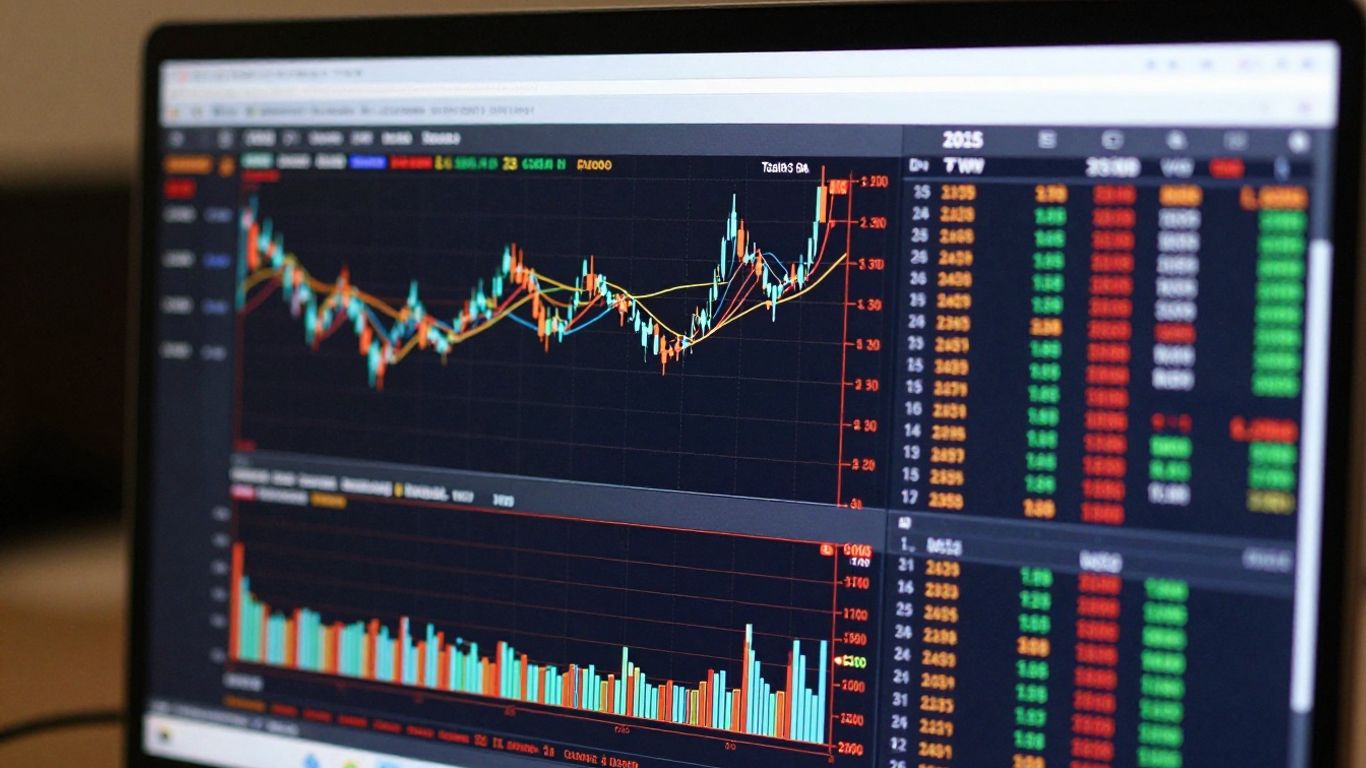
Alright, so you’ve got the basics down, you’re charting like a pro, and your strategy is starting to feel solid. Now, let’s talk about taking things up a notch. This section is all about those more advanced moves you can pull off using TradingView, stuff that can really make a difference in your trading.
Backtesting Strategies for Validation
Before you even think about risking real money on a new strategy, you absolutely have to test it. Backtesting is basically replaying historical market data to see how your strategy would have performed. TradingView makes this pretty straightforward. You can manually go back on charts, mark your entry and exit points based on your strategy rules, and then calculate the results. It’s not just about seeing if you would have made money; it’s about understanding the win rate, the average win/loss, and the drawdown. This gives you a realistic picture of what to expect.
- Identify historical periods that represent different market conditions (trending, ranging, volatile).
- Apply your strategy rules consistently to these periods.
- Record every trade – entry, exit, stop loss, take profit, and outcome.
- Analyze the results to identify strengths and weaknesses.
Backtesting isn’t a crystal ball, but it’s the closest thing we have to predicting future performance based on past behavior. It helps weed out strategies that look good on paper but fall apart in real-time.
Automating Trades with TradingView Tools
This is where things get really interesting. TradingView has features that let you automate parts of your trading. While TradingView itself isn’t a broker, it can connect to certain brokers or use third-party tools to execute trades based on your strategy. Think about strategies like the Fair Value Gaps (FVG) indicator; you could potentially set up alerts or even automated entries when specific conditions are met. This takes the emotion out of trading and ensures your strategy is executed precisely, even when you’re not watching the charts.
Analyzing Market Trends Effectively
Understanding market trends is key, but advanced traders look for more than just the obvious direction. They look for shifts in market structure, institutional order flow, and liquidity. Concepts like identifying Fair Value Gaps (FVGs) or understanding Breaker Blocks can give you an edge. These are areas where price imbalances or institutional activity might suggest a future move. TradingView’s charting tools, combined with a solid understanding of these concepts, allow you to spot these subtle but significant market dynamics. It’s about seeing the bigger picture and anticipating where the market might go next, rather than just reacting to price changes.
Continuous Learning and Improvement
The forex market is always changing, and what worked yesterday might not work tomorrow. That’s why sticking with it and always learning is super important. It’s not a one-and-done thing; you have to keep up.
Staying Updated with Market Developments
Markets shift because of news, economic changes, and even global events. You need to know what’s going on. Think about:
- Economic Calendars: Keep an eye on major economic releases like interest rate decisions or employment reports. These can cause big price swings.
- Geopolitical News: Major world events can impact currency values. It’s good to have a general awareness of what’s happening globally.
- Central Bank Policies: Understand how central banks influence their country’s currency. Their statements and actions matter a lot.
Staying informed helps you anticipate potential market moves. It’s like knowing the weather forecast before you go out.
Learning from Trading Communities
Trading alone can be tough. Connecting with other traders can give you new ideas and perspectives. You can find online forums, social media groups, or even local meetups. Sharing experiences, discussing strategies, and seeing how others approach the market can be really helpful. Just remember to take everything with a grain of salt and do your own research. It’s about gathering information, not blindly following others. You can find a lot of useful discussions on platforms like TradingView’s community.
Refining Your TradingView Forex Approach
Your TradingView setup and strategy aren’t static. As you learn and the market changes, you’ll want to tweak things. Maybe you discover a new indicator that works well for a specific pair, or perhaps you realize a certain chart pattern is more reliable for your style. Don’t be afraid to adjust your indicators, timeframes, or even your entire trading plan. Regularly reviewing your past trades, both winners and losers, is key. What went right? What went wrong? Use TradingView’s tools to analyze your performance and make informed adjustments. It’s about making your trading process better over time, not about finding a magic bullet.
The journey of a forex trader is ongoing. Success isn’t just about the trades you win, but about the discipline to keep learning, adapting, and improving your approach. Treat every trading day as a chance to get a little bit better.
Wrapping It Up
So, we’ve gone through a lot in this guide, from setting up your TradingView charts to understanding how to actually make sense of the market. Remember, trading isn’t just about fancy indicators or predicting the next big move. It’s about having a solid plan, managing your money wisely, and, honestly, keeping your cool when things get a bit wild. TradingView is a great tool to help you do all of that, but it’s up to you to put in the work. Keep practicing, keep learning, and don’t be afraid to adjust your approach as you go. That’s how you really get good at this.
Frequently Asked Questions
What is TradingView and why is it good for forex trading?
TradingView is a super popular website and app where you can look at charts for different money pairs, like the ones you trade in forex. It has tons of tools to help you see what the money pairs might do next. Think of it like having a really cool map and compass for your trading journey.
How can I make my own forex trading plan?
Making a trading plan is like deciding the rules for your game before you start playing. You need to figure out when you’ll buy or sell, when you’ll stop trading if you lose money, and what your goals are. It helps you stay focused and not make silly mistakes when you’re trading.
What are chart patterns and how do they help in forex trading?
Chart patterns are shapes that appear on the price charts, like a head and shoulders or a double top. Traders believe these shapes can give clues about where the price might go next. Learning to spot them can help you make smarter decisions about when to trade.
Why is managing my emotions important when trading forex?
When you trade, you might feel excited when you win or scared when you lose. These feelings can make you do things you shouldn’t, like trading too much or not trading when you should. Learning to control your emotions helps you make better choices and trade more wisely.
What does ‘backtesting’ mean in trading?
Backtesting is like practicing your trading strategy on old market data. You see how your plan would have worked in the past. This helps you find out if your strategy is good before you risk real money. It’s like testing your game plan before the big match.
How can I keep learning and get better at forex trading?
The forex market is always changing, so you need to keep learning. Read articles, watch videos, and talk to other traders. Try out new ideas on a demo account first. The more you learn and practice, the better you’ll become at trading.