- The Bloomberg Terminal was introduced in 1981 by Michael Bloomberg and his company, Bloomberg L.P., recognising a gap in the financial industry for a more efficient and accessible system that could provide real-time financial data, news, and analytics to market professionals. What makes the Bloomberg Terminal so essential to modern finance?
- With 355,000 users worldwide, processing nearly 100 terabytes of data daily, and enabling real-time market reactions, it’s more than just a data screen; it’s the engine powering today’s global financial decisions. Curious how one platform reshaped the financial world and where it’s heading next?

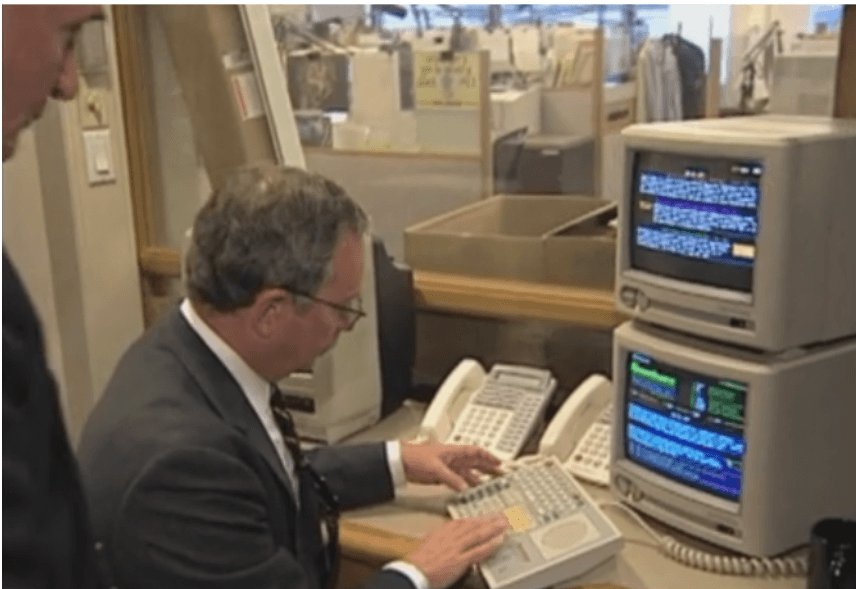
The Bloomberg Terminal | Image credits: Museum of American Finance
When I first saw a Bloomberg Terminal, I was fascinated by how fast and detailed everything looked, with numbers updating in real time, graphs changing by the second, and alerts coming in from all over the world.
It became clear to me that this was not just another financial tool; it was the centre of modern finance.
According to Fortune Business Insights, the global financial analytics market is valued at $10.70 billion in 2025 and is expected to reach $22.64 billion by 2032.
But how do investors and analysts make sense of all this information? And how do they make decisions with confidence when the markets are constantly changing?
The Bloomberg Terminal helps answer these questions.
It provides not only the data but also the tools to understand it, helping professionals make informed decisions quickly and accurately. According to recent data, over 355,000 users across the globe depend on Bloomberg’s terminals daily to stay ahead of market trends.
Whether it’s real-time updates on stock prices, economic indicators, or even breaking news, this tool has become the backbone of global finance.
But how Bloomberg began, how it works, and why it remains one of the most important platforms in global finance today.
Related Content: pre market trading
The birth of the Bloomberg Terminal
The journey of the Bloomberg Terminal began in 1981, when Michael Bloomberg, a former partner at Salomon Brothers, identified a significant gap in financial technology. Traders, even in the early 1980s, were relying on outdated methods like phone calls and paper reports to get market data.
Bloomberg saw an opportunity to streamline this process and offer real-time data on a computer screen, a revolutionary idea at the time. This idea turned into the first Bloomberg Terminal, which initially focused on delivering bond price information to institutional investors.
But Bloomberg’s vision didn’t stop there. The platform quickly expanded beyond bonds, adding stock prices, currency rates, and economic indicators. Over the years, Bloomberg introduced features that would define the platform as it is today: advanced charting tools, predictive analytics, and news integration. The terminal continued to evolve, incorporating powerful algorithms and machine learning models that provided users with not just data, but insights.

By the late 1990s, it was clear: Bloomberg was on the path to becoming an integral part of the financial world. The expansion wasn’t just technological.
Bloomberg built an ecosystem around its terminal, one where users not only received data but could also communicate, research, and collaborate, all without leaving the platform. This connectivity helped transform the terminal into an integral part of global financial operations, allowing professionals to access markets and information around the clock and across the globe.
Real-time market intelligence

The Bloomberg Terminal’s defining strength lies in its ability to aggregate and deliver vast amounts of data from multiple sources in real time. From equities and bonds to commodities and foreign exchange, it offers a holistic view of global markets.
In fact, it’s estimated that the Bloomberg Terminal processes around 100 terabytes of data daily. Imagine trying to analyse that amount of data without a tool like this, impossible, right?
For instance, think about a trader in London receiving economic reports just seconds after they’re released in New York. Bloomberg ensures that data isn’t delayed, giving financial professionals the advantage of acting on real-time information.
Beyond speed, Bloomberg provides access to decades of historical data. Analysts can use this to spot trends, compare performances, and make informed forecasts. Whether it’s a hedge fund manager evaluating market volatility or a trader reviewing bond yields, Bloomberg enables in-depth analysis for smarter decision-making.
Changing the landscape of financial markets
Before Bloomberg, market data was fragmented and often biased in favour of those with faster access. With its real-time updates and equal access to all users, the Bloomberg Terminal transformed market transparency.
For the first time, financial professionals, from individual traders to institutional investors, had access to the same data at the same time. This levelled the playing field and made market pricing more accurate.
By delivering information instantly, Bloomberg accelerated the pace of trading, with markets reacting faster than ever to news. A major earnings report, a Federal Reserve announcement, or a geopolitical event, these now have an immediate impact on the market, thanks to the Terminal’s speed. It has increased the efficiency of the market and made financial operations far more transparent.
The role of Bloomberg in modern trading
Today, Bloomberg is at the heart of modern trading strategies, including high-frequency trading (HFT). These strategies involve executing thousands of trades at incredibly high speeds, often measured in microseconds.
Without Bloomberg’s real-time data, such high-speed operations would be nearly impossible. The Terminal feeds its data directly into trading algorithms, which then automatically execute trades based on specific market conditions. This shift towards algorithm-driven trading has fundamentally changed how markets operate.
The real question is: Could we imagine trading without it?
Moreover, the Bloomberg Terminal is also a key player in risk management. With its tools, financial professionals can build complex models to assess potential risks, simulate market behaviour, and develop hedging strategies.
Take, for example, a major energy company dealing with volatile oil prices. Using Bloomberg’s analytics, risk managers can model future price movements and design strategies to protect their assets. The Terminal’s ability to handle multiple asset classes, calculate exposure to various risks, and provide deep market insights helps firms better navigate uncertain times.
The Bloomberg ecosystem: More than just data
What sets Bloomberg apart from other platforms is its ecosystem. It’s not just about data and analytics; it’s about connectivity and collaboration. The Terminal allows users to communicate, research, and collaborate within the same platform.
According to Bloomberg (May 2025), there are over 355,000 Terminal users worldwide, and its messaging component, Instant Bloomberg (IB), also known as Bloomberg Chat, remains central to professional workflows across the finance industry.
With Bloomberg, traders can exchange ideas, share insights, and collaborate in real time, creating an interconnected world where global financial markets operate 24/7.
This connectivity has become a vital part of how financial professionals operate, enabling them to work more efficiently and make faster, more informed decisions.
What’s next for Bloomberg?
Looking ahead, the Bloomberg Terminal will continue to evolve. In the future, we can expect even more sophisticated algorithms, machine learning tools, and predictive analytics integrated into the platform.
As financial markets grow more complex, having access to real-time data, insights, and predictive tools will be even more crucial for navigating the global economy.
Its ability to aggregate and deliver real-time data, coupled with its powerful analytics and global reach, has transformed financial markets, improved transparency, and changed the way trading and risk management are done.
The next time you glance at a Bloomberg screen, know that it’s not just a tool, it’s the foundation on which the modern financial world is built. What’s clear is this: the future of finance would look very different without it.