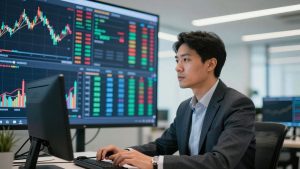

The crypto market has always had wild price swings; however, in 2026, something more meaningful is changing. It’s not only how the market moves and what’s used inside it that’s changing, too. It’s the people who play there who are changing.
The power of crypto trading used to be about speculation, hype cycles, and large price swings. Traders often went on instinct and looked for trending news. When they found they simply followed it up with sufficient strength to overcome that information’s pull on their mind; hesitant to act based on anything but actual performance in many lives’ little or big corners where past worst-timed decisions come back as stark reminders telling them: “It won’t work.” Today, this style of trading is becoming less effective.
A new era is emerging. With discipline, structured tactics, and a better understanding of risk, this is now a different time for crypto traders. No longer are those who make it in the market necessarily the fastest or boldest. They are the most consistent.
Understanding Market Behavior in a Data-Driven Era
In previous cycles, it was common to see investments rise solely based on attention. A single tweet or trend might push up prices. And while this still occasionally happens, the market is getting more efficient. That means that while opportunities are still out there, they require more careful preparation and are not hypocritical.
The modern trader relies on:
- Market structure rather than hype
- Data and indicators instead of rumours
- Long-term positioning while making short-term trades
Change to this evolutionary path reflects a broader maturity within the crypto ecosystem.
Why Structure Matters More Than Ever
Today, crypto prices are driven not only by demand and supply, but also by a variety of technical, fundamental, and macroeconomic factors. Traders are now aware of liquidity zones and order flow, institutional activity, usage of blockchain networks, and overall financial conditions in the world.
For instance, the ETH price has now become an important measure of overall market sentiment. With its roots in decentralized applications (such as ether-based contracts), smart contracts, and DeFi protocols, as Ethereum grows more active, this may be an indicator that good things are happening elsewhere on the blockchain scene.
But it isn’t just a single asset that will benefit from these changes. These trends begin to mean something else in the market.
The Rise of Advanced Trading Approaches
A major difference between past and present trading environments lies in the fact that nowadays traders have structured platforms at their disposal. Instead of operating multiple tools, traders today rely on unified systems such as BTCC Exchange, where analysis, execution, and monitoring all take place in one environment.
This simplifies matters greatly and lets them address strategy first rather than focusing on the mechanics of trade execution. A structured environment provides support for faster decision-making, direct trade execution, and greater reliability. In such a fast-moving market as this one, efficiency is a competitive advantage.
Risk Management: The Foundation of Longevity
It is no longer simply “buy and hold” in cryptocurrency trading; now there are more developed methods with greater flexibility available. One of the most important recent developments has been the increase in futures trading. This gives traders, inter alia, the ability to:
- Take positions on whether the market is rising or falling
- Make sure all necessary tools are at hand to hedge current holdings
- Manage exposure whenever possible
However, flexibility also implies responsibility. Existing investments need to be combined with a deeper understanding of futures trading than is indicated by leverage alone; risk management is another consideration for this. This is not about taking bigger risks. It is about being able to control the risks you have to take.
The Psychology of Modern Trading
In a market as volatile as digital currency, the very key to survival lies in how well risk is managed. Most traders focus on making a good profit, but more experienced ones also take into account keeping and increasing their capital.
Effective risk management involves:
- Establishing before entering how much risk will be taken on each transaction
- Sticking, always, to stop-loss levels
- Not allowing bad exposure to a single asset
A cardinal rule among professionals in this field is simple and exactly of the same order that hundreds or thousands of times it comes right: If you defend your downside, the upside will take care of itself.
With better tools, more data, and everything else to hand, human psychology remains of paramount importance. As before, how markets turn out/orpone.aspx yousay depends entirely on yourself. Intuitive trading decisions were way off the mark during the March collapse. With the crisis brought on by Covid- 18 end of the month suddenly stood up and took long strides.
Mistake roots often spring from greed and fear in the stock market. Some trade too late out of nervousness for missing out on the bandwagon. This brings other problems: Traders may enter trades late because they do things after they learn about it, or exit prematurely if they are scared of losing money.
As emotions go wild, it is easy to overtrade in such territories. For example, traders can earn money on one day and lose it the next by going in and out at high speeds. As a result, successful traders develop emotional discipline. They follow established trading systems or laws instead of impulses. This shift from being driven by emotion to making decisions based on rules is one of the defining characteristics of modern crypto trading.
Balancing Short-Term and Long-Term Thinking
Another significant change in 2026 is traders’ need to balance different time horizons. Short-term trading offers fast chances, but it needs constant attention: Your mind is never away from the question of variation. On the other hand, Long-term investment looks at the fundamentals and growth potential.
Many traders now practice both:
- Hold long-term positions in fundamentally strong assets.
- Actively trade smaller parts of their portfolio.
This hybrid strategy brings stability and flexibility in living conditions.
What the Future Holds for Crypto Traders
The crypto market may not be any less volatile, but it is definitely becoming more sophisticated. Future trends are likely to include the use of algorithmic and AI-driven trading increases, greater institutional involvement, better quality financial products built on blockchain, and improvement in user experience across all trading platforms.
Obviously, as these adjustments unfold, the gap between sophisticated and unsophisticated merchants will grow.
Conclusion
In 2026, crypto trading is no longer a wave-like pattern of where things go. It is skill, discipline, and regulated decision-making. It involves knowledge, discipline, and regulated decision-making.
Keeping an eye on the everyday, doing our things like leverage trading, for example, efficient platforms such as BTCC Exchange, and you are taking more advanced trading work as a part of that picture. The market has matured, and so with it must the trader.
For those who put a collar on this environment, new mena people will not just take volatility lying down but use it for their own purposes.