Trading in 2025 is fast, and small mistakes can cost money. A Stock Calculator shows your real profits, fees, and dividends quickly. Are you missing better trades by not using one? know how this simple tool helps traders make smarter choices and avoid losses in today’s market.

Trading in 2025 is faster, more global, and more data-driven than ever before. Every second, millions of trades take place across markets, and even a small price movement can change the outcome of an investment. Retail traders now account for nearly 25% of daily trading volumes worldwide, a sharp rise from a decade ago. This growing participation has made accurate calculations more important than ever.
A Stock Calculator has become one of the most useful tools for traders who want clarity before making a move. It helps break down costs, profits, brokerage fees, and even taxes, so investors know exactly where they stand. With markets becoming more complex, even seasoned traders rely on it to avoid costly errors.
The need for such tools is also linked to rising competition. According to recent studies, over 70% of traders say they use some form of digital calculator or trading tool before finalising an order. The reason is simple: when gains and losses are often separated by just a few pence per share, precision matters.
A Stock Calculator provides that precision. An index fund calculator is commonly used to estimate potential returns by factoring in contribution amounts, time horizon, and assumed growth rates. It gives traders the confidence to make quick, informed choices and maximises the chances of securing profits in a fast-moving market.
Related Content:
What is a stock calculator?
A Stock Calculator is a digital tool that helps traders work out the real cost and potential return of their trades. It takes away the guesswork by calculating profits, losses, brokerage fees, and even taxes in seconds. Instead of relying on rough estimates, traders can see the exact impact of each trade on their portfolio.
Stock Calculator asks for simple inputs. You enter the buying price of the stock, the number of shares, and the selling price you are aiming for. Some calculators also allow you to add details like brokerage charges, stamp duty, transaction tax, and dividend income. Once you enter this information, the calculator quickly shows you whether you are likely to make a profit or a loss, and by how much.
There are different types of Stock Calculators designed for various needs:
- Profit and Loss Calculator – Estimates gains or losses after a trade.
- Brokerage Calculator – Breaks down broker fees and hidden charges.
- Dividend Calculator – Projects income from dividend-paying shares.
- SIP or Investment Calculator – Helps with systematic investment plans.
- CAGR Calculator – Shows long-term growth through compounding.
The popularity of these tools has grown sharply in recent years. With stock markets seeing daily swings of 2–5% on average, traders cannot afford to be uncertain about their numbers. A Stock Calculator provides quick clarity, giving both beginners and professionals the confidence to act fast and avoid surprises.
Why every trader needs a Stock Calculator in 2025
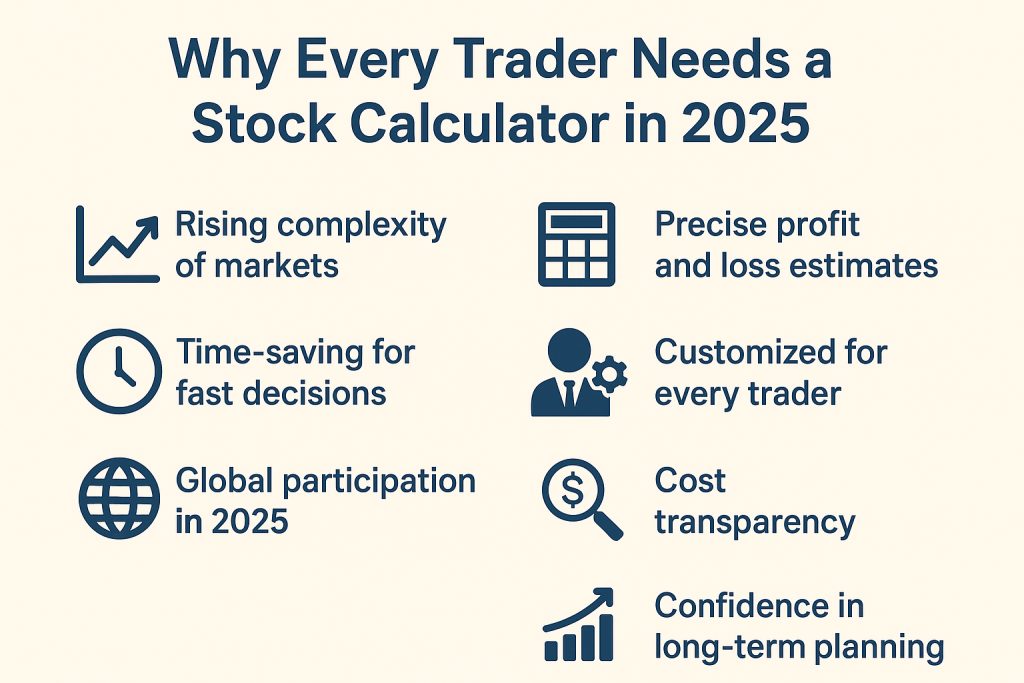
Trading today is no longer about simply buying low and selling high. Markets are faster, more competitive, and influenced by global events within seconds. A Stock Calculator has become essential for traders who want accuracy and speed in decision-making. Here’s why:
- Rising complexity of markets- With multiple stock exchanges, cross-border trades, and thousands of listed companies, traders deal with more data than ever before. A Stock Calculator helps cut through the complexity and focus on exact numbers.
- Precise profit and loss estimates- Small changes in price can make or break a trade. The calculator shows exact profit or loss after including brokerage, taxes, and other costs, leaving no room for guesswork.
- Time-saving for fast decisions- Day traders often have just seconds to enter or exit a position. A Stock Calculator instantly gives results, allowing quick and confident moves.
- Better Risk Management- It allows traders to set stop-loss levels and profit targets with accuracy. Knowing potential outcomes before placing an order helps limit risks.
- Customised for every trader- Whether it’s a beginner testing small trades or a professional managing large portfolios, calculators can be adjusted to match trading style and strategy.
- Global participation in 2025- With more retail traders joining markets worldwide, competition has grown. Over 50 million new trading accounts were opened globally in 2024 alone, showing the demand for smarter tools like Stock Calculators.
- Cost Transparency- Hidden charges such as stamp duty, securities transaction tax, or currency conversion fees often eat into profits. A Stock Calculator ensures traders see the true cost of trading upfront.
- Confidence in long-term planning- For investors building wealth through dividends or SIPs, calculators help project future returns, giving a clear roadmap.
In 2025, traders cannot rely on rough estimates. A Stock Calculator has become as important as a trading platform itself, ensuring accuracy, saving time, and maximising gains in a highly competitive market.
Key features of a good stock calculator
Not all calculators are built the same. Some are basic, showing only profit or loss, while others provide a complete picture of costs, risks, and long-term growth. A good Stock Calculator in 2025 should combine accuracy, speed, and ease of use. Here are the features that make it stand out:
1. User-Friendly Design
- A good calculator must be easy to understand, even for beginners.
- Clear input boxes for buying price, selling price, number of shares, and brokerage fees make it simple to use.
- Results should be displayed in a clean format, without complex charts or jargon.
2. Customisable Inputs
- Traders have different needs, and a flexible Stock Calculator allows adjustments.
- You should be able to add or remove fields such as dividend income, taxes, or multiple brokerage charges.
- Customisation ensures results match real-world scenarios.
3. Integration of Brokerage and Taxes
- One of the biggest challenges in trading is hidden costs.
- A good Stock Calculator automatically includes brokerage charges, stamp duty, and transaction taxes, so the final profit or loss figure is realistic.
- This avoids nasty surprises when the trade is settled.
4. Real-Time Market Data
- Modern calculators are often linked with live stock prices.
- Instead of entering numbers manually, traders can pull real-time data from exchanges to calculate instantly.
- This is especially valuable for day traders who act on small price movements.
5. Portfolio Tracking
- Some advanced Stock Calculators allow you to save multiple trades and track overall portfolio performance.
- This feature helps traders see not just single trade outcomes but also the bigger picture.
6. Mobile and Web Versions
- In 2025, most traders use their phones as much as laptops.
- A reliable calculator should be available as a mobile app or a responsive web tool for quick access on the go.
- Offline functionality is a bonus for those trading in low-connectivity areas.
7. Scenario Analysis
- A good Stock Calculator lets traders test “what if” situations.
- For example, you can check outcomes if a stock rises by 2%, drops by 5%, or pays an extra dividend.
- This helps build strategies with confidence.
8. Secure and Reliable
- As traders often enter personal or financial data, calculators should be secure and free from risks of data misuse.
- Trusted platforms usually come with encryption and regular updates.
Best Stock Calculators in 2025
In 2025, traders have access to a variety of advanced tools that go beyond basic profit and loss calculations. These calculators offer features like real-time data integration, scenario analysis, and portfolio tracking to enhance trading strategies. Below is a curated list of some of the best stock calculators available:
Top Selections Overview:
- Stock Average Price Calculator (iOS): Ideal for calculating the average cost of stocks when purchased multiple times. This app helps traders determine their break-even point, aiding in better decision-making.
- Stock Profit Calculator (Android): A comprehensive tool that calculates stock profit, loss, ROI, CAGR, dividends, and capital gains tax with precision. Its clean and simple interface makes it user-friendly for both beginners and seasoned traders.
- StockTrak Calculators (Web): Offers a suite of calculators including compound interest, future value, and savings to be a millionaire calculators. These tools are part of financial literacy resources designed to help users understand essential financial concepts.
- Koyfin (Web & Mobile): Provides global coverage of over 100,000 equities, each equipped with unique snapshots, consensus estimates, price targets, analyst ratings, charts, and fundamental data. It’s a powerful platform for in-depth financial analysis.
- TradeVision (Mobile): A mobile stock analysis app that offers real-time market data, advanced charting, and expert recommendations. It’s designed to cater to both novice traders and seasoned professionals.
- VectorVest (Web): Delivers real-time depth and precision for stock analysis. It’s particularly useful for professional traders seeking comprehensive analysis tools.
These tools cater to a range of trading needs, from basic calculations to advanced analysis. Selecting the right calculator depends on your trading style and the level of detail you require.
Step-by-step guide: How to use a stock calculator
Using a Stock Calculator may seem simple, but following each step carefully ensures accurate results and helps traders make informed decisions. Here’s how smart traders use it effectively:
Step 1: Enter the Stock Details
- Stock Name or Symbol: Select or type the stock you want to trade. Real-time connected calculators update prices automatically.
- Number of Shares: Input the number of units you plan to buy. Mistakes here can significantly affect results.
- Purchase Price: Enter the price at which you plan to buy. This can be the current market price or a target price for planning ahead.
Step 2: Add Brokerage and Other Charges
- Most trades involve brokerage fees, stamp duty, transaction taxes, and other charges.
- Input these amounts in the calculator. Some calculators automatically fetch standard brokerage charges based on your broker.
- Including all fees ensures the profit or loss calculation is realistic, not just theoretical.
Step 3: Enter the Selling Price
- Input the price at which you plan to sell the stock.
- For long-term investors, this may be a future estimated price. For day traders, it could be the target price during the trading day.
- Accurate selling price input is essential to see true gains or losses.
Step 4: Calculate Profit or Loss
- Once all details are entered, the calculator shows the expected profit or loss.
- It usually breaks down:
- Gross profit/loss – difference between buy and sell price.
- Net profit/loss – after fees, taxes, and other charges.
- This step helps traders decide whether the trade is worth executing.
Step 5: Include Dividend or Interest Income (if applicable)
- Some stocks pay dividends, and bonds or certain investment products may generate interest.
- Adding this income provides a more complete picture of returns.
- For long-term investors, this step can significantly change the profitability of a trade.
Step 6: Run “What If” Scenarios
- A powerful feature of Stock Calculators is scenario analysis.
- Test different selling prices, market fluctuations, or dividend changes.
- Example: see how a 5% price drop or a 10% increase affects your net profit.
- This helps plan risk management and exit strategies.
Step 7: Review Portfolio Impact
- Advanced calculators allow you to track multiple trades and overall portfolio performance.
- This step is important for professional traders managing several positions at once.
- You can see which stocks are performing better and which may need adjustment.
Step 8: Save or Export Calculations
- Most calculators allow you to save the calculation for future reference or export it as a spreadsheet.
- Keeping records helps track trading history and refine strategies over time.
Step 9: Make the Trading Decision
- After reviewing all outputs — net profit/loss, fees, scenario outcomes — you can decide:
- Execute the trade immediately.
- Adjust the trade size or target price.
- Postpone until conditions improve.
Using the Stock Calculator step by step gives traders confidence. It ensures every decision is backed by numbers, reduces errors, and maximises the chance of success in volatile markets.
Stock calculator vs manual Calculations
A Stock Calculator simplifies trading decisions, but some traders still calculate profits manually. The table below compares the two approaches:
| Feature | Stock Calculator | Manual Calculations |
| Speed | Provides instant results, even for multiple trades. | Time-consuming, especially for complex trades or large portfolios. |
| Accuracy | Calculates exact profit/loss including brokerage, taxes, and dividends. | High risk of errors, especially with fees and multiple trades. |
| Scenario Analysis | Can test multiple “what if” situations quickly (price changes, dividends, fees). | Difficult and slow to manually test different scenarios. |
| Portfolio Tracking | Tracks multiple stocks and provides an overall performance summary. | Requires separate calculations for each stock; hard to see the bigger picture. |
| Risk Management | Helps set break-even, stop-loss, and target profit levels with precision. | Hard to calculate precise thresholds quickly, increasing risk. |
| Learning Curve | Easy to use for beginners; minimal financial knowledge required. | Requires understanding of formulas, taxes, and brokerage charges. |
| Limitations | Relies on correct input; garbage in, garbage out. | Limited by human calculation speed and errors; also prone to bias. |
| Practicality | Essential for fast, accurate decisions in today’s volatile markets. | Suitable only for very simple trades or educational purposes. |
Final Thoughts
A Stock Calculator is more than a tool—it is a guide for smarter trading. By accurately calculating profits, losses, fees, and potential returns, it helps traders make informed decisions quickly. From beginners to professionals, anyone can benefit from using it to plan trades, test scenarios, and manage risks.
However, it works best when combined with research, market awareness, and careful input. In 2025’s fast-moving markets, relying on precise numbers can mean the difference between gains and losses. Using a Stock Calculator consistently improves accuracy, confidence, and trading success.

Shikha Negi is a Content Writer at ztudium with expertise in writing and proofreading content. Having created more than 500 articles encompassing a diverse range of educational topics, from breaking news to in-depth analysis and long-form content, Shikha has a deep understanding of emerging trends in business, technology (including AI, blockchain, and the metaverse), and societal shifts, As the author at Sarvgyan News, Shikha has demonstrated expertise in crafting engaging and informative content tailored for various audiences, including students, educators, and professionals.