Trading success isn’t about spotting every signal but about receiving them correctly. 70% to 90% of traders lose money, with only a small percentage achieving consistent profitability. Mastering this skill turns raw market data into actionable opportunities. Are you truly ready to receive signals the right way?

The financial markets are full of noise, excitement, and opportunity. Every day, traders scan charts, read reports, listen to analysts, and watch indicators. But despite all this information, the majority of traders still fail to act on signals in the right way.
Understanding market signals is one thing. Receiving them correctly and translating them into the right decision is another skill altogether. Many people believe trading is about finding the perfect system or secret indicator
Research indicates that approximately 70% to 90% of traders lose money, with some studies suggesting the figure could be even higher. In truth, trading success often depends on how well you filter, interpret, and act upon the signals that are already present in the market. It’s not merely about identifying patterns but understanding their context, timing, and the broader market dynamics.
The difference between seeing and receiving signals
Most traders can see signals on a chart or from an indicator. They notice a moving average cross, a support breakout, or an RSI divergence. But simply spotting something does not mean they are receiving it properly.
Seeing is visual.
Receiving is psychological and practical.
When you are receiving signals the right way, you not only identify them but also understand their context, reliability, and timing. You take them into account without being clouded by emotion or bias.
For example:
- A trader may see a bullish candle after a downtrend.
- But receiving it properly means asking: Is this candle appearing near a major support? Is the volume confirming? Does it align with the broader trend?
Without this depth, signals can mislead more than guide.
Common reasons traders fail at receiving signals
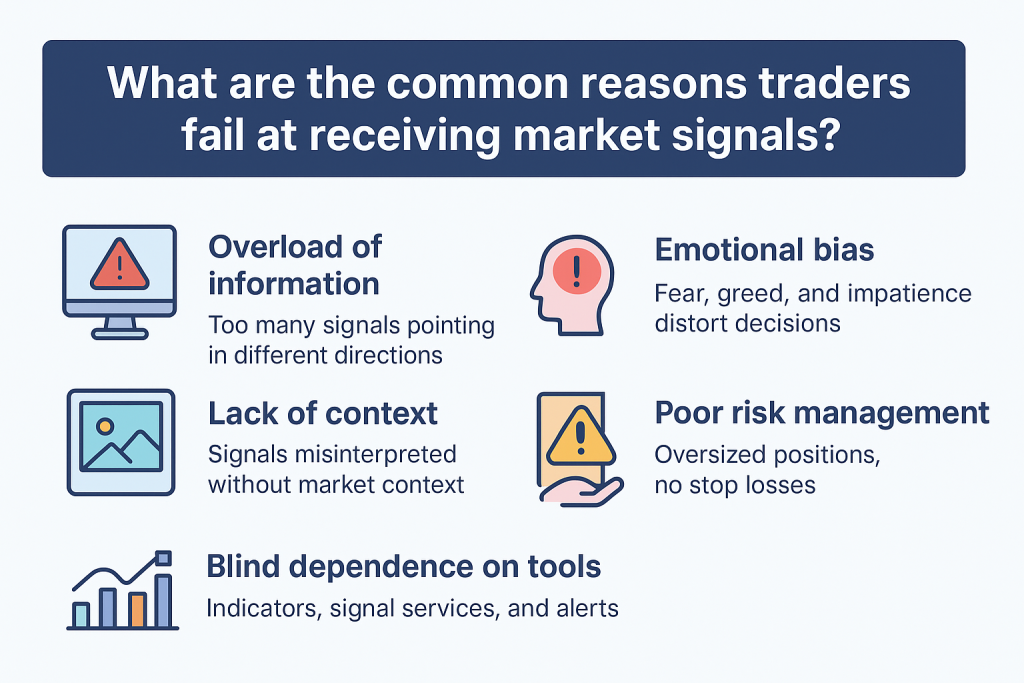
Overload of information
We live in a digital age where traders are bombarded with signals from every direction. Charting software, Telegram groups, Twitter feeds, Discord servers, and algorithmic alerts all compete for attention. The challenge is not a lack of data but an overflow of it.
Many traders mistake quantity for quality. The result is analysis paralysis – too many signals pointing in different directions, leading to confusion or hesitation. Traders either enter too many trades or fail to act because they are waiting for every signal to line up perfectly.
The truth is: the more signals you chase, the less clarity you have.
Emotional bias
Fear, greed, and impatience shape trading decisions more than signals themselves. For example:
- A trader receives a clear sell signal but refuses to close the trade because of attachment to a stock.
- Another sees a weak buy signal but enters aggressively out of FOMO (fear of missing out).
Signals lose their meaning when filtered through emotions. Even a strong setup becomes useless if the trader is not willing to follow it with discipline.
Lack of context
Signals are not universal truths; they only have meaning within context. A moving average crossover might be powerful in a trending market but nearly useless in sideways conditions.
Traders who apply signals mechanically, without reading the broader market environment, often misinterpret them. For example:
- A breakout in a low-volume environment is usually a trap.
- An RSI oversold condition during a strong downtrend may not mean a reversal; it could just signal continuation.
Context is the difference between a high-probability trade and a costly mistake.
Poor risk management
Even when traders receive signals correctly, they often fail at managing risk. No signal, however reliable, guarantees profit. Yet many traders place oversized positions, risking too much on one idea.
The problem is not the signal but the trader’s approach to risk. Without strict rules for stop losses and position sizing, a few wrong trades can wipe out months of gains.
Blind dependence on tools
Indicators and signal services are useful, but over-reliance on them is dangerous. Many traders never truly understand what their tools are showing. They become followers of alerts rather than decision-makers.
Successful traders use indicators as a supporting tool, not as a crutch. They combine them with price action, market structure, and experience to receive signals with greater accuracy.
The psychology behind receiving signals
The biggest difference between successful and struggling traders is not their strategy but their psychology. The way a trader’s mind processes signals often determines whether they win or lose.
Confirmation Bias- Traders often seek signals that support their existing belief. For instance, if they want to go long, they will only notice bullish signals and ignore bearish ones.
Impatience- The market rewards patience, but most traders want quick wins. They jump on the first signal they see without waiting for confirmation.
Fear of Being Wrong- Sometimes traders see the right signal but hesitate to act. The fear of loss prevents them from executing, which is as bad as mis-reading the market.
Overconfidence- At the other extreme, overconfidence makes traders ignore risk. They treat signals as certainties, not probabilities.
What it means to receive signals the right way
Receiving signals the right way involves four steps:
- Filtering: Not every signal deserves attention. Markets throw out hundreds of signals daily, but most are weak, conflicting, or irrelevant to your strategy. Filtering means focusing only on those signals that meet your predefined criteria. A trader who filters well avoids overtrading and keeps their attention sharp.
- Contextualising: A signal is never standalone. It gains meaning only in relation to the bigger picture. A bullish candlestick at strong resistance is not the same as a bullish candlestick at long-term support. Context separates strong setups from weak ones.
- Timing: Even the right signal, taken at the wrong time, can lead to losses. Timing means waiting for confirmation, ensuring that probability is on your side. It also means knowing when not to act, which is often harder than pulling the trigger.
- Discipline: Perhaps the most important element. Discipline is sticking to your plan, even when emotions push you in another direction. A signal only becomes profitable when it is acted upon consistently within your rules. Without discipline, even the best signals lose value..
This process transforms raw signals into actionable insights. The market constantly produces signals, but only those who filter and structure them correctly can trade consistently.
How to improve at receiving market signals
Build a trading plan
Your trading plan should clearly define:
- Which signals you consider valid.
- How you confirm them.
- What risk-reward ratio you expect.
When rules are in place, receiving signals becomes structured instead of emotional.
Use fewer tools
Too many indicators create confusion. Instead of running ten systems, focus on two or three reliable ones. For example, combine price action, moving averages, and volume. This reduces conflict and sharpens clarity.
Keep a trading journal
Write down every signal you acted on, why you took it, and what happened. Over time, patterns will emerge, showing which signals you are good at receiving and which ones you misinterpret.
Learn market context
Never take a signal in isolation. Study support and resistance, market structure, and economic news. This ensures you receive signals with the right perspective.
Train your psychology
Meditation, journaling, and strict risk management all help calm emotions. A clear mind is better at receiving signals accurately.
The role of technology in receiving signals
Technology has transformed trading by making signals more accessible and faster than ever before. Traders today have access to algorithmic alerts, AI-driven forecasts, and even fully automated systems that can scan thousands of assets in seconds. These tools can highlight opportunities that would be impossible to spot manually.
But technology is not a replacement for judgment. It is only as effective as the trader who uses it. An algorithm can generate signals, but it cannot understand market context, economic conditions, or trader psychology the way a human can.
For example, an AI tool may highlight a bullish setup, but if it’s during a period of low liquidity or just ahead of a major news announcement, blindly following it can be dangerous. Similarly, automated trading systems can execute trades with precision, but without strong risk management and monitoring, they can magnify losses quickly.
The real skill lies in interpreting what these tools provide. Successful traders treat technology as a support system, not a decision-maker. They use it to speed up analysis, filter noise, and provide alerts, but the final choice comes from combining signals with human reasoning, experience, and discipline.
In short: technology enhances signal detection, but traders must enhance signal reception.
Steps to master receiving market signals
These steps form the foundation for consistent improvement:
Mastering the art of receiving signals is not about finding new indicators—it’s about building a structured process around how you interpret and act on the information the market gives you. These steps form the foundation for consistent improvement:
1- Define Your Strategy Clearly- Without a defined strategy, every signal looks tempting. A clear strategy sets the rules for what you trade, how you trade, and what signals matter to you. This prevents confusion and keeps you from reacting to every random movement.
Tip: Write down your entry criteria, confirmation methods, stop-loss levels, and target profits. If a signal doesn’t meet those rules, you ignore it.
2- Select Only Reliable Tools- There are endless indicators and platforms, but more tools don’t mean better decisions. Focus on a small set of tools that you understand deeply. For most traders, a mix of price action, one or two indicators, and volume analysis is enough.
Tip: Learn the strengths and weaknesses of your chosen tools. For example, moving averages lag, while RSI can give false signals in strong trends.
3- Backtest Signals with Historical Data- A signal that looks good in theory must be tested in practice. Backtesting helps you see how reliable a signal is under different conditions. It also builds confidence in following it when real money is on the line.
Tip: Backtest at least 50–100 trades of your chosen setup to see its win rate, average profit, and risk-to-reward profile.
4- Set Strict Risk Rules- Even the best signal is only a probability, not a guarantee. Strict risk management ensures that when signals fail—as they sometimes will—you survive without major damage.
Tip: Risk a fixed percentage of your capital per trade (e.g., 1–2%). Always place stop-losses and avoid moving them based on emotion.
5- Keep Emotions in Check- Signals lose their meaning if filtered through fear, greed, or impatience. A calm, disciplined mindset is essential for receiving signals correctly.
Tip: Before trading, ask yourself: Am I following my plan, or my feelings? Simple awareness can prevent emotional mistakes.
6- Learn Continuously from Mistakes- Every trade, win or lose, carries feedback. Reviewing mistakes reveals whether you misread the signal, acted too early, or ignored context. Over time, this feedback loop sharpens your skill at receiving signals.
Tip: Keep a trading journal with notes on why you took each signal, how you managed it, and what the result was. Patterns will emerge.
Read More:
The Psychology of Receiving Profits vs Losses in Trading
Conclusion
Trading success is not about finding a magic formula. It is about discipline, risk management, and above all, receiving market signals the right way. Many traders fail because they either overload on information, let emotions take over, or misunderstand context.
If you want long-term success, focus less on hunting for secret indicators and more on improving how you receive, interpret, and act on signals.
The market will always give opportunities, but only disciplined traders will be prepared to take them.

Shikha Negi is a Content Writer at ztudium with expertise in writing and proofreading content. Having created more than 500 articles encompassing a diverse range of educational topics, from breaking news to in-depth analysis and long-form content, Shikha has a deep understanding of emerging trends in business, technology (including AI, blockchain, and the metaverse), and societal shifts, As the author at Sarvgyan News, Shikha has demonstrated expertise in crafting engaging and informative content tailored for various audiences, including students, educators, and professionals.