
So, you’re looking to get a better handle on trading, specifically with the M pattern. It’s a chart formation that traders use to spot when an uptrend might be about to turn into a downtrend. Think of it like seeing a double peak on a graph – that’s the ‘M’. Learning to spot this pattern can help you make smarter moves in the market, whether you’re dealing with stocks, crypto, or forex. We’ll walk through what it looks like, how to find it, and how to actually use it in your trades without losing your shirt.
Key Takeaways
- The M pattern, also known as a double top, signals a possible shift from an uptrend to a downtrend, showing two peaks with a dip in between.
- To trade the M pattern well, you need to confirm it using tools like volume charts and trend lines, which makes your trading signals stronger.
- Watch out for common errors like jumping into a trade too soon, not paying attention to trading volume, or ignoring the bigger picture of market trends.
- Using the M pattern can point to good spots for reversals, but figuring it out by hand can be tricky and sometimes lead to mistakes.
- Getting better at M pattern trading means practicing a lot, learning continuously, and using the right tools and timeframes to fit your style.
Understanding the M Pattern in Trading
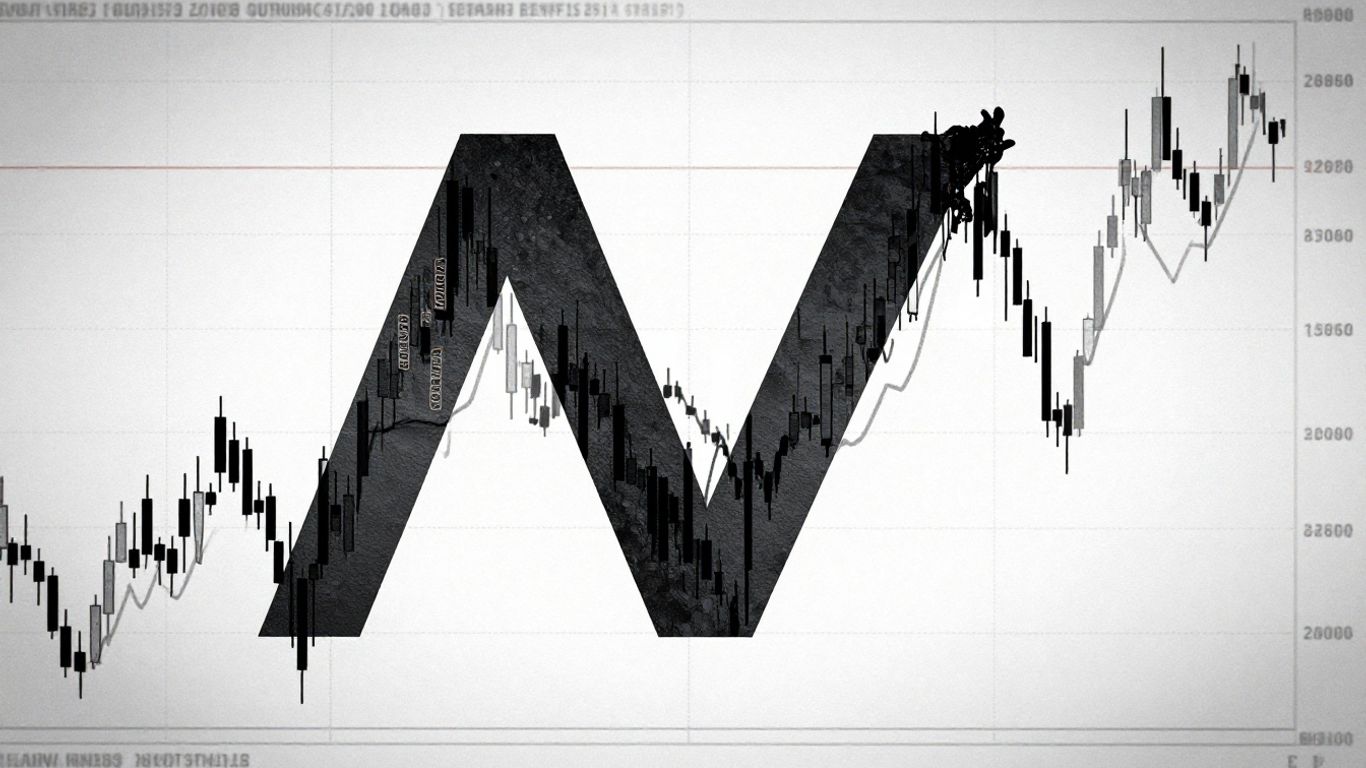
Alright, let’s talk about the M pattern. You’ve probably seen it on charts, looking a bit like the letter ‘M’, hence the name. It’s a pretty well-known signal in the trading world, and for good reason. Basically, it suggests that an uptrend might be running out of steam and could be about to turn into a downtrend. Think of it as the market trying to go higher, failing, trying again, and then giving up.
Key Characteristics of the M Pattern
So, what makes an M pattern an M pattern? It’s not just any wobbly line on the chart. There are a few things to look for:
- Two Peaks: You’ll see two distinct high points, or peaks, in the price action. These peaks should be roughly at the same price level, though the second one might be a little lower than the first. This shows buyers tried to push the price up, hit a ceiling, tried again, and couldn’t quite get over it.
- A Trough: Between these two peaks, there’s a dip, a low point. This is where the price pulled back after hitting the first peak before attempting the second one. This dip forms the "valley" of the M.
- Neckline Break: The real confirmation, the "aha!" moment, comes when the price breaks below the low point (the trough) between the two peaks. This break below what’s called the "neckline" is a strong signal that sellers are taking control.
The M pattern is significant because it signals buyer exhaustion, the inability of the market to push the price higher after two attempts.
Market Sentiment Behind the M Pattern
What’s going on in traders’ heads when this pattern forms? Well, after an uptrend, buyers are feeling pretty good, pushing prices up. But when the price hits a certain level and can’t go any higher (the first peak), some traders start to get nervous. They might take some profits, causing a small dip. Then, if buyers jump back in and try to push it up again, but they fail to make a new high (the second peak), those initial buyers who missed out, or those who sold too early, might realize the momentum is gone. Sellers, seeing this hesitation and the failure to make new highs, start to get more aggressive. They see an opportunity to push the price down, and when that neckline breaks, it confirms their view. It’s a shift from optimism to caution, and then to outright selling pressure.
Identifying the M Pattern
Spotting an M pattern on a chart can feel like uncovering a hidden clue about where the market is headed next. Here’s a simple way to recognize it in real time, even if you’re just scanning your charts casually. You’re looking for that classic shape: an upward move, a peak, a pullback, another peak that doesn’t quite reach the first one, and then a drop below the pullback level. It’s similar in concept to a Double Top pattern, but the M pattern emphasizes the break of the support level as the key confirmation. Keep an eye on your charts, and you’ll start to see it more often than you think. It’s a pattern that can signal a potential market downturn following an uptrend, serving as a bearish reversal signal.
Technical Analysis Tools for M Pattern Trading
Okay, so you’ve spotted a potential M pattern forming on your chart. That’s cool, but just seeing the shape isn’t enough, right? We need to make sure it’s the real deal. That’s where technical analysis tools come in. They’re like your trusty sidekicks, helping you confirm what your eyes are telling you and giving you more confidence before you jump into a trade.
Volume Indicators
Volume is super important here. Think of it as the ‘oomph’ behind the price moves. When you see an M pattern, you want to see how much buying and selling activity was happening. For example, if the second peak of the ‘M’ forms on lower volume than the first peak, it suggests that buyers are losing steam. This is a good sign that the uptrend might be getting tired. A drop in volume on the second peak is a key confirmation signal for the M pattern. It helps you avoid getting fooled by fake-outs. You can use tools like the On-Balance Volume (OBV) or simple volume bars on your chart to check this out. It’s a pretty straightforward way to gauge the strength of the price action.
Trend Lines
Trend lines are another great way to get a handle on the M pattern. You can draw a line connecting the lows between the two peaks of the ‘M’. This line acts as a sort of support level. When the price breaks below this trend line, it’s another strong signal that the M pattern is playing out and the price might continue to fall. It gives you a visual cue for when to potentially enter a short position. You can also draw trend lines along the peaks to see resistance levels. Understanding these lines helps you see potential breakout points more clearly. It’s all about visualizing the price action and potential turning points.
Other Technical Indicators
Beyond volume and trend lines, there are other indicators that can back up your M pattern analysis. Moving averages can be useful. For instance, if the price crosses below a key moving average (like the 50-day or 200-day) around the time the M pattern completes, it adds another layer of confirmation. Oscillators like the Relative Strength Index (RSI) or the Moving Average Convergence Divergence (MACD) can also help. If you see a bearish divergence on an oscillator (meaning the price makes a higher high, but the indicator makes a lower high), it can signal weakening momentum, which aligns perfectly with the bearish implications of an M pattern. Using a combination of these tools can really improve the reliability of your M pattern signals, helping you make more informed decisions. It’s like having multiple witnesses to confirm a story before you believe it. You can find more about using indicators in technical analysis.
Relying on just one indicator is risky. The best approach is to use a few different tools together. This way, if multiple indicators are pointing to the same conclusion as your M pattern, you can be much more confident in your trade setup. It’s about building a strong case for your trade.
Strategic Approaches to M Pattern Trading
Alright, so you’ve spotted that M pattern on your chart. Now what? It’s not enough to just see the shape; you need a solid plan to actually make money from it. This is where strategy comes in, turning a visual cue into a potential profit.
Entering Short Positions
When that second peak forms and starts to pull back, and especially if it breaks below the low point between the two peaks (the "neckline"), that’s usually your signal to consider going short. The confirmation of the pattern is key before you jump in. You don’t want to be the first one to sell if the market decides to keep climbing. Waiting for that break below the support level, often confirmed by a candle closing below it, gives you a much better chance of success. It’s like waiting for the green light before you cross the street – safer that way.
Stop-Loss and Risk Management
This is super important, folks. Nobody likes losing money, but with trading, it’s a fact of life. You’ve got to protect your capital. Once you’re in a short trade based on an M pattern, you need to set a stop-loss order. A common place for this is just above the second peak of the M. This way, if the market suddenly reverses and goes higher, your loss is limited. Think of it as an insurance policy for your trade. You also need to figure out how much of your total trading capital you’re willing to risk on any single trade. For most traders, keeping it between 1% and 2% is a good rule of thumb. It might seem small, but over time, it stops one bad trade from wiping you out.
Profit Target Calculation
So, you’re in the trade, and your stop-loss is set. Now, where do you take your profits? There are a few ways to figure this out. One common method is to measure the height of the pattern (from the neckline to the second peak) and project that distance downwards from your entry point. Another approach is to look for previous support levels on the chart that might act as targets. You can also use a risk-reward ratio. If you’re risking $1 to make $2 (a 1:2 risk-reward ratio), you’d aim for a profit target that’s twice the distance of your stop-loss from your entry. It’s all about having a clear exit plan before you even enter the trade. This helps you avoid getting greedy or panicking when the market moves.
Trading is a marathon, not a sprint. Having a well-defined strategy, including entry, exit, and risk management, is what separates consistent traders from those who are just gambling. The M pattern is a great tool, but it’s your strategy that makes it work.
Here’s a quick look at how you might set up a trade:
| Component | Example Placement |
|---|---|
| Entry | Below the neckline after confirmation |
| Stop-Loss | Above the second peak |
| Profit Target 1 | Measured height projected down from entry |
| Profit Target 2 | Previous significant support level |
| Risk/Reward | Aim for at least 1:1.5 or 1:2 |
Common Mistakes in M Pattern Trading
Making mistakes with the M pattern can seriously hurt your trading outcomes. Here are the major pitfalls that trip up many traders:
Early Entry
Jumping into trades before the M pattern is clearly confirmed is a big mistake. If you act only on a hint of the pattern, you might end up caught in a fake-out or a trap. Impatience often leads to entering too soon, thinking you’ll get ahead, but often it just means you’ll face losses when the pattern fizzles out before truly forming.
- Wait for the pattern to break the neckline (confirmation point)
- Avoid trading on the first bounce or dip
- Watch out for sudden moves that look like a reversal but aren’t
Waiting for confirmation may feel slow, but it often saves you money in the long run by filtering out false signals.
Ignoring Volume
Volume adds a layer of confirmation to any pattern, especially the M pattern. When traders ignore volume, they risk acting on setups that never truly had momentum.
- Spike in volume during the breakdown supports the pattern’s reliability
- Low or decreasing volume might signal a weak move
- Consider volume in relation to both tops of the M
Here’s a quick comparison table:
| Pattern Confirmation | Volume Trend | Reliability |
|---|---|---|
| Breaks neckline, high volume | Increasing | Strong |
| Breaks neckline, low volume | Decreasing | Weak |
| Breakout, no volume change | Flat | Unpredictable |
Taking volume seriously stops you from falling into bear or bull traps. Need more ways to guard your trades? Review basic risk management principles from market tops and bottoms mistakes.
Overlooking Broader Trends
Focusing only on the M pattern without looking at overall market direction can lead to trouble. Patterns mean different things depending on the bigger picture.
- During a strong uptrend, an M pattern might just be a pause, not a reversal
- In a weak or sideways market, patterns might not have much power
- Checking multiple timeframes helps ensure the pattern matches the larger context
Keep these mistakes in mind each time you spot an M setup. Most traders who improve at pattern recognition are the ones who take the time to confirm, use volume clues, and always look at the bigger market landscape.
The Advantages and Limitations of M Pattern Trading

High Probability Reversal Points
The M pattern is pretty neat because it often shows up right when a trend is about to flip from going up to going down. Think of it as the market taking a breather and then deciding to head in the opposite direction. This makes it a really good spot to look for potential short trades. When you see this pattern form, especially after a solid uptrend, it’s a strong signal that sellers might be taking over. It gives you a clearer idea of when to get in and out, which can lead to better odds for your trades. It’s all about catching those moments when the market sentiment is shifting.
Challenges in Manual Pattern Identification
Now, spotting these M patterns isn’t always as easy as it looks in the textbooks. Sometimes, you can look at a chart and think you see an M, but it’s not quite right. This is where human error can creep in. You might misread the price action or not wait for all the signs to line up perfectly. It takes practice and a good eye to get it right consistently. Plus, if you’re trying to do it all by hand, it can be pretty time-consuming and, honestly, a bit of a headache.
- Subjectivity: What one trader sees as a clear M, another might not. It’s not always black and white.
- Time Consumption: Manually scanning charts for patterns takes a lot of time, especially if you’re watching multiple markets.
- Confirmation Bias: It’s easy to want to see a pattern so badly that you convince yourself it’s there, even when the signs aren’t strong.
Sometimes, the market throws a lot of ‘noise’ at you. This can be small price swings that don’t really mean anything, or sudden bursts of activity. This noise can make it really hard to see the actual M pattern clearly, leading to confusion and potentially bad trading decisions. It’s like trying to hear a whisper in a crowded room.
Table: Manual vs. Automated Pattern Identification
| Feature | Manual Identification | Automated Software |
|---|---|---|
| Accuracy | Prone to error | Highly accurate |
| Speed | Slow | Fast |
| Consistency | Varies | Consistent |
| Time Investment | High | Low |
How to Improve Your M Pattern Trading Skills
So, you’ve been learning about the M pattern, and maybe you’ve even tried spotting a few on charts. It’s one thing to read about it, and another thing entirely to actually use it in real trading. Getting good at this takes time and a bit of a smart approach. It’s not just about seeing the pattern; it’s about making it work for you.
Continuous Learning and Practice
Think of it like learning a new skill, say, playing an instrument. You don’t just pick it up and become a rockstar overnight, right? Trading’s the same. You need to keep learning and, importantly, keep practicing. This means staying on top of what’s happening in the markets and learning new ways to look at charts. The market changes, and what worked last year might not be as effective today.
- Attend webinars and online courses: Many platforms offer sessions focused on technical analysis and specific chart patterns like the M pattern. These can give you fresh insights.
- Read trading books and articles: Keep your knowledge base broad. Look for resources that explain trading psychology and risk management alongside technicals.
- Follow market news and analysis: Understanding the broader economic picture can help you interpret why a pattern might be forming.
Practicing with a demo account is your safe space to try out strategies without risking actual money. It’s where you can make mistakes, learn from them, and build confidence before you start trading with your own capital.
Leveraging Technological Solutions
Manually spotting patterns can be tough, and let’s be honest, sometimes we miss things or get them wrong. That’s where technology comes in handy. There are tools out there that can help you find these patterns more easily and accurately.
- Automated pattern recognition software: Some trading platforms have built-in features or add-ons that can alert you when a potential M pattern appears on your charts.
- Charting tools with advanced indicators: Use software that allows you to layer multiple indicators (like volume and RSI) on your charts to confirm patterns.
- Backtesting platforms: These tools let you test how a strategy would have performed on historical data, giving you a realistic idea of its potential.
Choosing Appropriate Timeframes
Not all M patterns are created equal, and where you find them matters. An M pattern on a 5-minute chart is very different from one on a daily chart. You need to figure out which timeframes fit your trading style and goals.
- Short-term traders: Might focus on intraday charts (like 15-minute or 1-hour) for quicker trades, but these can be noisier.
- Swing traders: Often look at daily or weekly charts to capture moves that last a few days to a few weeks.
- Long-term investors: Might use weekly or monthly charts to identify major trend reversals.
It’s a good idea to start with one or two timeframes and get really good at identifying patterns on those before spreading yourself too thin. Remember, consistency is key, and finding the right timeframe for you is part of that.
Wrapping It Up
So, we’ve gone over the M pattern, how to spot it, and how to trade it. It’s a pretty neat tool for seeing when an uptrend might be running out of steam and a downtrend could be starting. Remember, though, no trading strategy is perfect. Always use other indicators to back yourself up, keep an eye on your risk, and don’t jump into trades too early. Practice on a demo account first, and keep learning. The markets are always changing, so staying sharp is key. Hopefully, this guide gives you a good starting point for using the M pattern in your own trading.
Frequently Asked Questions
What exactly is an ‘M’ pattern in trading?
Think of the ‘M’ pattern like a shape you see on a chart that looks like the letter M. It usually shows up after prices have been going up for a while. When you see this ‘M’ shape, it often means the price might start going down soon. It’s like a warning sign for traders.
How can I spot an ‘M’ pattern on a trading chart?
To find an ‘M’ pattern, look for two peaks (high points) that are about the same height, with a dip in the middle. The second peak is usually a little lower than the first one. The pattern is confirmed when the price drops below the low point between the two peaks.
What tools help traders confirm an ‘M’ pattern?
Traders use a few helpful tools. They look at trading volume to see if lots of people are buying or selling. They also draw trend lines to see the direction prices are moving. Other tools, like the RSI, can also help confirm if the pattern is likely to work.
Is it safe to trade when an ‘M’ pattern appears?
It can be, but you need to be careful. It’s best to wait until the pattern is confirmed, meaning the price has clearly broken below the middle dip. Also, always use stop-loss orders to limit how much money you could lose if the trade doesn’t go as planned.
What are common mistakes people make with ‘M’ patterns?
One big mistake is jumping into a trade too early, before the pattern is fully confirmed. Another is not paying attention to trading volume, which can show if a move is strong. Some traders also forget to look at the bigger picture of the market trends.
Can I always trust an ‘M’ pattern?
No pattern is perfect, and the ‘M’ pattern can sometimes give false signals. That’s why it’s super important to use it with other tools to confirm your decision. Never rely on just one thing when making trading choices.