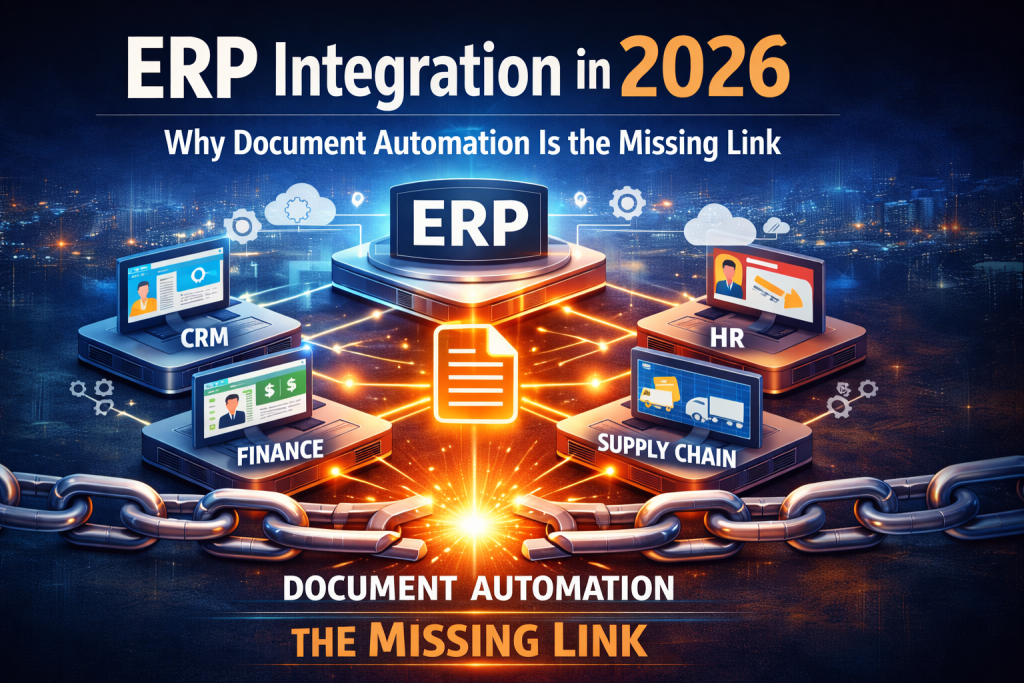
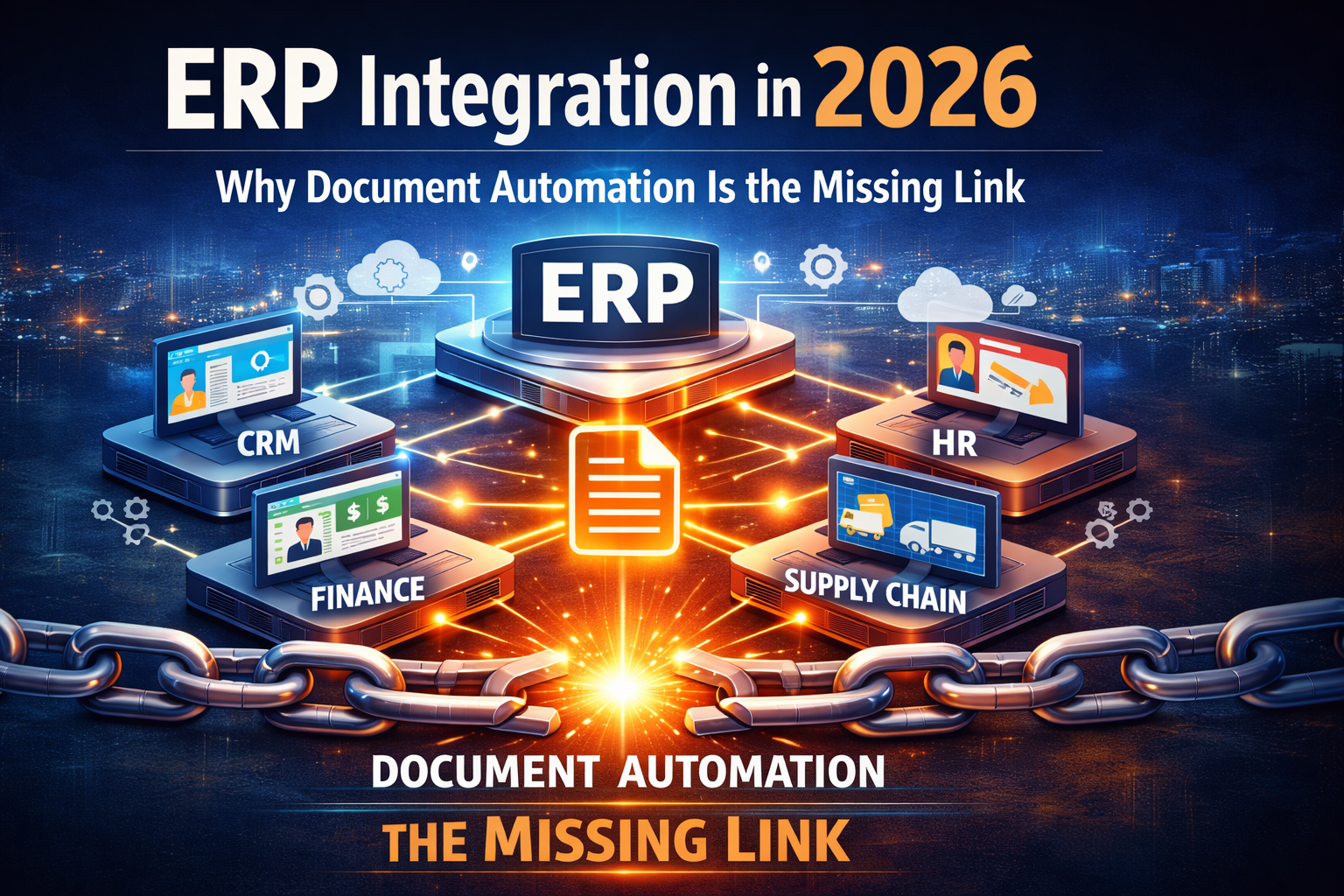
Enterprise Resource Planning (ERP) systems have long been the backbone of modern businesses. Their ability to integrate every core business process, including finance, HR, manufacturing, supply chain, and sales, into a single, unified system has made them indispensable in the everyday running of a company. However, many organizations are still facing frustrating problems. Despite powerful ERP platforms, their workflows remain slow, manual, and error-prone. The reason is that they all miss one key component: document automation.
The ERP Promise vs. Reality
ERP systems are designed to centralize operations and streamline processes, vastly increasing effectiveness and saving time and money. There is one hitch, though. Most business data doesn’t originate inside the ERP. It comes from invoices, purchase orders, receipts, contracts, and other documents. Many of these are still handled manually, creating bottlenecks.
Employees often spend hours entering data from PDFs, emails, or scanned documents into ERP systems. Not only does this slow down operations, but it also introduces human error and delays decision-making.
Even the most advanced ERP cannot deliver full value if the data feeding into it is inefficiently captured.
The Role of Document Automation
This is where document automation, specifically Intelligent Document Processing (IDP), comes into play. It enables businesses to automatically capture, extract, validate, and route data from documents directly into ERP systems. Instead of manually inputting invoice details or order data, organizations can rely on AI-driven solutions to handle these tasks in real time.
Modern platforms combine technologies like Optical Character Recognition (OCR), machine learning, and robotic process automation (RPA) to transform unstructured data into structured, usable information. Document OCR solutions convert scanned or printed documents into digital data, significantly reducing manual entry and improving accuracy. The result is seamless data integration from document to ERP.
Why Integration Matters More Than Ever
Increasing demands businesses face in 2026 have forced ERPs to transform from standalone systems to part of a broader network that includes cloud applications, analytics tools, and even payment platforms.
Document automation acts as the connective tissue between systems. It ensures that data flows smoothly from external inputs into the ERP, maintaining consistency and accuracy across the organization.
Real Business Impact
The benefits of combining ERP systems with document automation are both immediate and measurable. Processing times improve significantly, with tasks like invoice handling that once took days now completed in minutes through automated extraction and routing. Accuracy also increases, as automation minimizes human error by validating data against predefined rules and existing records.
At the same time, businesses can reduce operational costs by eliminating repetitive manual data entry and allowing employees to focus on higher-value work. Perhaps most importantly, real-time data capture enhances visibility across the organization, enabling faster reporting and more informed decision-making.
The Integration of Digital Payments and ERP
The integration of digital payments into ERP opens up some interesting opportunities. With the use of blockchain and smart contracts, it is possible to automate payments to suppliers and other expenses.
As organizations explore faster and more cost-effective cross-border transactions, some are beginning to incorporate crypto payments into their financial workflows. These payments, however, impose new security demands on companies.
Businesses experimenting with blockchain-based payments, including assets like Bitcoin, Ethereum, and XRP, must ensure not only proper ERP integration but also secure storage solutions. That is why evaluating the best XRP wallets, for instance, becomes part of a broader financial technology strategy and a key security issue.
Incorporating cryptocurrencies is another example of how versatile ERP systems can be. Sites like Webopedia have an excellent selection of educational content that can help business owners get a grasp on all things crypto and how to integrate cryptocurrencies into existing ERPs.
Conclusion
ERP systems are powerful, but they are only as effective as the data they receive. Without document automation, organizations are left with fragmented workflows and untapped potential.
By integrating intelligent document processing into ERP ecosystems, businesses can unlock true end-to-end automation, helping transform slow, manual processes into fast, accurate, and scalable operations.