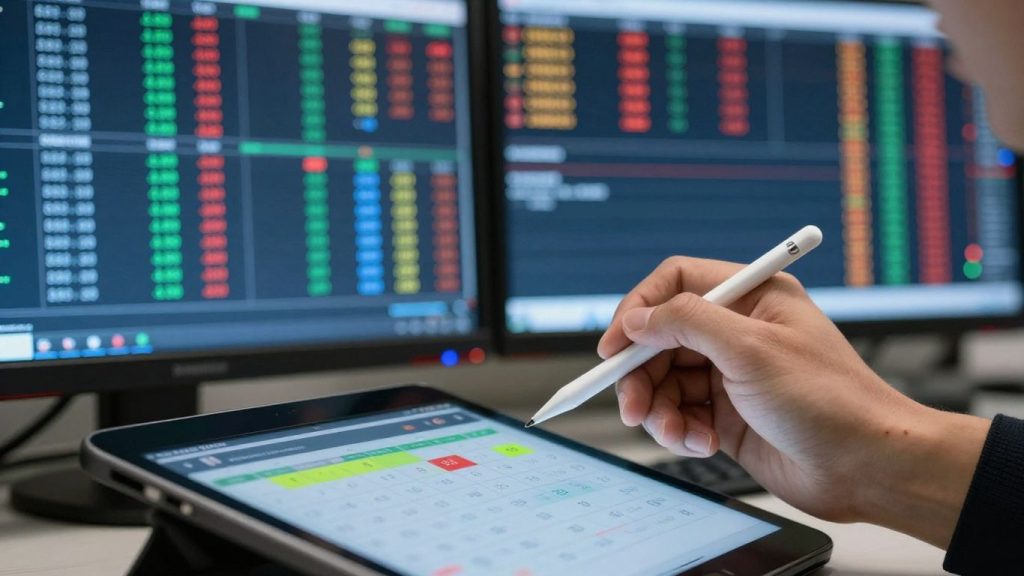
Alright, so you’re looking to get a better handle on trading the forex markets. It can feel like a lot sometimes, right? Like there’s always something happening you didn’t see coming. Well, one of the best tools out there to help you stay on top of things is the fx calendar. It’s not some fancy, expensive thing either; it’s actually free. This guide is all about making that fx calendar work for you, so you can trade smarter, not just harder. We’ll go through the basics and then some of the more detailed stuff.
Key Takeaways
- Setting your personal time zone on the fx calendar is super important so you know exactly when events are happening for you.
- Focusing on high and medium-impact news events on the fx calendar helps you avoid getting bogged down by less important stuff.
- Using the fx calendar lets you plan your trades around big economic announcements, either to join the move or stay out of the way.
- You can check past event data on the fx calendar for context, but remember that what’s happening on your charts is usually more important for price action trading.
- Saving your preferred settings on the fx calendar means you don’t have to set it up every single time, making your trading routine smoother.
Understanding The Forex Calendar Essentials
Alright, let’s talk about the Forex calendar. Think of it as your weather report for the currency markets. It tells you when things might get choppy or when a big move could be brewing. Without it, you’re basically trading blindfolded, hoping for the best. We’re going to focus on the Forex Factory calendar because, honestly, it’s the go-to tool for most traders, and it’s free. That’s a big win right there.
Navigating To The Forex Factory Calendar
First things first, you need to get to the right place. Just type forexfactory.com into your browser. Make sure you’re on the official site; there are imitators out there. Once you’re there, look for the ‘Calendar’ tab. It might look a little busy at first glance, with all sorts of numbers and colors, but don’t let that scare you. We’ll break it down.
Configuring Your Personal Time Zone
This is super important. The times listed on the calendar are usually in GMT or some other time zone you might not be familiar with. You need to change this so the event times match your local time. Look for a time display, usually near the top right of the calendar page. Click on it. You’ll see options to set your time zone and even toggle Daylight Saving Time on or off. Make sure you get this right; otherwise, you’ll be guessing when events are actually happening, and that’s a recipe for missed opportunities or bad trades.
Setting Up Your Event Filters
Now, the calendar shows everything, and most of it isn’t going to make the currency markets do much. You need to filter out the noise. Look for a ‘Filter’ button, usually near the time settings. Clicking this opens up a whole new set of options. You can filter by currency pairs, but more importantly, you can filter by the ‘Impact’ level of the news.
Here’s a quick rundown of the impact levels:
- High Impact (Red): These are the big ones. Think interest rate decisions, major employment reports (like Nonfarm Payrolls in the US), or GDP figures. These can cause significant price swings.
- Medium Impact (Orange): These are still important and can move the market, but usually not as dramatically as the red ones. Examples include retail sales or manufacturing data.
- Low Impact (Yellow): These are generally minor economic indicators that are unlikely to cause major price action on their own.
For most traders, focusing on just the High and Medium Impact events is the smartest way to go. It keeps your calendar clean and highlights the news that actually matters for trading decisions. You don’t want to be overwhelmed by every little piece of data. After you’ve selected your filters, hit ‘Apply Filter’ to see your customized view. You can always go back and change these settings later if you need to.
Leveraging The Forex Calendar For Trading Decisions
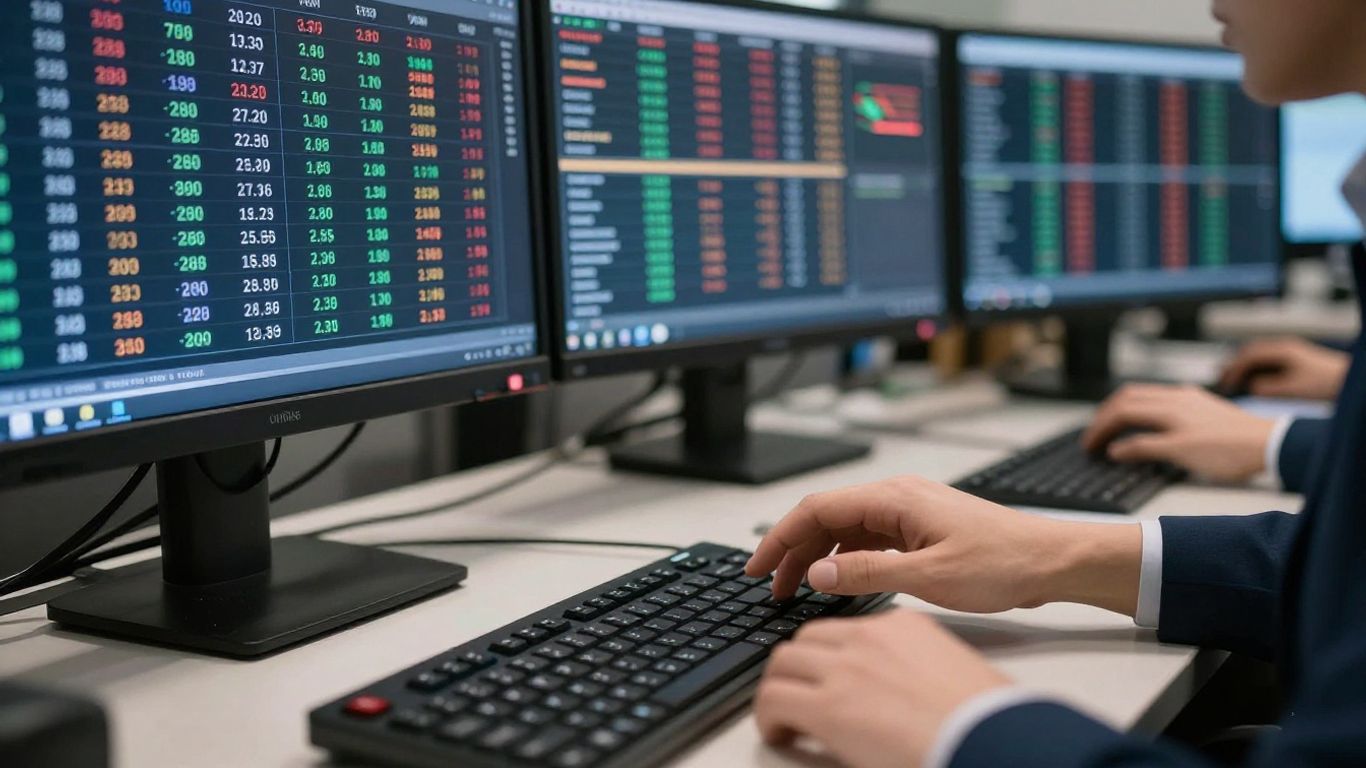
So, you’ve got the calendar set up, time zone sorted, and filters dialed in. Now what? It’s time to actually use this thing to make smarter trading choices. The economic calendar isn’t just a list of dates; it’s a map of potential market fireworks. Learning to read the signals it provides can make a big difference in your trading results.
Identifying Market-Moving Events
Not all news is created equal when it comes to moving currency prices. You don’t want to get bogged down by every little announcement. Focus on the events that have a history of shaking things up. Think of it like this: some news is a gentle breeze, while other news is a hurricane.
- High-Impact Events: These are the big ones. We’re talking about things like interest rate decisions from major central banks (like the Federal Reserve or the European Central Bank), major employment reports (such as Non-Farm Payrolls in the US), and Gross Domestic Product (GDP) figures. These can cause significant price swings.
- Medium-Impact Events: These can still cause noticeable price action, but usually not as dramatic as the high-impact ones. Examples include retail sales figures or manufacturing data.
- Low-Impact Events: Generally, these are less likely to cause major moves on their own. While they can add to the overall picture, they’re often not worth building your entire trading strategy around.
By filtering your calendar to show only medium and high-impact events, you cut through the noise and focus on what really matters for potential volatility. This helps you avoid getting caught off guard by unexpected market shifts.
Understanding Event Impact Levels
Forex Factory and similar calendars use color-coding to quickly show you the potential impact of an economic event. It’s a simple system, but incredibly useful.
| Color Code | Impact Level | Description |
|---|---|---|
| Red | High | Events likely to cause significant price volatility. |
| Orange | Medium | Events that can cause noticeable price movement. |
| Yellow | Low | Events with minimal expected impact on currency prices. |
When you’re starting out, it’s best to concentrate on the red and orange events. These are the ones that have the power to create trading opportunities or significant risks. You can always add yellow events later as you get more comfortable.
Utilizing Economic Event Details
Each event on the calendar usually comes with more than just a name and time. You’ll often see:
- Actual: The real number released for the economic indicator.
- Forecast: What economists and analysts predicted the number would be.
- Previous: The number from the last time this event was reported.
Comparing the ‘Actual’ number to the ‘Forecast’ is where you can often spot potential trading setups. If the actual number is significantly better or worse than expected, it can trigger a strong market reaction. For instance, if the US Non-Farm Payrolls report comes in much higher than forecasted, it could signal a stronger US economy, potentially leading to a rise in the US Dollar.
Remember, while the details are helpful, don’t get lost in the weeds. The primary goal is to identify events that will likely cause price movement. The calendar is a tool to help you anticipate, not a substitute for analyzing price action on your charts. Keep it simple and focus on the big picture.
Understanding these details helps you gauge market sentiment and anticipate potential price direction. It’s a key part of using the economic calendar effectively to inform your trading decisions.
Strategic Approaches Using The Forex Calendar
Knowing when big economic news is coming out is half the battle in forex trading. It’s not just about seeing the numbers; it’s about planning your trades around them. This section is all about making that happen.
Planning Trades Around High-Impact News
High-impact news events, like Nonfarm Payrolls or central bank rate decisions, can really shake up the market. You don’t want to be caught off guard when these drop. Instead, you can use the calendar to prepare. Some traders like to get into a position before the news, hoping the market moves in their favor. Others prefer to wait for the dust to settle after the announcement, looking for clearer price action. It really depends on your style and how much risk you’re comfortable with. Remember, events like Federal Open Market Committee (FOMC) announcements are major market movers.
Here’s a quick look at how you might approach it:
- Before the News: Decide if you want to enter a trade beforehand. If you do, make sure your stop-loss is set appropriately, considering the potential for increased volatility.
- During the News: Many traders sit on the sidelines during the actual release. It’s often too unpredictable to trade safely.
- After the News: Once the initial reaction subsides, you can look for established trends or reversals based on the new information. This is often a safer bet for many.
Managing Risk Before Economic Releases
Trading right before a big news event can be tricky. If you already have a profitable trade open, you’ve got a few choices. Maybe your trade is already way ahead, like 200 pips in profit, and it’s only 40 pips from your target. In that case, it might be smart to just close it and take the profit rather than risk giving it all back for those last 40 pips. Another option is to take some profit off the table, leaving a smaller part of the trade open to see if it hits the final target. This way, you secure some gains while still having a chance for more.
It’s easy to get caught up in the details of every single economic indicator. But for most forex traders, especially those focused on price action, the most important things to watch are the scheduled time and the expected impact level of the news. Anything beyond that can sometimes be more of a distraction than a help.
Capitalizing On Volatility With The Fx Calendar
Periods of high volatility around news releases can present opportunities. If you’re looking to trade these events, it’s wise to focus on the medium and high-impact news. These are the ones that tend to cause the biggest price swings. You can filter your calendar to show only these events, cutting out the noise from less significant releases. This helps you concentrate on what’s likely to move the market. By understanding the potential impact, you can position yourself to benefit from the increased activity, whether that’s by entering trades after the initial shock or by carefully managing existing positions.
Advanced Forex Calendar Techniques
Integrating The Fx Calendar With Price Action
There’s a bit of an art to mixing the calendar with what’s happening on your charts. When big news is on the way, patterns like pin bars, engulfing candles, or breakouts hit differently. A calendar event doesn’t tell you which way to trade, but it can show you when things might get wild. Here are a few tips for blending price action with the FX calendar:
- Mark news times on your chart, so you’re not caught off guard by volatility.
- Look for price building up near a key level ahead of the news—a break after the release might mean the move has real strength.
- Sometimes the first reaction after news isn’t the one that lasts; wait for the candle to close before jumping in.
Watching for market structure right before and after key releases can help filter out knee-jerk reactions. Sometimes, it’s worth skipping the first sharp move and waiting for things to calm down.
Using The Calendar For Specific Currency Pairs
You can get a lot more out of your FX calendar if you set it up for the exact pairs you trade most. There’s no reason to clutter your calendar with every currency—focus on those you actually trade. Try this simple setup:
| Step | Action |
|---|---|
| 1 | Filter calendar by your pairs |
| 2 | Mark high-impact events only |
| 3 | Check for overlapping news |
It’s smart to watch for events that hit both sides of a pair at the same time—for instance, a USD and EUR event if you trade EUR/USD. Those can lead to unpredictable price moves, so sometimes it’s best to stay out until the dust settles.
Analyzing Historical Event Data
Checking what happened after big events in the past can give some clues about how the market might react next time. Sure, no two news days are exactly the same, but patterns do repeat. Here’s how you can use the history feature of the FX calendar:
- Pull up past results for major events that matter for your pair.
- Compare how price moved versus what came out (was it higher or lower than forecast?).
- Note how long it took for price to settle after the news—was it a quick spike or did it trend for hours?
Sometimes, you’ll spot that the market tends to overreact right after certain data releases. Tracking this can help you plan to wait, instead of rushing in right after the event hits.
If you want your trading to make sense in the middle of all the noise, combining the FX calendar with historical outcomes and your own pair-specific filters is the way to go.
Maximizing Your Fx Calendar Experience
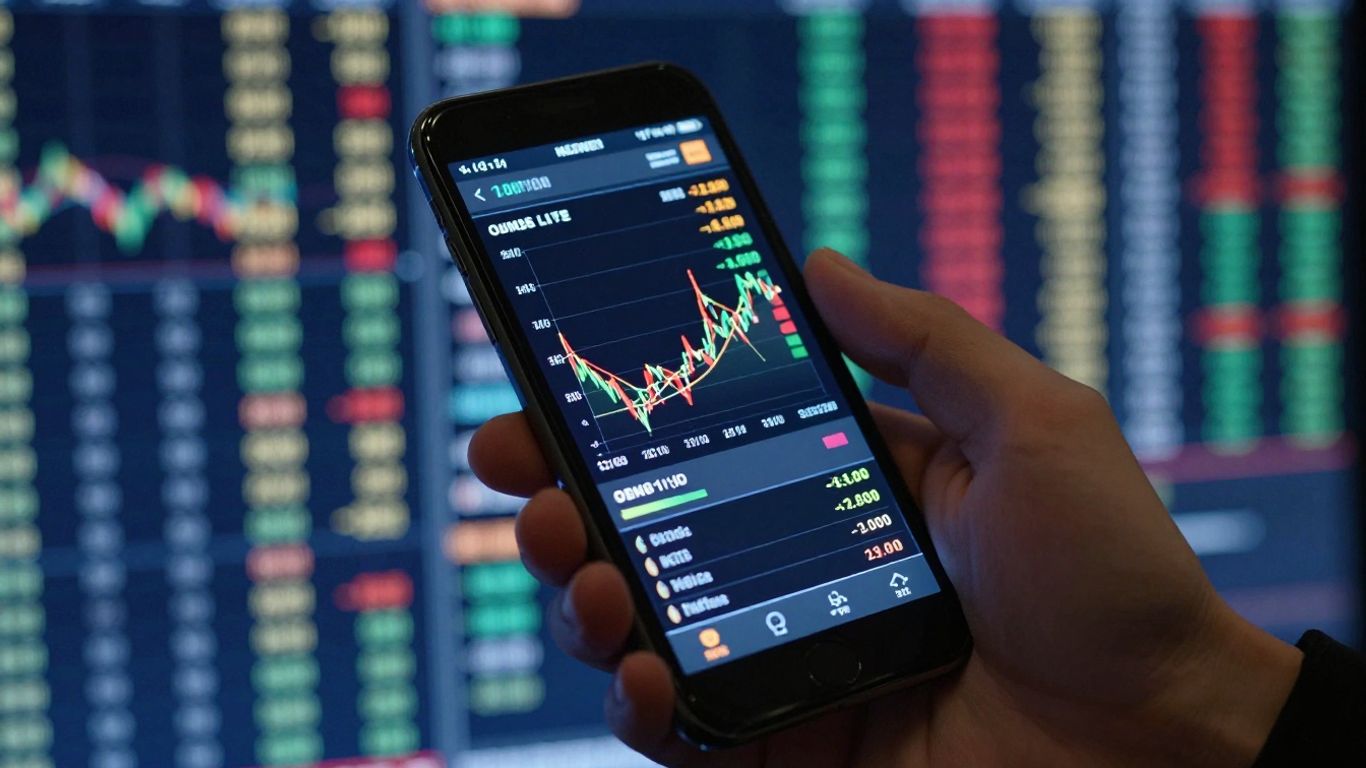
So, you’ve got the Forex Factory calendar set up, you know what events to watch, and you’re ready to trade. But how do you make sure you’re getting the absolute most out of this tool without it becoming a distraction? It’s all about fine-tuning and making it work for your specific trading style.
Customizing Your Calendar View
Think of the calendar like a dashboard for your trading. You wouldn’t want a car dashboard cluttered with every single dial and sensor, right? Same here. You need to see what’s important to you, quickly.
- Filter by Impact: Seriously, don’t get bogged down by low-impact news. Stick to medium (orange) and high (red) impact events. This cuts out a ton of noise.
- Filter by Currency: If you only trade EUR/USD and GBP/JPY, why clutter your view with news affecting the CAD or AUD? Select only the currency pairs you’re actively trading.
- Event Types: Are you particularly interested in interest rate decisions or employment figures? You can filter to show only those specific types of releases.
Saving Your Preferred Settings
This is a big one. Once you’ve dialed in your filters and time zone, you don’t want to do it all over again every single time you log in. Forex Factory lets you save these preferences.
Look for a "Save Settings" button, usually near the top. Clicking this means your personalized calendar view will load automatically. It saves you precious minutes and mental energy, letting you focus on the actual trading setup instead of fiddling with settings.
The Importance Of A Trading Timetable
Having a timetable, or a trading schedule, is key. It’s not just about when the news happens, but how it fits into your day and your trading plan. You need to know when you’re going to check the calendar, when you’ll be actively avoiding trades, and when you might look for opportunities.
Here’s a simple way to think about it:
- Morning Check-in: Before you even think about placing a trade, check the calendar for the day’s high-impact events. Note down the times and potential impact.
- Pre-News Routine: Decide on your strategy for events happening within the next hour or two. Will you close positions? Move stops? Or stay out completely?
- Post-News Analysis: After a major event, take a moment to see how the market reacted. Did it move as expected? This is learning data for your next trade.
By integrating these steps, the Forex calendar becomes less of a passive information source and more of an active part of your trading strategy. It’s about making it work for you, not the other way around.
Putting It All Together
So, we’ve gone through how to set up the Forex Factory calendar, making sure it works for your time and showing you only what matters. Remember, it’s not about knowing every single detail of every economic report. It’s about spotting those big events that can really shake things up in the market. By focusing on the high and medium impact news, you can better plan your trades, avoid nasty surprises, and maybe even catch some good opportunities. This tool is free, and when used right, it can make a big difference in how you approach your trading. Don’t just look at it, use it to build a smarter plan.
Frequently Asked Questions
What is a forex calendar and why should I use it?
A forex calendar is a tool that lists important economic events and news that can affect currency prices. By using it, you can plan your trades better and avoid surprises when big news hits the market.
How do I set my time zone on the Forex Factory calendar?
To set your time zone, click the time shown at the top right of the Forex Factory calendar page. Pick your local time from the list and save your choice. This makes sure all events show up in your local time so you don’t miss anything important.
What do the colored boxes on the calendar mean?
The colored boxes show how much an event might move the market. Red means high impact, orange is medium, and yellow is low. Focus on red and orange events if you want to watch for big changes in prices.
How can I filter the calendar for only the events I care about?
Click the ‘Filter’ button on the calendar page. You can choose which types of news, impact levels, and currencies to see. This helps you focus on the things that matter most to your trading plan.
Should I trade during big news events?
Trading during big news events can be risky because prices can move quickly. Some traders avoid trading at these times, while others use special strategies to take advantage of the extra movement. Always manage your risk and know what events are coming up.
Can I use the forex calendar for any currency pair?
Yes, you can use the forex calendar for any currency pair. Just set the filters to show news about the currencies you trade. This way, you only see events that could affect your trades.