Online Forex, crypto, and betting platforms face unique payment challenges like high chargebacks, international transactions, and fraud. High Risk Merchant Accounts help businesses manage these risks efficiently. Are standard merchant accounts enough, or is a specialised high-risk solution essential for smooth, secure, and reliable payment processing in high-risk industries?

The global foreign-exchange market saw average daily turnover around $7.5 trillion in the latest BIS survey, while daily crypto trading often runs into the hundreds of billions.
Higher volumes bring more problems. Online betting and gambling alone are a multi-billion dollar market, and payment disputes or fraud can quickly spike; card networks watch dispute ratios closely and will flag merchants that breach thresholds. A sudden rise in chargebacks can lead to fines, limits or even account closure.
That is why many forex, crypto and betting businesses use High Risk Merchant Accounts.
These accounts accept global payments while giving banks extra protection, such as reserves, stricter checks and stronger fraud tools, so platforms can keep running even when disputes rise. Are traders ready to handle the trade-off between higher costs and payment stability?
What are high risk merchant accounts?
A merchant account is basically a type of bank account that allows a business to accept payments online. For most online stores, a standard merchant account is enough. But for certain industries, like Forex trading, cryptocurrency, and online betting, standard accounts often don’t work. That’s because banks see these businesses as “high risk.”
So, what makes a business high risk? There are a few main reasons:
High Chargeback Rates – If customers frequently dispute transactions, banks see it as risky.
Large or Frequent Transactions – Big payments or many transactions can raise red flags.
Cross-Border Payments – Accepting payments from different countries can trigger extra scrutiny.
Industry Type – Forex, crypto, and betting platforms are naturally considered high risk due to regulations and potential fraud.
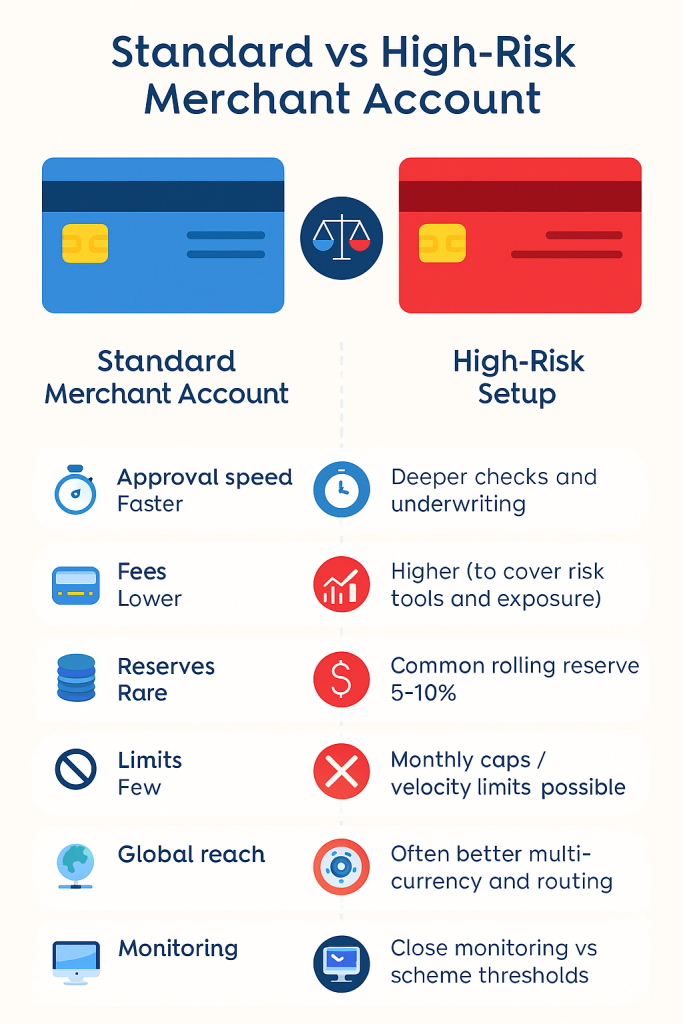
This is where High Risk Merchant Accounts come in. Unlike standard accounts, these are specifically designed to handle high-risk businesses safely. They provide tools to reduce the chance of chargebacks, manage fraud, and allow businesses to operate across borders without unnecessary interruptions.
For example, a crypto exchange might receive hundreds of payments daily from users around the world. If it used a standard merchant account, the bank might freeze payments after just a few disputes, slowing down business. But with a High Risk Merchant Account, the platform can continue processing payments securely, even if some transactions are disputed.
Another key feature is flexibility. High risk accounts often support multiple payment methods and currencies, making it easier for businesses to serve global clients. They also come with better support for handling disputes and managing transaction risks.
Why forex platforms need High Risk Merchant Accounts
Forex trading, or foreign exchange trading, involves buying and selling currencies online. It’s one of the largest financial markets in the world, with over $7 trillion traded daily. With so much money moving quickly, Forex platforms face unique challenges when handling payments.
Forex trading platforms face unique payment challenges that standard merchant accounts often cannot handle. Here’s why High Risk Merchant Accounts are essential for them:
High Volume of Transactions – Forex platforms can have thousands of deposits and withdrawals daily. Standard accounts may flag frequent transactions as suspicious, causing delays. High Risk Merchant Accounts allow smooth processing even with high transaction volumes.
Large Transaction Amounts – Forex traders often move large sums of money quickly. Banks consider these transactions risky and may freeze funds. High Risk Merchant Accounts handle large payments safely without interrupting operations.
International Clients – Forex platforms operate globally, accepting payments from multiple countries and currencies. Standard merchant accounts often restrict cross-border payments, but high risk accounts support international transactions seamlessly.
Chargeback Protection – Traders may dispute transactions if they experience losses. This increases chargeback rates. High Risk Merchant Accounts are designed to manage higher chargeback levels without penalising the business.
Fraud Prevention Tools – Forex platforms are targets for online fraud. High risk accounts come with advanced fraud detection tools, protecting both the business and its clients.
Regulatory Compliance Support – Forex trading is heavily regulated in many countries. High Risk Merchant Accounts help platforms comply with payment regulations while continuing to serve customers globally.
Real Example: A well-known Forex platform reported losing thousands in revenue when a standard merchant account froze payments after multiple disputes in one week. Switching to a High Risk Merchant Account allowed them to continue operations without interruptions, supporting both domestic and international clients.
According to industry data, Forex platforms face 3–5 times more chargebacks than typical e-commerce sites, highlighting the need for specialised payment solutions.
Why crypto platforms rely on High Risk Merchant Accounts
Cryptocurrency platforms deal with digital currencies like Bitcoin, Ethereum, and others. They face unique payment challenges that make High Risk Merchant Accounts essential.
Key reasons why crypto platforms need high-risk merchant accounts:
High Transaction Volume
- Crypto exchanges often handle thousands of transactions daily.
- Example: A medium-sized exchange may process $2 million in deposits and withdrawals every day.
- Standard merchant accounts may flag this volume as unusual, causing delays.
Cross-Border Payments
- Crypto users are global, sending and receiving money from different countries.
- Example: A US user deposits $5,000, while another in Japan deposits $10,000 in USD equivalents.
- Standard accounts can block international payments, while High Risk Merchant Accounts handle them seamlessly.
Fraud and Scam Risk
- Crypto platforms are targets for hackers and fraudulent transactions.
- High risk accounts provide advanced fraud detection tools to reduce financial losses.
Chargebacks and Disputes
- Users may claim they didn’t authorize a transaction or report lost funds.
- Example: $20,000 lost in a disputed transaction could trigger account freezes in a standard merchant account.
- High Risk Merchant Accounts are designed to handle such disputes without shutting down the account.
Regulatory Challenges
- Banks and payment processors are cautious about crypto because of regulations and money-laundering concerns.
- High risk accounts allow crypto businesses to operate legally while meeting compliance requirements.
Multiple Payment Methods
- Crypto platforms accept credit cards, bank transfers, and digital wallets.
- High Risk Merchant Accounts can process all these options efficiently.
Business Growth
- Smooth payment processing helps exchanges attract and retain users.
- Without a high-risk account, users may leave for competitors with faster and safer payment solutions.
Betting and gambling platforms: A high risk industry
Online betting and gambling platforms are among the most high-risk industries when it comes to payment processing. These platforms handle thousands of transactions daily, including deposits, withdrawals, and winnings. Customers often make payments from different countries and currencies, which can trigger extra scrutiny from banks and payment processors. Standard merchant accounts usually struggle to manage these complex payment flows, making High Risk Merchant Accounts essential for smooth operations.
One of the main challenges is chargebacks. In online betting, a customer may dispute a transaction if they believe a bet was unfair or if they fail to recognize a payment. High chargeback rates can lead banks to freeze accounts or terminate merchant services. High Risk Merchant Accounts are specifically designed to handle higher chargeback volumes, allowing betting platforms to continue processing payments without interruptions.
Fraud is another significant concern. Online gambling platforms are prime targets for cybercriminals attempting identity theft, stolen credit cards, or money laundering. High Risk Merchant Accounts often come with advanced fraud detection and prevention tools. These tools help platforms verify transactions in real-time, reducing the risk of fraudulent activity while protecting both the business and its customers.
Cross-border transactions are also common in the betting industry. Players often participate from countries with different regulations and currencies. Standard merchant accounts may block or delay international payments, frustrating customers and impacting revenue. High Risk Merchant Accounts allow platforms to accept multiple currencies and payments from international clients, ensuring a seamless experience.
To illustrate, consider a popular online betting site that saw repeated payment disruptions due to chargebacks and international transaction limits. After switching to a High Risk Merchant Account, the platform was able to process payments reliably, expand its international user base, and reduce operational stress caused by disputes.
Statistics show that the global online gambling market reached over $66 billion in revenue in 2023, with a significant portion of transactions flagged as high risk by banks. Without the right payment solution, platforms risk losing revenue and customer trust. By using High Risk Merchant Accounts, betting and gambling companies can operate securely, manage risks effectively, and provide a reliable payment experience for players worldwide.
Key benefits of High Risk Merchant Accounts
High Risk Merchant Accounts offer several advantages for businesses in industries like Forex, crypto, and online betting. Here are the main benefits:
Smooth Cross-Border Payments – High Risk Merchant Accounts allow businesses to accept payments from clients worldwide, supporting multiple currencies and international payment methods.
Reduced Chargeback Risk – These accounts are designed to handle higher chargeback rates without causing account freezes or penalties, helping businesses manage disputes more effectively.
Large Transaction Support – They can process large payments safely, which is essential for platforms dealing with significant deposits and withdrawals.
Fraud Protection – Advanced fraud detection and prevention tools help protect businesses from fraudulent transactions and cyber threats.
Regulatory Compliance Assistance – High Risk Merchant Accounts often come with support to help businesses stay compliant with local and international payment regulations.
Business Scalability – Platforms can expand operations globally without worrying about payment processing limitations or bank restrictions.
Flexible Payment Options – These accounts typically support multiple payment methods, including credit/debit cards, e-wallets, and bank transfers, making it easier for customers to pay.
Improved Cash Flow – Faster and reliable payment processing ensures businesses maintain steady cash flow, even in high-risk industries.
Dedicated Support – Providers of High Risk Merchant Accounts often offer specialised support for handling disputes, fraud, and transaction issues.
Peace of Mind for Business Owners – Knowing that payments are secure, chargebacks are manageable, and international transactions are supported allows business owners to focus on growth rather than payment problems.
How to choose the right High Risk Merchant Account provider
Choosing the right High Risk Merchant Account provider is crucial for businesses in Forex, crypto, and betting industries. Here are the key factors to consider:
Reputation and Reliability – Look for providers with a proven track record of serving high-risk businesses successfully. Check reviews, testimonials, and case studies.
Fee Structure –Compare setup fees, monthly fees, transaction fees, and chargeback fees. Some providers offer flexible pricing for high-volume businesses.
Payment Methods Supported –Ensure the provider supports multiple payment options, including credit/debit cards, e-wallets, and bank transfers. This makes it easier to cater to a global customer base.
Cross-Border Payment Support –If your business operates internationally, choose a provider that allows seamless payments from different countries and currencies.
Chargeback Management –Check whether the provider offers tools and support to handle chargebacks effectively, reducing disruption to your business.
Fraud Protection –Look for advanced fraud detection systems to safeguard transactions and prevent losses.
Integration with Existing Systems –Ensure the merchant account can easily integrate with your website, trading platform, or payment gateway for smooth operations.
Customer Support –Dedicated support is essential for resolving payment issues quickly. Choose a provider known for responsive and knowledgeable support teams.
Regulatory Compliance Assistance –Providers that help with legal and regulatory requirements can save you time and reduce the risk of penalties.
Scalability –Make sure the provider can handle your business growth, from increasing transaction volumes to expanding into new markets.
Common misconceptions about High Risk Merchant Accounts
Many people misunderstand what High Risk Merchant Accounts are and assume they are only for shady or illegal businesses. In reality, legitimate industries like Forex trading, cryptocurrency exchanges, and online betting often need these accounts simply because of the nature of their operations. High transaction volumes, international clients, and frequent disputes make them “high risk” in the eyes of banks—not because they are doing anything wrong.
Another common misconception is that high risk accounts always have extremely high fees. While it’s true that fees can be higher than standard merchant accounts, this is because providers take on more risk. Many providers offer competitive pricing, especially for businesses with strong payment histories or high transaction volumes. The benefits—like reduced disruptions, fraud protection, and smooth international payments—often outweigh the costs.
Some businesses also think that once they have a high-risk account, they are automatically safe from all chargeback or fraud issues. While these accounts provide better tools and support, businesses still need to implement good security practices, monitor transactions, and educate their customers to reduce disputes.
Lastly, some people assume that standard merchant accounts are “good enough” even for high-risk industries. The reality is that standard accounts frequently freeze funds, block international payments, or terminate accounts when a chargeback occurs. High Risk Merchant Accounts are specifically designed to handle these challenges and allow businesses to operate reliably.
Understanding these misconceptions helps business owners make informed decisions. Using a High Risk Merchant Account is not a sign of risk; it’s a smart, proactive way to manage payment challenges while supporting growth and customer trust.
By choosing the right provider, businesses can also benefit from dedicated support, regulatory compliance assistance, and scalable solutions that grow with their operations. Real-world examples from Forex, crypto, and betting platforms show how switching to a High Risk Merchant Account can prevent disruptions, expand international reach, and improve overall business reliability.

Shikha Negi is a Content Writer at ztudium with expertise in writing and proofreading content. Having created more than 500 articles encompassing a diverse range of educational topics, from breaking news to in-depth analysis and long-form content, Shikha has a deep understanding of emerging trends in business, technology (including AI, blockchain, and the metaverse), and societal shifts, As the author at Sarvgyan News, Shikha has demonstrated expertise in crafting engaging and informative content tailored for various audiences, including students, educators, and professionals.