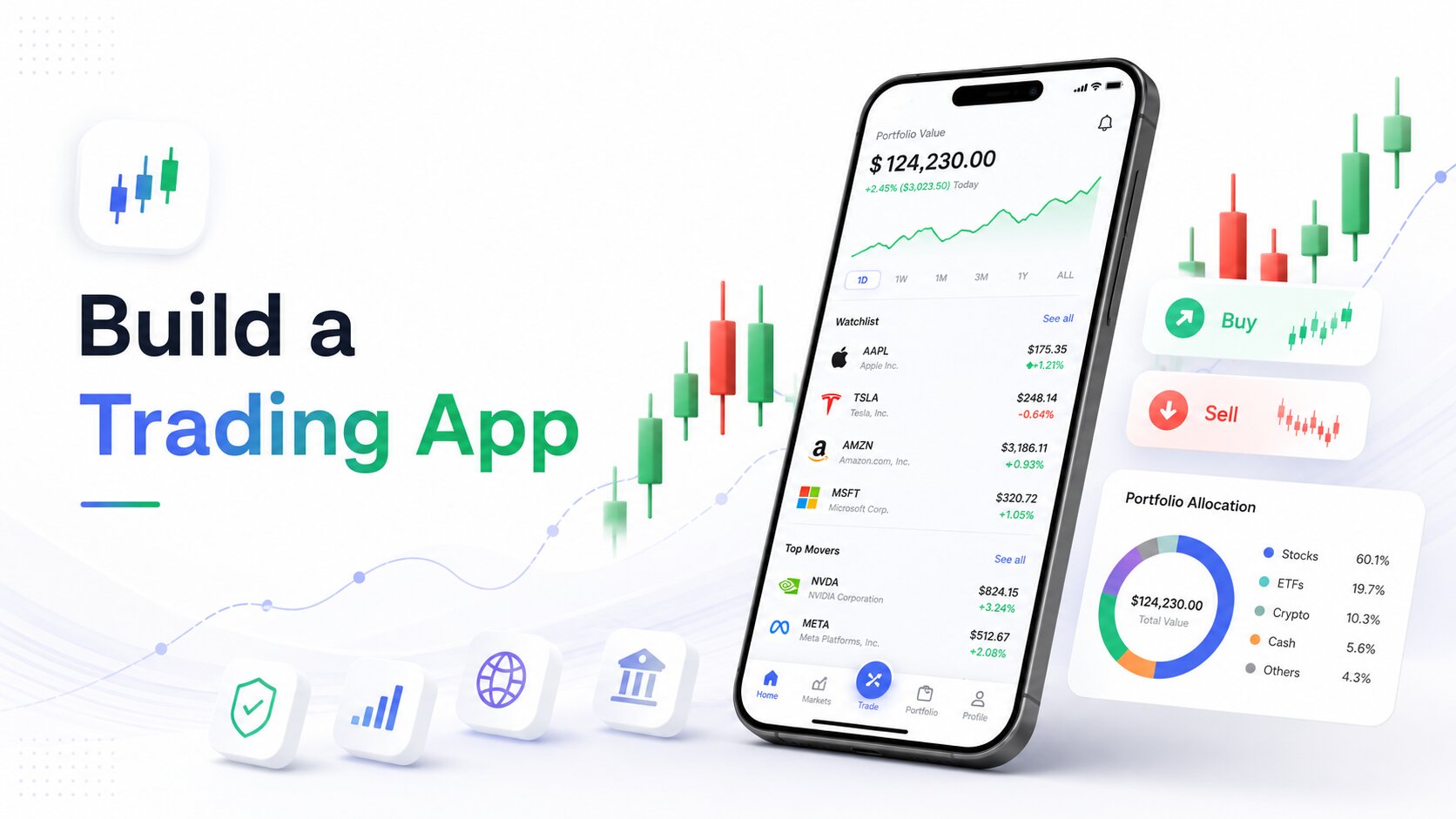
Over 130 million people used stock trading apps last year alone, not just to execute trades but to build portfolios, track positions in real time, and learn market mechanics from the ground up.
Building a trading app is not like building a productivity tool or a social platform. The infrastructure you lay down on day one has a direct relationship with user trust, execution reliability, and regulatory standing.
This guide walks through what it actually takes to go from idea to production, covering the prerequisites you need to clear before writing code, the architecture that keeps a trading system stable under pressure, and the step-by-step implementation process that development teams follow on serious fintech projects.
Part 1: Prerequisites Before You Write a Line of Code
Define Your User Segment Precisely
The single most consequential decision you make before building is defining who the app is for.
Stock trading apps attract meaningfully different users,
Beginners who need educational scaffolding and simplified interfaces, active day traders who want candlestick charts, Level 2 order books, and fast execution, and long-term investors who care about portfolio tracking, dividend management, and automated rebalancing.
These personas are not variations of the same product. They require different data models, different UI priorities, different compliance workflows, and different infrastructure tradeoffs.
A beginner-facing app built on the same latency requirements as a high-frequency platform will be over-engineered, expensive, and slow to ship. A day trading app with a simplified UI that hides order types will bleed power users immediately.
Before defining any feature set, write down the primary user segment explicitly. Validate it against actual market behavior.
Platforms like Robinhood built their growth on the assumption that millennials would trade equities on mobile if the experience felt as simple as any other consumer app, and the zero-commission, gamified interface was a direct result of that research.
Zerodha’s success in India followed a different logic based on serving active traders who were frustrated by clunky legacy brokerage tools, and charge low fees on high volume.
Both are right for their respective user segments. Neither would have worked for the other’s audience.
Understand the Regulatory Landscape Before Architecture Decisions
Compliance is not a post-launch task. It shapes your database design, your onboarding flow, your data storage policies, and your API integrations. Treating it as a feature to add later results in expensive rearchitecting and delays your ability to operate legally.
The core compliance requirements every trading platform must navigate include:
KYC (Know Your Customer)
Every trading platform that handles real financial instruments must verify user identity before allowing transactions. This means collecting government-issued ID, address proof, and in many regions, a tax identification number.
The EU requires a national ID as part of KYC. US platforms typically use Social Security Numbers or ITIN. Rather than building identity verification from scratch, most teams integrate third-party services.
Onfido, used by platforms like Revolut, uses AI and machine learning to analyze documents and facial biometrics.
Trulioo connects to trusted data sources across 195 countries for real-time verification.
These services offer API-first integrations that reduce the developer burden to an onboarding flow and a webhook listener, while keeping verification logic and compliance updates on the vendor side.
AML (Anti-Money Laundering)
Under FINRA Rule 3310, member firms are required to maintain a written AML program. For trading apps, this translates to transaction monitoring engines that flag unusual behavior: large sudden deposits, rapid cross-jurisdiction transfers, velocity anomalies.
Modern platforms use AI-based transaction monitoring rather than static rules, because rule-based systems generate too many false positives on legitimate high-volume users. Services like ComplyAdvantage and NICE Actimize offer real-time screening against sanctions lists and politically exposed persons databases.
Regulatory registration
In the US, a trading platform connecting retail users to securities markets must register with FINRA and the SEC, or partner with a registered broker-dealer that handles execution on its behalf. In the UK, FCA authorization is required.
In India, platforms operate under SEBI guidelines. In Europe, MiFID II applies. Each regulatory regime has different requirements around data storage, reporting, investor disclosures, and trade execution.
Global expansion means compliance is not a single implementation but a modular, region-configurable system.
Data residency
The EU’s GDPR and regional regulations in markets like the Middle East (DFSA) mandate that user data be stored within specific geographic boundaries. This has direct implications on your cloud infrastructure choices and database replication strategy.
The critical implementation decision here: build your compliance requirements into the data model from the start. If your KYC status, AML flags, and trade reporting fields are not part of your initial schema, every future compliance feature becomes a migration.
One practical approach is to separate your compliance service into its own microservice that other parts of the system query rather than embedding compliance logic in every service that touches user data.
Choose Your Market Access Model
There are two primary ways a trading app accesses financial markets:
The first is building directly on a licensed broker-dealer or exchange.
You become the frontend and the experience layer, while the partner handles execution, clearing, and regulatory reporting.
This model significantly reduces your compliance burden and time to market. Robinhood initially used this model before acquiring its own broker-dealer license as it scaled.
The second is acquiring your own license and connecting directly to exchange infrastructure via FIX (Financial Information exchange) protocol.
This gives you full control over execution logic, order routing, and margin handling, but requires clearing agreements, capital requirements, and dedicated compliance staff.
This path suits platforms targeting institutional users or those where execution latency at the microsecond level is a competitive requirement.
For most early-stage teams, the first model is the rational choice. The second becomes relevant once you have a product with proven demand and the capital to handle the regulatory overhead.
Part 2: System Architecture
The Core Components of a Trading Platform
A trading application is not a monolith. It is a collection of services that need to communicate reliably, handle failure gracefully, and scale independently during market volatility. The following components form the backbone of any production trading system.
Market Data Service
This is the pipeline that ingests real-time price feeds from data vendors or exchange APIs, normalizes them, and distributes them to the rest of the system.
Common providers include Bloomberg, Refinitiv, IEX Cloud, and Polygon.io. During volatile market sessions, this service needs to handle millions of messages per second.
The architecture here typically involves a message queue as a buffer between the incoming feed and the processing layer, which smooths out spikes and prevents data loss if a downstream component temporarily fails.
Order Management System (OMS)
The OMS is responsible for the complete lifecycle of a trade: from the moment a user submits an order through validation, routing, partial fills, execution, and final settlement.
Every state change like new, pending, partially filled, filled, cancelled, rejected must be tracked.
This is not a component where eventual consistency is acceptable. The OMS needs strong consistency guarantees, and its data model should be designed as an event log rather than a mutable state table, so that the full history of every order is always recoverable.
Risk Engine
Before any order reaches execution, it passes through the risk engine. This component enforces position limits, checks margin availability, validates that the user’s account status permits the trade, and applies any regulatory restrictions.
Risk controls that fail silently or fail open are a liability, both financially and legally. The design principle is that the risk engine should be the last gate before execution and should default to blocking any order it cannot fully validate.
Execution Gateway
This is the service that communicates with external exchanges or broker-dealer APIs to submit and manage orders. Because it talks to external systems, it needs robust retry logic, circuit breakers, and fallback handling.
The FIX protocol is the industry standard for this communication layer. The execution gateway converts your internal order format to exchange-specific payloads and translates execution reports back into your internal data model, keeping your trading logic independent of any particular exchange’s API.
Portfolio and Account Service
Manages user account balances, positions, transaction history, realized and unrealized P&L, and margin state. This service is the source of truth for everything the user sees in their dashboard. It consumes execution events from the OMS to update positions in real time.
Notification Service
Delivers order fill confirmations, price alerts, margin calls, and account activity notifications. This needs to be fast and reliable, since delayed execution confirmations degrade user trust quickly.
Event-Driven Architecture with Kafka
The architecture that has emerged as the standard for high-throughput trading systems is event-driven, with Apache Kafka at the center.
Kafka acts as a durable, distributed event log. Rather than services calling each other directly, they publish and consume events from Kafka topics.
This design achieves high decoupling: if the analytics service is temporarily unavailable, orders continue to process because the OMS is not dependent on it. Events accumulate in Kafka and the analytics service catches up when it recovers.
A typical Kafka-based trading architecture looks like this: the market data service ingests exchange feeds and publishes price tick events to a Kafka topic.
The OMS subscribes to relevant topics and publishes order state change events. The execution gateway consumes order events and publishes execution reports.
Every component reads from and writes to Kafka, which creates a complete, replayable audit trail of every event in the system.
Kafka’s transactional API, combined with idempotent producers, allows you to ensure that each order event is processed exactly once even in the presence of failures or network partitions.
The Data Layer: Choosing the Right Databases
Trading applications have heterogeneous data storage requirements, and no single database serves all of them well. A common approach is polyglot persistence: using different databases for different access patterns.
PostgreSQL or CockroachDB
Either of these databases are used for user accounts, order records, and compliance data. These require ACID transactions and strong consistency. CockroachDB’s distributed architecture is particularly suited for trading platforms that need geographic distribution and multi-region consistency.
Redis
Redis is used as the in-memory layer between Kafka and the user-facing API, so that a request for the current price of a stock does not require a database query.
TimescaleDB or InfluxDB
Used for historical prices, trade history, volume data, and charting data. TimescaleDB, built on PostgreSQL, is particularly attractive because it handles time-series data with native hypertable partitioning while still supporting standard SQL queries.
Teams building analytics on top of historical data can use the same query patterns without learning a different query language.
Real-Time Data Delivery to the Client
WebSockets are the standard transport layer for pushing real-time data from server to client in trading applications. HTTP polling is unsuitable because the polling interval introduces unacceptable latency and generates unnecessary server load.
WebSocket connections stay open, allowing the server to push price updates, order confirmations, and portfolio changes to the client as events occur.
For mobile clients, where battery consumption and network reliability vary, the design needs to handle reconnection gracefully, send snapshot plus incremental delta updates rather than full state on each event, and allow subscription-based filtering so the client only receives updates for the symbols it is actively displaying.
Spring WebFlux, used by Java-based platforms, handles WebSocket management and reactive stream backpressure natively.
For Node.js backends, the `ws` library combined with a Redis Pub/Sub pattern allows the Node server to receive events from Kafka via Redis and fan them out to WebSocket clients.
Part 3: Technology Stack
Backend
The backend of a trading application is typically split across languages and frameworks based on performance requirements.
Java with Spring Boot
The JVM combination dominates the execution-critical path in institutional and broker-dealer systems.
It’smature garbage collection minimizes pause times, strong typing catches errors at compile time, and the Spring ecosystem provides battle-tested libraries for everything from concurrency to security.
Java’s thread model is well suited to the bounded concurrency requirements of order processing.
Platforms that need deterministic execution latency and the ability to tune garbage collection for low-pause characteristics consistently reach for Java.
Python
Python Is used heavily on the data and analytics side: backtesting, algorithmic strategy implementation, risk modeling, and machine learning for fraud detection.
Libraries like pandas, NumPy, and scikit-learn make Python the natural language for anything involving time-series analysis or quantitative modeling.
The production choice here is typically to use Python for the analytics pipeline while keeping the execution path in a lower-latency language.
Go
Has gained significant traction in fintech infrastructure for services that need high concurrency with lower memory overhead than Java. Go’s goroutine model makes it well suited for services that manage thousands of simultaneous WebSocket connections. Several modern broker-dealer platforms use Go for their API gateway layer precisely because it handles concurrent connections efficiently without the JVM memory overhead.
Suits teams with JavaScript expertise who are building retail-facing platforms where the primary backend workload is API aggregation rather than compute-intensive trading logic. It works well for the notification service, the user-facing REST API layer, and webhook processing.
A real-world illustration of these decisions at work: when a trading platform needs to serve both a mobile app’s REST endpoints and a real-time WebSocket feed for price updates, the REST layer can run in Node.js behind a load balancer, while a dedicated Java service handles WebSocket connections and Kafka consumption. Each component is scaled independently based on its load profile, and the two do not compete for resources.
Frontend
For mobile applications, the debate between native and cross-platform remains active. React Native with Redux and a framework like NestJS on the backend is a stack that has proven capable of supporting platforms at scale.
The key advantage is code sharing between iOS and Android, which reduces team size requirements. GeekyAnts used this combination to build a platform that serves millions of users, with Redux providing predictable state management for the complex, real-time state that a trading dashboard requires.
For teams where performance on high-end devices is the primary concern, Swift for iOS and Kotlin for Android provide maximum hardware utilization and access to platform-specific APIs.
E*TRADE and Fidelity maintain native codebases for this reason, when a user is executing a multi-leg options order on a volatile market, the difference between a 16ms frame render and a 32ms frame render is felt.
Charting is a non-trivial engineering problem on trading apps. TradingView’s Lightweight
Charts library is widely used because it renders thousands of candlesticks in a canvas-based approach that maintains 60fps even on lower-end devices.
Rolling your own charting library is rarely justified unless you have very specific rendering requirements.
Infrastructure
AWS is the dominant cloud provider for trading platforms. Its financial-grade compliance certifications (SOC 2, PCI DSS, ISO 27001), low-latency networking, and global region availability make it the infrastructure baseline for regulated fintech.
Specific services used in trading infrastructure include Amazon MSK (managed Kafka), ElastiCache (managed Redis), RDS or Aurora for relational data, and CloudFront for static asset delivery.
For high-frequency use cases where proximity to exchange matching engines matters, co-location at financial data centers (NY4 and LD4 for equities and forex, Chicago for CME futures) is considered standard practice.
The latency reduction from hosting execution infrastructure in the same data center as the exchange can be the difference between a consistently profitable strategy and an unprofitable one.
Container orchestration with Kubernetes is the standard for managing the microservice architecture. Individual services deploy independently, scale horizontally based on load, and restart automatically on failure.
The combination of Kafka for event durability and Kubernetes for service resilience means that no single component failure should cause an order to be lost or a position to be incorrectly reported.
Part 4: Core Features and Their Implementation Complexity
User Onboarding and KYC
The onboarding flow is where compliance and user experience intersect most visibly. The goal is to complete identity verification with minimum friction while ensuring the data you collect is sufficient for regulatory requirements.
The practical approach for most teams is to integrate a third-party KYC service via API and build a thin onboarding UI on top of it.
The onboarding flow has these stages: account creation with basic credentials, personal information collection, ID document upload and facial liveness check, risk profile assessment, and account funding.
The risk profile assessment is a regulatory requirement in many jurisdictions (MiFID II in Europe explicitly mandates suitability assessments) and also helps you understand which features and instruments to surface to each user.
One implementation decision worth making early, build KYC status as a first-class field on your user model, not as a separate system that gets queried ad hoc.
Every permission check in your application, from viewing account balances to placing a trade, should be able to reference the KYC status field directly without a network call.
Real-Time Market Data Display
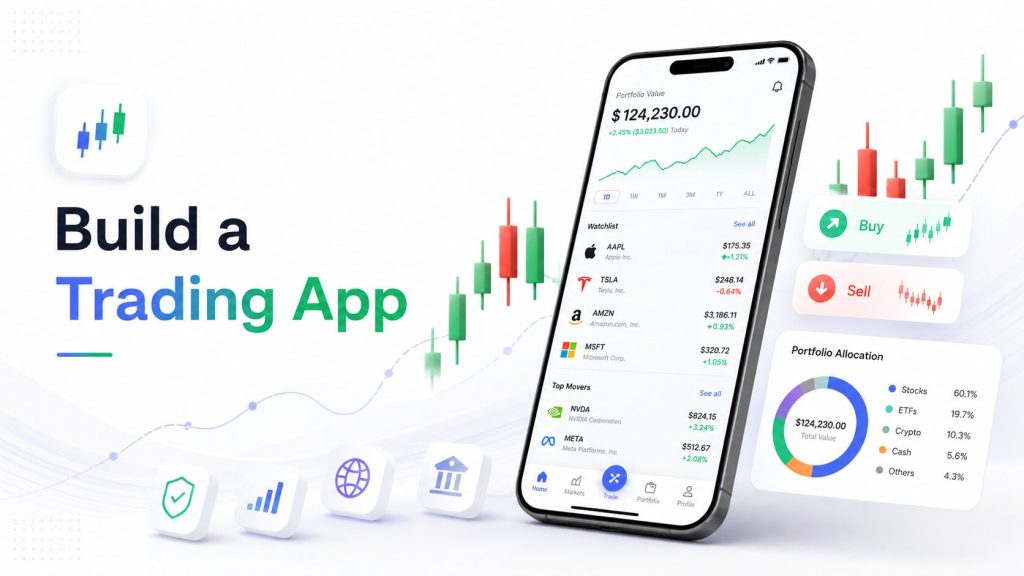
The user-facing market data display consists of a price ticker, a charting view, and an order book.
Each has different update frequency requirements and different client-side rendering challenges.
Price tickers update at tick frequency, which during active market sessions means dozens to hundreds of updates per second for liquid instruments. Rendering every tick in the UI would cause layout thrashing on mobile.
The standard approach is to throttle UI updates to a fixed interval (100ms to 250ms is the typical range) while the underlying data model stays current. The display refreshes at the throttled interval, and the user sees smooth, readable numbers rather than a blur of values.
The order book is the most computationally demanding component. A full Level 2 order book for a liquid equity can have hundreds of price levels on each side.
Rendering and updating this efficiently requires either virtualized list rendering (only rendering the rows currently in the viewport) or a canvas-based approach.
For most retail applications, displaying only the top 10 to 20 levels on each side is sufficient and dramatically simplifies rendering.
Order Placement and Execution
The order placement flow needs to handle several order types: market orders (execute at best available price immediately), limit orders (execute only at a specified price or better), stop-loss orders (trigger a market order when a threshold price is hit), and on more advanced platforms, options orders with their multi-leg complexity.
From a security standpoint, order submission endpoints need to be idempotent. A network timeout on the client side should not result in duplicate orders.
The standard implementation is to generate a client-side idempotency key when the user submits an order, include it in the API request, and have the server reject any duplicate request with the same key within a defined time window.
This prevents the common scenario where a user taps “Buy” twice because the first tap appeared to not respond.
Order confirmation notifications should be delivered via WebSocket push, not polling.
The WebSocket connection that delivers price updates to the user’s dashboard is the same connection that delivers order status events.
This means fill confirmations appear within milliseconds of execution rather than on the next polling interval.
Portfolio Dashboard
The portfolio dashboard aggregates account balance, open positions, realized P&L, unrealized P&L, and transaction history.
The data model behind this is straightforward, but the display performance is not. On a volatile trading day, positions update with every tick in the underlying instrument.
Recalculating unrealized P&L for every position on every price tick would be expensive if done server-side for every user.
The recommended architecture is to push raw price events to the client via WebSocket and calculate unrealized P&L on the client side using the locally maintained position state and the incoming price.
This offloads computation from the server to the client and means the display stays current without requiring a server round-trip for each update.
The server-calculated P&L values (which are authoritative) are sent on a lower-frequency basis, such as at end of day or on explicit request, for reconciliation.
Security Implementation
Security in trading applications operates on multiple layers. The foundational controls are: TLS encryption for all data in transit, AES-256 encryption for sensitive data at rest, multi-factor authentication on all accounts, session token expiration with forced re-authentication, and rate limiting on all authenticated endpoints to prevent credential stuffing and brute force attacks.
The deeper layer involves application-level security: parameterized queries everywhere to prevent SQL injection, input validation on all API endpoints before any business logic runs, secure API gateway patterns using authentication tokens for every inter-service request, and dependency management to track and patch known vulnerabilities in third-party libraries.
Threat modeling before the first commit is worth the investment. Mapping every attack surface at the design phase, rather than finding vulnerabilities in pen testing after launch, changes the cost structure of security significantly.
Regular penetration testing by third-party security firms should be written into the development roadmap before launch and at defined intervals after, not as an ad hoc exercise.
Part 5: The Development Process
Foundation (Weeks 1 to 8)
Set up the development environment, cloud infrastructure, CI/CD pipelines, and core services: Kafka, Redis, and your relational database. Implement the authentication service, the basic user model with KYC state fields, and the market data ingestion pipeline. At the end of this phase, your system should be able to ingest live or simulated price data, persist it, and serve it via a basic API.
Core Trading Functionality (Weeks 9 to 20)
Build the OMS, risk engine, and execution gateway. Implement paper trading (simulated execution without real money) as your test harness. This lets you validate the full order lifecycle, including edge cases like partial fills, order cancellations, and rejected orders, without touching a live market. Implement the portfolio service and the WebSocket delivery layer. At the end of this phase, you have a functioning trading system that can process orders and update positions in real time.
Client Application (Weeks 15 to 28, overlapping with Phase 2)
Frontend development runs in parallel with backend development. The mobile or web client connects to the WebSocket feed, renders real-time price data, implements the order placement flows, and builds the portfolio dashboard. This phase also includes the full onboarding flow with KYC integration.
Compliance, Security, and Testing (Weeks 26 to 36)
This phase is not an afterthought. Compliance integration, security audit, and load testing need dedicated time before any real money flows through the system. Load test the WebSocket layer at 10x your expected concurrent user count. Run the OMS through a full day of simulated market data, including high-volatility scenarios. Complete the security penetration test and resolve every critical and high finding before launch.
Regulatory Approval and Soft Launch (Weeks 34 to 52)
Regulatory approval timelines vary significantly by jurisdiction. In the US, FINRA registration or establishing a broker-dealer partnership can take months. Allocate time for this in your roadmap from the beginning. A soft launch with a limited user group lets you validate real money flows, customer support processes, and incident response procedures before scaling.
Cost and Timeline Benchmarks
A basic MVP trading application, covering KYC onboarding, real-time price display, basic order types, and a portfolio view, typically costs between $80,000 and $150,000 with an experienced team and takes 6 to 9 months.
A full-featured platform with advanced order types, multi-asset support, algorithmic trading capabilities, and institutional-grade infrastructure is a $500,000 to $1,000,000+ investment over 12 to 24 months.
The variables that move cost most significantly are: regulatory complexity (building for a single regulated market versus multi-jurisdiction from day one), team location and seniority, whether you are building native mobile or cross-platform, and whether you are partnering with a broker-dealer or acquiring your own license.