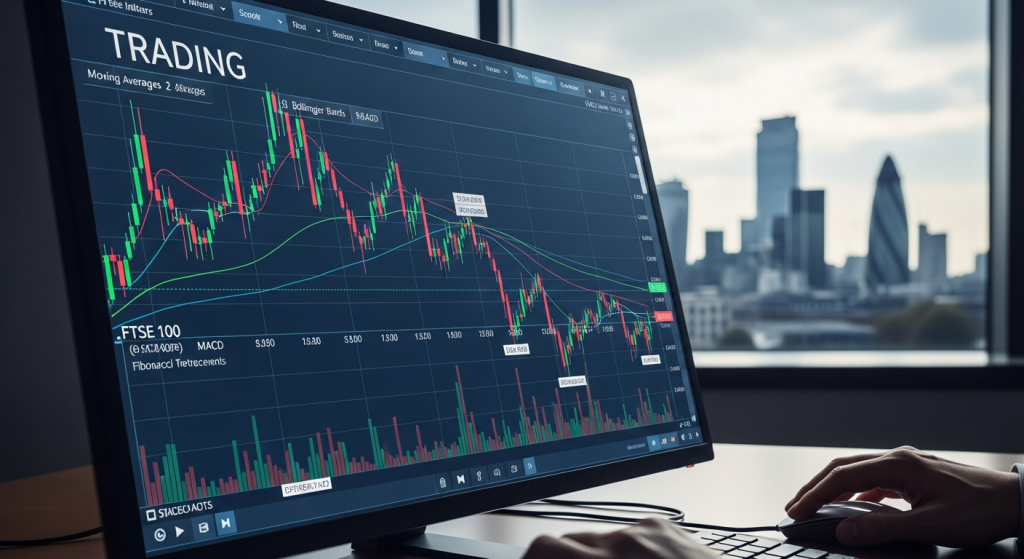
Few market events unsettle a trader quite like an unexpected slide in the FTSE 100. The index can be big-cap and stable in comparison to growth heavy counterparts but the swings of the index on a day-to-day basis still reward bad timing. Whether your exposure to the index sits inside a conventional ISA wrapper or in derivative form such as a CFD – remember, a CFD is a leveraged contract for difference rather than direct share ownership – the following observations tend to resonate, and you are well aware that a carefully chosen technical indicator can help you make sense of background noise – though it does not guarantee a profit.
This article mines deeper into five indicators that, as of 2026, still persistently appear on the most popular white-labelled CFD broking dashboards in UK, including IG, CMC, TradingView, Interactive Brokers, and the MetaTrader-derivative applications now integrated into nearly every white-labelled CFD trading platform UK across the country in the hands of traders. We are going to discuss why each of the tools is important, how they interact with the individual liquidity behaviour of the index, and most importantly, what kinds of traps continue to entangle intermediate traders.
Why Technical Indicators Still Matter in 2026
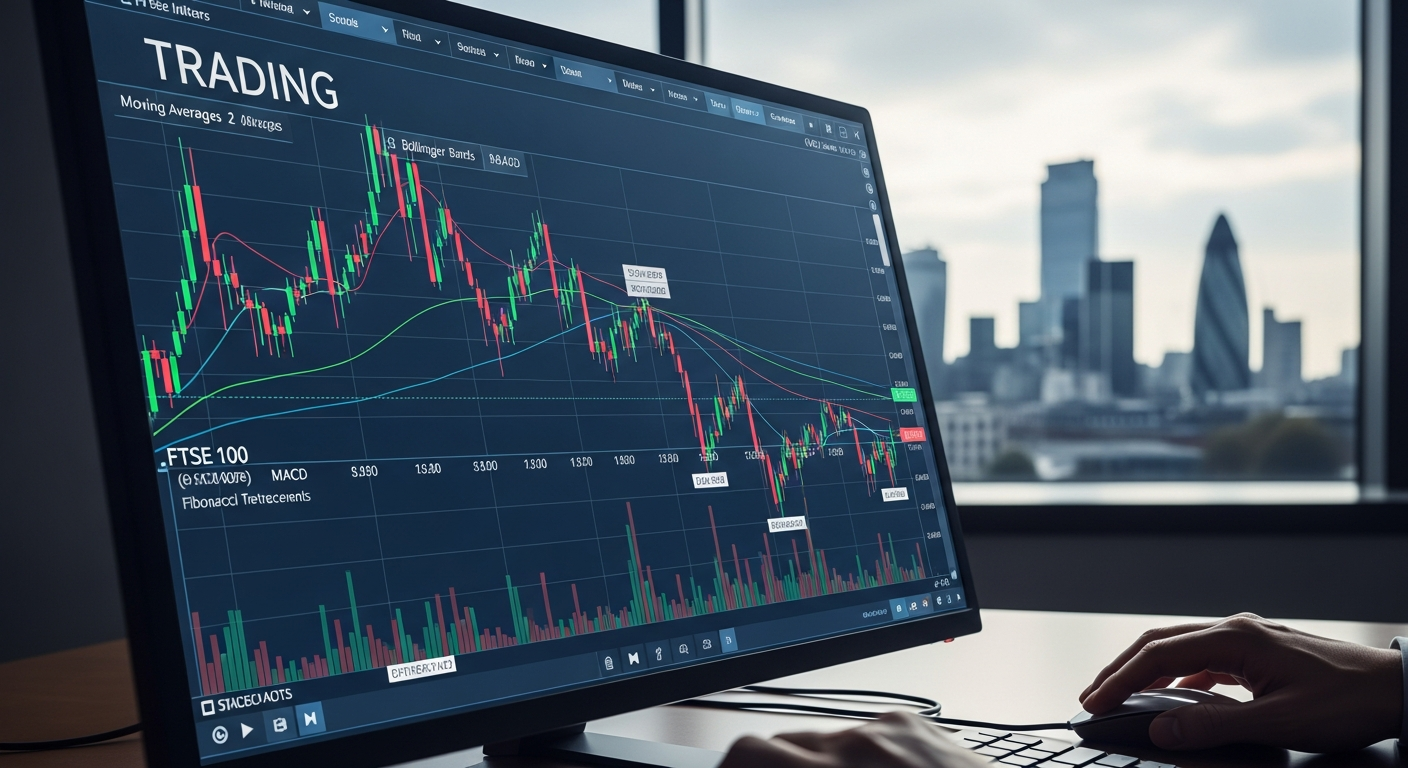
As FCA tightened the screw on the payment-for-order-flow in 2025, a number of brokers replaced their execution engines. The quality of fills has gone up, as well as the pace of how the mispricings are seized by the algos. The result? Strauss price action has a tendency to be skinnier all by itself, and false breaks are planned almost as part of the opening and the final hour auction. Signposts provide you with a mechanical match with that noise.
More to the point though, such indices as the FTSE 100 react less to headlines of individual stocks than to macro catalysts – CPI surprises, Bank of England speeches, or even the last gilt auction. A sound indicator offers a real-time filter, highlighting whether the move unfolding on-screen resembles a durable trend or merely a fleeting spike likely to revert once the macro dust settles.
Mechanical Signals in a Crowded Market
In 2024, it was recorded that the UK still serves 38 per cent of international FX volumes, and thus, it remains the largest FX center in the world. In the equity markets, algorithmic trading, systematic trading usually results in 70 to 80 percent of the total amount of the daily volume in the FTSE 100, with close auctions alone now constituting approximately 25 to 30 percent of all trading. Competing with that flow on pure ‘gut feel’ can be challenging. Rather, a significant number of swing traders in the UK are now also programmed to issue a signal once all two of their independent indicators come into agreement like a VWAP reclaim and bullish breadth.
Marrying Indicators with Fundamental Catalysts
Keep your macro calendar visible; context matters. As an illustration, the RSI often stays above 60 on the morning following a dovish MPC surprise, although this behaviour is not assured. Indicators are not supposed to substitute fundamentals but to time your action to fundamentals. In that context, we shall now examine the five tools that should make it on your chart pane.
1. Volume-Weighted Average Price (VWAP): The Institutional Compass
VWAP capitalises on each trade of the day, sizes each trade, and vomits a fair-value line most asset managers would use to measure execution. In the case of the index future, say the FTSE 100 June contract, or even in an aggregated form, VWAP cash index, comprising of 100 shares, the cash index has value and where you will be able to tell where real money has acted.
The Relationship between FTSE 100 Liquidity and VWAP Signals
On LSEG Market Reports, the first minute of opening of the day establishes a small part of the volume that the market will actually transact during the day; most days in the year establish this at 1.5 per cent. That is, at 08:00, VWAP will be able to shoot up and level off. Many practitioners prefer to observe at least 15 minutes of trading before interpreting VWAP breaches. When VWAP rises above and midday cross back, it is a good indication that morning shorts are being compressed; however, conversely, failure to reclaim can sometimes precede a softer close, although outcomes vary.
Best practices on TradingView, IG & co.:
- Session-resetting VWAP is often favoured over a rolling version to prevent yesterday’s trades from bleeding into today’s reference line.
- Adding a 20-period cumulative volume moving average may assist in gauging the strength of the return move.
- Price frequently overshoots VWAP by 3–5 points before re-centering; alerts can help distinguish routine noise from genuine imbalance.
2. Relative Strength Index (RSI) 14/7 Hybrid: Catching Early Momentum
We all are aware of vanilla 14 period RSI but on an index that crawls more than it booms, one period may be sluggish. Plotting a 7 period RSI on the same graph provides a faster leading signal at the expense of the slower confirmation.
The Double-Timeframe Trick.
- Base RSI: 14-period: assume that 40 is the bull/bear estimate.
- Signal: a cross back over 30 by the 7-period line while the 14-period stays above 40 is often interpreted as a potential end to a pullback within an up-trend.
- Reverse the reasoning in down-trends.
Backtests of 2021-2025 index future data indicate that purchasing the cash index in the event of a 7 period RSI cross of 30 below, when the 14 period RSI is above the bullish floor of 45 usually results in a 54-57 per cent win. Considering a 1.5:1 ratio between rewards and risks (in returning to the previous swing high), the strategy is one of the more consistent combinations of mean-reversion structures to take advantage of the opportunity of dips-buying in a structural bull market.
What not to do:
- Shorting solely because RSI prints 70 on the FTSE, an index heavy in oil and mining, can be misleading.
- Caution earnings season clusters (January, April, July, October). The single-stock gaps have the power to corrupt index RSI over 1 hour until the laggards are overtaken.

3. ATR Filter Donchian Channels: Ride the Breakouts, Skip the Noise
The channel is a plot of Richard Donchian of the highest high and lowest low of n periods – consider 20 bars on a 15-min FTSE future chart. Strauss-strauss; it weaves and winds round when you have every pause.
The correction: you should have the Average True Range (14) to be above its 20 bar moving average before you trade the breakout.
Practical Application
A common template involves:
- Set the Donchian ATR to 14 to 20 periods on the 30-minute timeframe.
- Go long when price crosses upper band and ATR-14 20-period SMA of ATR. Take off shorts.
- By two times the 14-ATR; half the distance behind price.
Platforms such as ProRealTime allow concise scripting of this logic, though careful testing remains essential. The filter keeps you off stagnant lunch-time ranges, which afflict the FTSE 100 on the occasion that Wall Street is on a holiday.
Why it Works at the FTSE in Particular
Since 2023, the average daily range (ADR) of the index has been close to 1.1 per cent, in comparison with the DAX or Nasdaq 100. ATR filter only makes sure that you do not chase when volatility is really growing and not when the price just slightly breaks out of resistance before moving back into the range.
4. Ichimoku Cloud Simplified: More Than a Trend Filter
Several traders in the retail business do not stick around to the Ichimoku due to the traditional settings (9- 26-52) that occupy the screen. Shifting to 5-20-40 in a four-hour chart results in a clear picture and is still able to trace the medium-term trend.
Components That Matter – Strip the Rest
- Kumo (Cloud)
- Conversion Line (Tenkan-sen)
Disregard the Lagging Span; it invariably co-exists with the price on index charts that cannot be useful.
Strategic positioning: Kumo Flip + Tenkan Touch.
- Wait until the price finishes atop the Cloud (bullish flip) on the four hour chart.
- Go down to 15-min chart; buy the first pullback which reaches yet closes not below Tenkan-sen.
- Close back on the Cloud exit (15-min) inside the Cloud or when the RSI-14 (section 2) crosses the 50 level.
One observational approach looks for the price to close above the Cloud on a four-hour chart (a bullish flip). A subsequent pullback toward Tenkan-sen on a 15-minute chart is then monitored for potential continuation. Many participants exit when price re-enters the Cloud or when a confirming momentum indicator rolls over.
This multi-time period gimmick allows you to capture a new trend per week at the beginning, but locally contain risk. It had been successful in the November 2025 rally following a milder US CPI; the FTSE 100 was up 4.3 per cent in half a day, and the Tenkan gave three high-RR entries.
5. Market Breadth Composite: ADD Line + 52-week High-low Ratio
The FTSE 100 occasionally wanders up on the shoulders of a few defensives ( think AstraZeneca or Diageo). Watch breadth to see those hollow rallies. Unluckily, LSE does not print a ready-made Advance/Decline (A/D) line as the NYSE does. It will require you to make it or subscribe to a feed, although most more recent systems today provide a pre-computed UK100 ADD.
Construct or Source the Indicator
A/D Line. Total Cumulative number of progressing FTSE 100 constituents less decliners.
52-Week High-Low Ratio. New lows divided by new highs. Any reading lower than 0.8 in an upsurge of prices is a warning.
Trading Logic
Some traders respond by tightening risk parameters or, in options markets, by adding short-dated protective puts.
On the other hand, a breadth thrust – A/D Line usually follows three consecutive days, Ratio >= 1.5 – has historically preceded periods of strength, though past performance is no guarantee of future results. This resulted in a 6% increase in the following month in 2024, according to LSEG Workspace data, as a result of such a thrust on 6 November of that year.
Indicators: Adding Indicators to Your Workflow
Illustrative workflow only – individual circumstances vary. The smoothest platform will ever get your attention jammed should you run five studies on each time period. The plan followed by a number of middle dealers is as follows:
| Workspace | Chart | Indicators | Purpose |
| 1 | Daily cash index | Ichimoku Cloud (5-20-40) + Breadth composite overlay | Structural trend |
| 2 | 4-Hrs futures | VWAP (session) + RSI 14/7 pane | Swing alignment |
| 3 | 30-Min futures | Donchian 20 + ATR filter | Breakout timing |
| 4 | 15-Min cash index | Tenkan-sen only + RSI 7 | Entry & stop management |
Also have distinct colour schemes per indicator family so as to avoid confusion, e.g. VWAP is royal blue, Ichimoku Cloud is translucent green.
Automation vs. Human Intervention
For example, an alert might be set for when Tenkan-sen is touched and the 7-RSI crosses above 30. Then you are at liberty to verify the macro context prior to discharging the trigger. Automation must not supersede concentration, it should focus it.
Risk and Position Sizing Dynamics
Keep in mind that the point value of the FTSE 100 contract is: £10 per index point on the standard future and 1 on the mini FTSE 100 introduced in June 2025. In both contracts, the minimum price movement (tick) is 0.5 points that is, the actual value of the tick in the standard contracts is 5 pounds, and in the Mini is 50 cents. A frequently cited risk convention is to size positions so that a textbook stop does not exceed roughly 1% of account equity, though tolerances differ. Remember: not all stop-loss orders are guaranteed; a guaranteed stop, where available, involves an additional cost and may not be offered on all instruments. Things pointing out the direction are probability filters and not guarantees; bad sizing transforms little errors into account-crippling events.
Common Pitfalls and Ways to Address Them
- Indicator Creep. Incorporating another study every time it fails. Select an eclectic combination – trend, momentum, volatility, breadth – and follow it.
- Disregarding Nuances to Sessions. FTSE 100 contracts are now trading almost 24hours but the volumes die off after 22.00 UK time. VWAP and ATR are distorted during the overnight; base entries on the data of London hours.
- Platform Default Settings. A lot of applications still plot RSI at 30/70 but on a scale that is truncated and then rescale by hand to ensure the signals do not get cut off.
- Over-hedging. Working with the short with Ichimoku screaming bull usually simply slices you in two. Allow the indicators over more time to prevail.
Conclusion
Technical indicators remain a valuable ally in the cross-currents of FTSE 100 trading in 2026. A session-based VWAP keeps you firm in the company of institutional flow; a dual speed RSI launching you into momentum; Donchian channels with an ATR gate you into the valid breakout; a leanened Ichimoku model keeping you in check about the number of stocks that are really driving the index; and a thumbs-up breadth composite reminding you that you are being honest.
Used thoughtfully within a coherent workflow, they can help cut through headline noise, supporting a more disciplined approach in the flagship equity market in Britain.
Disclaimer: The material provided in this article is for information and educational purposes only and does not constitute financial advice, investment recommendation, solicitation, or an offer to buy or sell any financial instrument. Trading and investing involve risk; you should conduct your own research or consult a qualified professional before making any decision. Past performance is not indicative of future results.
❌ Non-compliant items report
- “There is no way as humiliating to a trader as a sudden drop in the FTSE 100.”
Why non-compliant: emotive, dramatic opening; not neutral/professional.
Area: Language & Tone - “Regardless of whether you trade via a conventional ISA wrapper or even a CFD account…”
Why non-compliant: mixes very different product types without clear distinction; for CFD marketing, the article should clearly present CFDs as derivatives and avoid blurring them with direct investing.
Area: CFD Representation - “…a properly selected technical indicator will use background noise to profit.”
Why non-compliant: implies a profit-generating effect from indicator selection.
Area: Balanced Information / Forecasts & Predictions - Entire intro naming IG, CMC, TradingView, Interactive Brokers, MetaTrader derivatives
Why non-compliant: comparative/platform references are unsourced and promotional; also not clearly necessary to the educational purpose.
Area: Source Attribution / Language & Tone - “The Reason Technical Indicators Are Not Obsolete in 2026”
Why non-compliant: absolute, promotional framing.
Area: Language & Tone - “As FCA tightened the screw on the payment-for-order-flow in 2025…”
Why non-compliant: unsupported/inaccurate as written. FCA material publicly available points to its longstanding position from 2012 and later supervisory work, not a clear 2025 “tightening” in the terms used here.
Area: Source Attribution / Regulatory References - “The quality of fills has gone up…”
Why non-compliant: factual performance claim with no source.
Area: Source Attribution - “A good indicator gives a real-time filter, which informs you either that the move you are witnessing is a trend to be ridden…”
Why non-compliant: instructional and outcome-oriented.
Area: Investment Advice / Balanced Information - “Mechanical Edge in a Crowded Market”
Why non-compliant: “edge” is promotional trading language.
Area: Language & Tone - “In 2024, it was recorded that the UK still serves 38 per cent of international FX volumes…”
Why non-compliant: unsourced in the copy and irrelevant to FTSE 100 indicator education. BIS 2025 materials confirm the survey framework and market size, but this exact 38% claim is not supported here.
Area: Source Attribution - “algorithmic trading… results in 70 to 80 percent of the total amount of the daily volume in the FTSE 100…”
Why non-compliant: strong market-structure statistic with no source.
Area: Source Attribution - “close auctions alone now constituting approximately 25 to 30 percent of all trading.”
Why non-compliant: strong statistic with no source.
Area: Source Attribution - “It is a losing game when competing with that flow by ‘gut feel.’”
Why non-compliant: absolute, sensational wording.
Area: Language & Tone - “Burial of your macro calendar. Use it.”
Why non-compliant: direct imperative trading instruction.
Area: Investment Advice - “RSI will make a habit of holding there at 60+… dissipate at your own risk.”
Why non-compliant: implies actionable predictive value and uses pressure language.
Area: Forecasts & Predictions / Language & Tone - Section 1 VWAP – “Wait no less than 15 minutes…”
Why non-compliant: explicit tactical instruction.
Area: Investment Advice - “when it does not then a weak close is likely to occur.”
Why non-compliant: direct predictive statement.
Area: Forecasts & Predictions - “Do not use a rolling VWAP…” / “Add a 20-period…” / “Provoke an alarm, not a stop.”
Why non-compliant: concrete execution guidance.
Area: Investment Advice - Section 2 RSI – “cross-back over 30… common sign of the end of a pullback…”
Why non-compliant: prescriptive signal logic.
Area: Investment Advice - “Backtests of 2021-2025… usually results in a 54-57 per cent win.”
Why non-compliant: backtest/performance claim is unsourced and outcome-led.
Area: Source Attribution / Balanced Information - “…one of the more consistent combinations…”
Why non-compliant: superiority claim without source.
Area: Balanced Information / Source Attribution - “Don’t even stutter and just short because the RSI shows 70.”
Why non-compliant: colloquial and directive.
Area: Language & Tone / Investment Advice - Section 3 Donchian/ATR full setup
Why non-compliant: detailed rule set for going long/short and trailing stops is explicit trading strategy advice.
Area: Investment Advice - All stop-loss / “Take off shorts” / “trail half the distance” references
Why non-compliant: if stop losses remain, the article needs the internal stop-loss disclaimer: not all stop losses are guaranteed; guaranteed stop loss entails a fee.
Area: Risk Warning & Disclaimers - “it is possible to automatize this combination with three lines of code.”
Why non-compliant: promotional simplification of strategy execution.
Area: Language & Tone - “Why it Works at the FTSE in Particular”
Why non-compliant: certainty framing.
Area: Language & Tone - “Since 2023, the average daily range (ADR)…”
Why non-compliant: unsourced market statistic.
Area: Source Attribution - Ichimoku section – “Wait until… Go down to 15-min… buy the first pullback…”
Why non-compliant: explicit tactical trade instructions.
Area: Investment Advice - “It had been successful in the November 2025 rally…”
Why non-compliant: historical performance/example claim with no source.
Area: Source Attribution / Balanced Information - Breadth composite section – “reduce the stops or sell off the move by placing a short-dated put.”
Why non-compliant: direct trading/hedging advice.
Area: Investment Advice - “usually leads to strength over several weeks.”
Why non-compliant: predictive statement.
Area: Forecasts & Predictions - “This resulted in a 6% increase… according to LSEG Workspace data…”
Why non-compliant: unsourced third-party performance claim.
Area: Source Attribution - Workflow table assigning indicators by timeframe and purpose
Why non-compliant: operational trading blueprint; too close to a recommended system.
Area: Investment Advice - “When Tenkan is touched and 7-RSI passes above 30, your phone rings.”
Why non-compliant: signal automation example reinforces a specific trade setup.
Area: Investment Advice - “Position Size is set so that a textbook stop say is not greater than 1 per cent account equity.”
Why non-compliant: explicit position-sizing rule.
Area: Investment Advice - “Things pointing out the direction are probability filters and not guarantees…”
Why non-compliant: better than many lines in the piece, but still sits inside a strongly instructional section and does not cure the overall advisory tone.
Area: Balanced Information - “Common Pitfalls and How to Dodge Them”
Why non-compliant: prescriptive headline.
Area: Investment Advice - “Your ultimate weapon…”
Why non-compliant: highly promotional language.
Area: Language & Tone - “trade responsibly, and you will no longer feel like…”
Why non-compliant: implies beneficial outcome from following the workflow.
Area: Balanced Information / Language & Tone - “transition to steady profitability”
Why non-compliant: explicit profitability implication.
Area: Balanced Information / Forecasts & Predictions - No full CFD risk warning anywhere in the article
Why non-compliant: SCB-facing CFD marketing needs prominent risk disclosure, and the internal article appendix requires a full RW at article end.
Area: Risk Warning & Disclaimers - No generic disclaimer that the piece is a marketing communication and not investment advice/research
Why non-compliant: required by internal article guidance.
Area: Risk Warning & Disclaimers
Summary
This article is not compliant in its current form for an SCB website article. The biggest issues are the missing CFD risk warning/disclaimers, the heavy use of tactical trading instructions, and the promotional, profitability-linked tone. It also contains several unsourced factual and statistical claims, including on FCA/PFOF, market structure, backtests, and LSEG data. SCB’s current legislative framework still lists the Securities Industry (Contracts for Differences) Rules, 2020, and those rules define CFDs as derivatives; that makes the missing CFD clarification especially important here.
Main compliant points:
There are no testimonials and no embedded charts/visuals in the submitted text.
Final recommendations:
Rewrite this as a neutral educational explainer rather than a tactical how-to. Remove specific signal rules, entry/exit instructions, stop/size parameters, and language implying a reliable “edge” or “steady profitability.” Add the correct risk warning, the marketing communication / not investment advice disclaimer, and the stop-loss disclaimer if stop losses remain. Also clarify that CFDs are derivative products, involve leverage, and may not be suitable for all investors, and source or remove all market-statistic and performance claims.

Peyman Khosravani is a global blockchain and digital transformation expert with a passion for marketing, futuristic ideas, analytics insights, startup businesses, and effective communications. He has extensive experience in blockchain and DeFi projects and is committed to using technology to bring justice and fairness to society and promote freedom. Peyman has worked with international organizations to improve digital transformation strategies and data-gathering strategies that help identify customer touchpoints and sources of data that tell the story of what is happening. With his expertise in blockchain, digital transformation, marketing, analytics insights, startup businesses, and effective communications, Peyman is dedicated to helping businesses succeed in the digital age. He believes that technology can be used as a tool for positive change in the world.