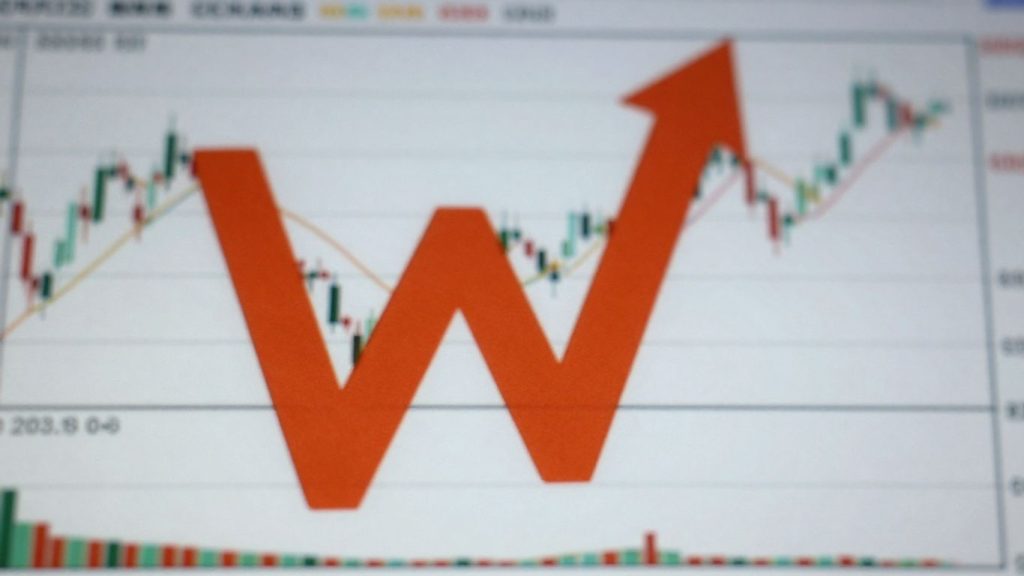
So, you’re looking to get a handle on the W pattern in trading? It’s a pretty common sight, especially when the market’s thinking about doing a U-turn from a downtrend. Basically, it looks like the letter ‘W’, and it shows that sellers are getting tired and buyers are starting to show up. Learning how to spot and use the W pattern trading strategy can really help you catch those potential reversals early on. Let’s break down how to make this pattern work for you.
Key Takeaways
- The W trading pattern is a solid tool for spotting potential bullish reversals after a downtrend.
- Look for a clear downtrend, two distinct bottoms at similar levels, and a breakout above the middle peak for confirmation.
- Volume is your friend; higher volume on the breakout often means the move is more likely to stick.
- Don’t forget risk management; always use stop-losses to protect yourself from false signals or unexpected turns.
- Practice makes perfect: The more you see and trade W patterns, the better you’ll get at identifying the high-probability setups.
Understanding the W Pattern Trading Formation
Defining the W Pattern for Bullish Reversals
The W pattern, often called a double bottom, is a chart formation that traders look for when they think a stock or asset is about to stop going down and start going up. Think of it like the letter ‘W’ on a price chart. It shows up after a period where prices have been falling. Basically, it’s a sign that the sellers who were pushing the price down are getting tired, and the buyers are starting to show up and push back.
Visualizing the W Pattern’s Structure
To spot a W pattern, you’re looking for a few key things. First, there’s a clear downtrend leading into the pattern. Then, the price hits a low point – that’s the first ‘V’ of the W. After that, it bounces up a bit, but not too high. Then, it falls back down again, trying to go lower, but it stops around the same low point as before. This second low is the second ‘V’. If the price then breaks above that middle high point, that’s usually the signal that the W pattern is complete and a reversal might be happening.
Here’s a simple breakdown:
- First Bottom: The price reaches a low.
- Midpoint Rally: The price moves up from the first bottom.
- Second Bottom: The price falls back down, ideally to around the same level as the first bottom.
- Breakout: The price moves decisively above the midpoint rally level.
The Psychology of Seller Exhaustion and Buyer Entry
What’s really going on when you see a W pattern? It’s a battle between buyers and sellers. When the price hits the first bottom, a lot of sellers might be exiting their positions, or maybe some buyers see a good deal and step in. But the sellers aren’t completely gone yet, so the price falls again. The fact that the price doesn’t make a new, lower low on the second attempt is important. It suggests that the selling pressure is weakening. When the price then breaks above that middle high, it shows that buyers have gained control, at least for now. It’s like the market is saying, ‘Okay, we’ve tried going down, and it’s not working anymore.’
The W pattern is essentially a visual representation of a shift in market sentiment. It shows a period where sellers are losing their grip and buyers are starting to take over, signaling a potential end to a downtrend.
Identifying High-Probability W Pattern Setups
Okay, so you’ve seen the W pattern, and you’re thinking, ‘Great, but how do I know if it’s actually going to work?’ That’s the million-dollar question, right? Not every W is a winner. We need to be picky. The goal here is to filter out the noise and find those setups that have a better chance of leading to a real reversal.
Spotting the Downtrend Preceding the Pattern
Before the W even starts forming, you need to see a clear downtrend. This isn’t just a little dip; it’s a sustained move lower. Think lower lows and lower highs. If the market’s been chugging along sideways, a W pattern forming there isn’t usually a strong reversal signal. It needs that preceding downward momentum to give the reversal some oomph.
Recognizing the Double Bottom Formation
This is the heart of the W. You’re looking for two distinct lows. The first low is where sellers push the price down. Then, buyers step in, and the price bounces up a bit. After that, sellers try to push it down again, but they can’t quite reach the previous low, or they do, but the buying pressure is much stronger this time. That second low, especially if it’s higher than the first, is a big clue.
Confirmation Signals for a Valid W Pattern
Just seeing two bottoms isn’t enough. We need more evidence. Here’s what to look for:
- Volume: Ideally, volume should pick up as the price moves away from the second bottom and especially when it breaks through the resistance level (the ‘neckline’) between the two bottoms. High volume on the breakout is a strong sign.
- The Neckline: This is the resistance level formed by the peak between the two bottoms. A clear, well-defined neckline is better than a fuzzy one. The price needs to break decisively above this line.
- The Second Bottom’s Position: A second bottom that’s higher than the first is generally a stronger signal than one that’s lower (which can sometimes lead to a more drawn-out reversal).
- Timeframe: A W pattern on a daily chart might carry more weight than one on a 5-minute chart, simply because more participants are involved over longer periods.
When you’re evaluating a W pattern, think of it like a checklist. Does it have a solid downtrend before it? Are the two bottoms distinct? Is there increasing volume on the way up, especially at the breakout? Is the neckline clear? The more ‘yes’ answers you get, the higher the probability that this W pattern is the real deal and not just a temporary pause before the downtrend continues.
Here’s a quick way to score potential setups:
| Feature | Strong Signal | Moderate Signal | Weak Signal |
|---|---|---|---|
| Second Bottom | Higher than the first | Similar level to the first | Lower than the first |
| Volume at Break | Significantly increasing | Moderate increase | Low or decreasing |
| Neckline | Clear, horizontal resistance | Slightly sloping or less defined | No clear neckline |
| Preceding Trend | Clear, sustained downtrend | Noticeable downtrend | Weak or choppy downtrend |
Remember, no pattern is perfect, but by looking for these confirming signs, you can significantly improve your chances of catching a genuine market reversal.
Mastering Entry and Exit Strategies for W Pattern Trading
Alright, so you’ve spotted a W pattern forming on your chart. That’s great! But knowing when to jump in and when to get out is where the real magic (and profit) happens. It’s not just about seeing the shape; it’s about executing the trade smartly.
Aggressive Entry Techniques
If you’re the type who likes to get in on the action early, an aggressive entry might be your style. This usually means getting into a trade right after the price breaks above that "neckline" – the resistance level between the two bottoms of the W. The idea here is to catch as much of the initial upward move as possible. It’s exciting, and when it works, you can snag some serious gains right out of the gate. But, and this is a big ‘but’, it also means you’re more likely to get caught by a fakeout if the breakout isn’t solid.
Conservative Entry Approaches
Now, if you prefer to play it a bit safer, a conservative entry is probably more your speed. Instead of jumping in immediately after the breakout, you wait. You wait for the price to pull back and actually retest that neckline you just talked about. This time, the neckline should act as support, holding the price up. If it does, it’s a much stronger signal that the breakout is real. You might miss out on a little bit of the initial profit compared to the aggressive entry, but your risk of getting stopped out by a false move is way lower.
Strategic Exit Points and Profit Targets
Getting out of a trade is just as important as getting in. You don’t want to leave money on the table, but you also don’t want to hold on too long and watch your profits disappear. Here are a few ways to think about exits:
- Fixed Target: This is pretty straightforward. You measure the height of the W pattern from its lowest point up to the neckline. Then, you project that same distance upwards from the breakout point. That’s your profit target. It’s simple and gives you a clear goal.
- Trailing Stop-Loss: This is a bit more dynamic. You set a stop-loss order, but instead of it being fixed, it moves up with the price as your trade goes into profit. This way, you lock in gains as the price moves higher. If the price suddenly reverses, your trailing stop gets triggered, and you exit with whatever profit you’ve secured.
- Multiple Targets: Some traders like to take profits in stages. You might set a first target to lock in a portion of your gains, then let the rest of the trade run with a trailing stop or a second, higher target. This way, you’re guaranteed some profit, but you still have a shot at bigger rewards.
Deciding between an aggressive or conservative entry, and choosing the right exit strategy, really comes down to your personal trading style and how much risk you’re comfortable with. There’s no single ‘best’ way; it’s about finding what works for you and sticking to your plan.
Here’s a quick look at how these strategies stack up:
| Strategy Type | Entry Point | Exit Strategy | Risk Level | Potential Reward | Best For |
|---|---|---|---|---|---|
| Aggressive Entry | Breakout above neckline | Various | Higher | Higher | Traders seeking quick gains, strong momentum |
| Conservative Entry | Retest of neckline as support | Various | Lower | Moderate | Risk-averse traders, confirming breakouts |
| Fixed Target Exit | N/A (Entry as above) | Pre-determined price | N/A | Moderate | Stable markets, clear price levels |
| Trailing Stop Exit | N/A (Entry as above) | Dynamic stop-loss | N/A | Potentially High | Trending markets, capturing extended moves |
| Multiple Targets Exit | N/A (Entry as above) | Tiered profit levels | N/A | Balanced | Traders balancing profit-taking and growth |
Leveraging Volume and Indicators with W Pattern Trading

So, you’ve spotted a W pattern. That’s great! But just seeing the shape isn’t enough to make a solid trade. We need to bring in some backup – volume and other indicators. Think of them as your trusty sidekicks, helping you figure out if this W pattern is the real deal or just a tricky illusion.
Volume Confirmation for Breakouts
Volume is basically the number of shares or contracts traded. When a W pattern is forming, especially as the price starts to climb back up from that second low, you want to see the volume pick up. This surge in trading activity suggests more buyers are jumping in, giving the potential reversal some real muscle. If the price breaks through the "neckline" (that resistance level at the middle peak of the W) on high volume, it’s a much stronger signal that the downtrend is over and a new uptrend is starting. Low volume on a breakout? That’s a red flag, meaning the move might not have enough support to last.
Here’s a quick way to think about volume during a W pattern:
- First Low: Volume might be high as sellers are still pushing down, or it could start to decrease as selling pressure wanes.
- Middle Peak: Volume might be moderate here.
- Second Low: Ideally, volume should be lower than the first low, showing less selling conviction, or it could pick up if buyers are starting to step in.
- Breakout: This is key. You want to see a noticeable increase in volume as the price moves above the neckline. This confirms buyer interest.
Combining W Patterns with Oscillators
Oscillators like the RSI (Relative Strength Index) or Stochastic Oscillator can give us clues about momentum and potential overbought or oversold conditions. During the formation of the second low of the W, an oscillator might dip into oversold territory. If the price makes a new low but the oscillator makes a higher low (this is called bullish divergence), it’s a strong hint that selling momentum is fading, even though the price is still dropping. When the price then breaks the neckline, and the oscillator is also showing upward momentum, it adds another layer of confidence to the trade.
Utilizing Moving Averages for Confirmation
Moving averages can help smooth out price action and identify trend direction. When a W pattern is forming, you might notice the price bouncing off a longer-term moving average (like the 50-day or 200-day) at the second low. More importantly, a bullish crossover on shorter-term moving averages (like the 20-day crossing above the 50-day) occurring as the price breaks the neckline can act as a confirming signal. It suggests that the short-term trend is shifting upwards, aligning with the bullish reversal indicated by the W pattern.
Using a combination of these tools – volume, oscillators, and moving averages – helps create a more robust trading plan. It’s not just about spotting a pattern; it’s about confirming its validity with objective data before committing capital. This layered approach can significantly improve your chances of catching genuine reversals and avoiding false signals.
Adapting W Pattern Trading to Market Conditions
The W pattern is a great tool for spotting potential market reversals, but it doesn’t work the same way everywhere, all the time. You’ve got to tweak your approach based on what the market’s doing and what you’re trading.
W Pattern Success Rates in Different Markets
Think about it: a super-fast, liquid market like the forex might show clearer W patterns than a thinly traded stock. In markets with lots of trading activity, price action tends to be smoother, making the pattern’s peaks and valleys easier to see. Less liquid markets can sometimes throw up fake signals, so you need to be extra careful. It’s not just about spotting the pattern; it’s about understanding the environment it’s forming in.
- Highly liquid markets (e.g., major forex pairs): Generally clearer patterns, higher success rate.
- Less liquid markets (e.g., penny stocks, some altcoins): More prone to false signals, requires extra confirmation.
- Sideways or consolidating markets: W patterns can be very effective at pinpointing turning points within a range.
- Strong trending markets: W patterns might be less frequent or less reliable as the existing trend often continues.
The effectiveness of any chart pattern, including the W, is heavily influenced by the prevailing market sentiment and the underlying forces driving price. A pattern that signals a reversal needs a reason to reverse, and that reason is often weaker in a dominant trend.
Asset Class Performance and W Pattern Effectiveness
Different types of assets behave differently. Stocks, forex, cryptocurrencies – they all have their own quirks. For instance, a W pattern in a stable, blue-chip stock might have a different reliability than one seen in a highly volatile cryptocurrency. You might find that certain asset classes tend to produce more reliable W patterns than others, often due to their inherent volatility and trading volume.
| Asset Class | Typical Volatility | W Pattern Reliability | Notes |
|---|---|---|---|
| Major Forex Pairs | Medium to High | Good | Liquid, clear trends, but can be fast-moving |
| Stocks (Large Cap) | Medium | Good | Generally stable, good for trend reversals |
| Cryptocurrencies | Very High | Variable | Prone to sharp moves, needs extra caution |
| Commodities | High | Moderate | Can be influenced by external factors |
Adjusting Strategies for Volatility Levels
Volatility is a big one. When markets are swinging wildly, you can’t use the same tight stop-losses you might use in a calm market. You need to give your trades a bit more room to breathe to avoid getting stopped out by random noise. This means potentially widening your stop-loss orders. On the flip side, in low-volatility markets, you might be able to use tighter stops to lock in profits more quickly. Your profit targets should also adapt; in a trending market, you might aim for bigger gains, while in a choppy market, smaller, more frequent wins might be the way to go.
Navigating W Pattern Trading Challenges

Avoiding False Breakouts
Sometimes, a price will surge above the neckline of a W pattern, making it look like the reversal is on. But then, bam! It falls back down, leaving you with a losing trade. These are called false breakouts. They happen because a lot of traders might jump in too early, pushing the price up temporarily, only for the sellers to regain control. The key is patience; wait for the price to not only break the neckline but also hold above it for a bit, maybe even retest it as support. Think of it like testing the water before jumping in – you want to be sure it’s safe.
Managing Market Whipsaws
Markets can be choppy, right? You might see a W pattern forming, enter a trade, and then the price swings wildly in both directions, hitting your stop-loss before eventually moving in the direction you expected. This is a whipsaw. It’s like being on a rollercoaster you didn’t sign up for. In volatile markets, using wider stop-losses can help. This gives your trade room to breathe without getting stopped out by normal price fluctuations. It’s a trade-off, though; wider stops mean a bigger potential loss if the trade goes against you.
Overcoming Confirmation Bias
It’s easy to get excited when you think you’ve spotted a W pattern. You start seeing Ws everywhere, even where they aren’t really there. This is confirmation bias – you’re looking for evidence to support what you already believe. To fight this, try to be objective. Ask yourself: Does this really look like a textbook W? Are the volume levels right? Are other indicators confirming the move? Sometimes, it’s better to sit on your hands and wait for a clearer setup than to force a trade that might not be there.
Here’s a quick checklist to help stay objective:
- Pattern Structure: Are both troughs roughly at the same level? Is the second trough showing signs of buyer strength?
- Neckline Break: Did the price decisively break above the resistance line (neckline)?
- Volume: Was there a noticeable increase in trading volume on the breakout candle?
- Follow-Through: Did the price continue to move higher after the breakout, or did it quickly reverse?
Sometimes, the most profitable trade is the one you don’t take. Learning to recognize when a W pattern isn’t quite right or when market conditions are too uncertain is a skill that develops with experience. Don’t be afraid to let a potential setup pass if it doesn’t meet your strict criteria.
Variations and Nuances in W Pattern Trading
The Short-Form W Pattern
Sometimes, you’ll see a W pattern that looks a bit squished. This is what we call a short-form W. It happens when the second bottom of the pattern forms higher than the first one. Think of it like the sellers trying one last push, but the buyers are already stepping in more strongly. This often signals a quicker, more immediate shift in sentiment. It can lead to a faster price move upwards, but you also need to watch out because these can sometimes be a bit more volatile. It’s like the market can’t wait to reverse.
The Extended W Pattern
On the flip side, we have the extended W pattern. This one takes its time. Here, the second bottom dips lower than the first. It suggests a longer tug-of-war between buyers and sellers. The sellers are really digging in, but eventually, the buyers win out. While these patterns might take longer to play out and could have a lower win rate initially, they often lead to more significant price increases once the breakout happens. You’ll need more patience with these, and probably wider stop-loss orders.
Interpreting W Pattern Symmetry
When you look at a W pattern, you’ll notice how symmetrical it is. The two bottoms should ideally be at roughly the same price level, and the peak in the middle shouldn’t be too far off. A perfectly symmetrical W often suggests a cleaner reversal. However, real markets aren’t always neat. If the second bottom is higher, it’s the short-form W we talked about. If it’s lower, it’s the extended version. The peak in the middle also gives clues. A higher peak might mean stronger buying pressure is already building. Paying attention to these subtle differences helps you gauge the potential strength of the reversal. It’s not just about seeing the shape; it’s about understanding what that shape is telling you about the market’s sentiment.
Wrapping Up Your W Pattern Journey
So, we’ve walked through what the W pattern is, how to spot it, and why it works. It’s not some magic bullet, for sure. Sometimes you’ll see a W and it just fizzles out, or maybe you get caught in a fake-out. That’s just trading. But by understanding the basics, keeping an eye on volume, and always, always managing your risk with stop-losses, you’ve got a solid tool in your belt. Remember, practice makes perfect, so keep looking for those patterns on your charts and see how they play out. Happy trading!
Frequently Asked Questions
What exactly is a W pattern in trading?
Think of the W pattern like a ‘W’ shape on a stock chart. It shows up when a stock has been going down for a while. First, it hits a low point, then bounces up a bit, goes back down to make a second low (around the same level as the first), and then finally breaks upward. It’s like sellers tried twice to push the price down but failed, and buyers started taking over.
How can I be sure a W pattern is real and not a fake signal?
To be more confident, look for a few things. Make sure there was a clear downtrend before the W started. The second bottom should ideally be higher than the first, or at least not much lower. The most important part is waiting for the price to break above the middle peak of the ‘W’ and stay there. Also, check if trading volume (how many shares were traded) increases when the price breaks out – that’s a good sign.
When is the best time to buy if I see a W pattern?
There are a couple of ways to jump in. Some traders buy right when the price breaks above that middle peak of the ‘W’. This is a bit riskier but can get you in early. Others prefer to wait for the price to go back down to that middle peak after breaking it, and then buy when it bounces up again. This is safer because it confirms the breakout worked.
What if the W pattern doesn’t work out as planned?
It’s super important to always have a plan for when things go wrong. This means using a ‘stop-loss’ order. It’s like an automatic sell order that kicks in if the price drops to a certain point, limiting how much money you could lose. You should also set a ‘take-profit’ goal, which is a price where you plan to sell to lock in your earnings.
Does the W pattern work on all types of investments and timeframes?
The W pattern can show up in stocks, currencies (forex), and even cryptocurrencies. It can also appear on charts that show minutes, hours, or days. However, it tends to work better in markets that are easier to trade, like stocks or forex, and on longer timeframes (like daily charts) because there’s less ‘noise’ or random price movement. Shorter timeframes can sometimes give more false signals.
Are there different kinds of W patterns?
Yes, there are! Sometimes the ‘W’ might look squished, with the second bottom being much higher than the first. This is called a ‘short-form’ W and might signal a quicker change. Other times, the ‘W’ might be stretched out, with the second bottom lower than the first. This is an ‘extended’ W and might mean the change will be slower but potentially bigger. Paying attention to these shapes can give you more clues.