Cryptocurrency adoption has never been driven by technology alone. While protocols, smart contracts, and liquidity mechanics form the backbone of decentralized finance, real growth happens at the social layer. Communities, conversations, and shared narratives determine whether a project gains traction or disappears into obscurity.
In recent years, social platforms like Telegram and newer decentralized networks such as Farcaster have become critical infrastructure for crypto ecosystems. They are not just communication tools — they are distribution channels, trust layers, and cultural hubs. This article explores how these platforms shape meme culture, accelerate DeFi adoption, and redefine how crypto communities grow.
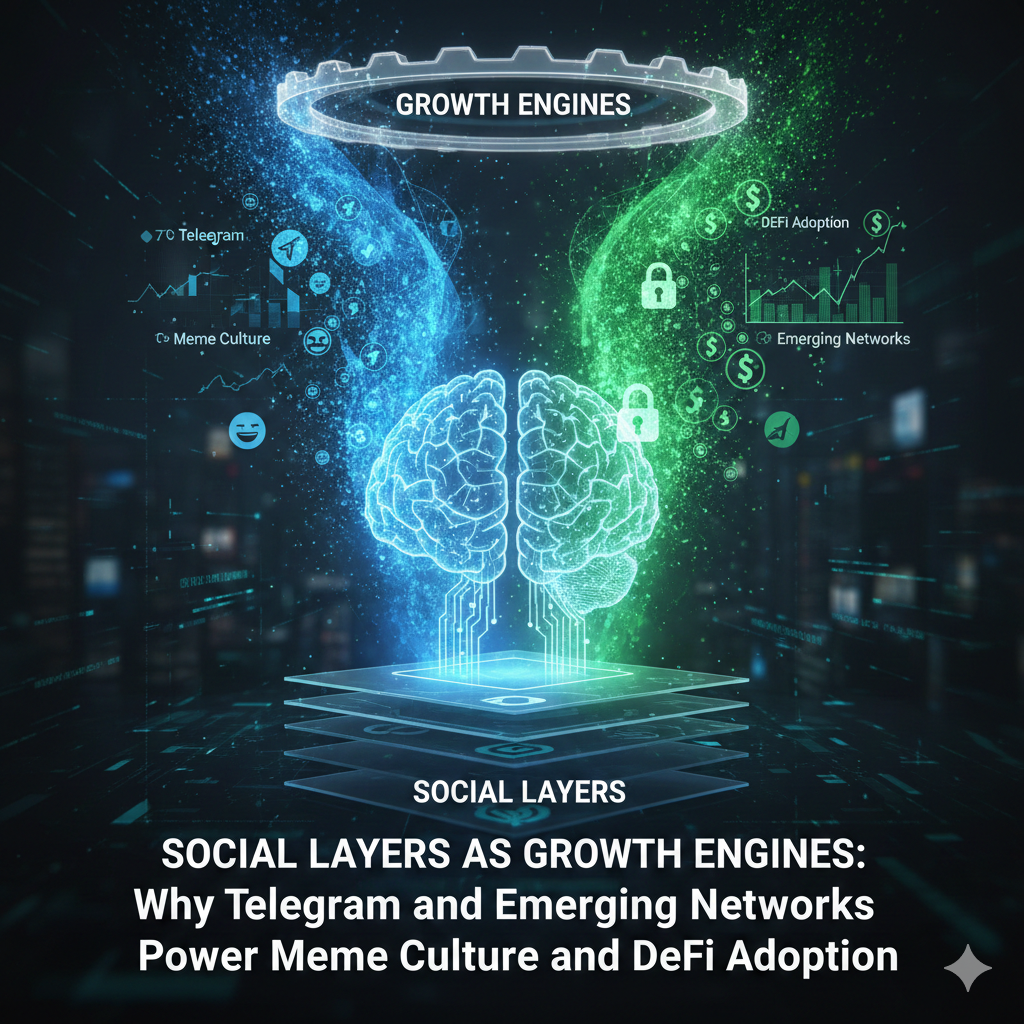
The Social Layer: Crypto’s Invisible Infrastructure
The social layer refers to the networks where users interact, coordinate, and form shared beliefs around projects. Unlike on-chain infrastructure, social layers are off-chain but no less important. They influence sentiment, behavior, and decision-making at scale.
Crypto-native users rarely discover projects through traditional media. Instead, they rely on:
Group chats and channels
Peer recommendations
Real-time discussion and feedback
Cultural signals like memes and inside jokes
Telegram, in particular, has emerged as a dominant force in this space, while newer platforms experiment with decentralized social coordination.
Why Social Context Matters More Than Ever
In permissionless systems, anyone can deploy a token or protocol. What differentiates successful projects is not access, but attention and trust. Social layers provide context — explaining why something matters, who is involved, and whether momentum is real or manufactured.
Without strong social infrastructure, even technically sound projects struggle to gain adoption.
Telegram as the Backbone of Meme Culture
Telegram has become the default communication layer for meme tokens and community-driven crypto projects. Its structure aligns perfectly with the fast-moving, high-energy nature of meme culture.
Telegram enables:
Instant broadcasting to thousands of users
High-frequency interaction without algorithmic filtering
Tight feedback loops between builders and communities
Viral spread of memes, screenshots, and narratives
Unlike mainstream social platforms, Telegram prioritizes immediacy and group identity over reach optimization.
Memes Thrive Where Friction Is Low
Meme culture depends on speed. A joke that lands today may be irrelevant tomorrow. Telegram’s real-time environment allows communities to create, remix, and propagate memes without delay. This makes it an ideal environment for cultural experimentation and rapid narrative shifts.
A deeper look at why Telegram remains central to meme-driven crypto communities can be found here:
https://kb.ape.store/why-telegram-remains-the-core-of-meme-culture-complete-guide-to-community-driven-crypto/
This dynamic explains why most meme token movements still originate or consolidate on Telegram before spreading elsewhere.
Beyond Memes: Social Layers and DeFi Adoption
While meme culture often gets the spotlight, the same social mechanics apply to DeFi adoption. Complex financial tools require explanation, trust, and peer validation — all of which happen more effectively in social environments than on static websites.
Telegram groups often serve as:
Onboarding hubs for new users
Informal support desks
Governance discussion spaces
Early warning systems for updates or risks
As DeFi matures, social layers evolve from hype engines into educational and coordination tools.
Farcaster and the Evolution of Social Coordination
Newer platforms like Farcaster experiment with decentralized identity, open social graphs, and censorship resistance. These features aim to solve limitations of centralized platforms while preserving social interaction.
Rather than replacing Telegram outright, these platforms add new dimensions to the social layer:
Portable identities across applications
More transparent reputation systems
Reduced reliance on centralized moderation
An analysis of how social layers like Telegram and Farcaster influence DeFi adoption is available here:
https://kb.ape.store/the-role-of-social-layers-farcaster-telegram-in-defi-adoption/
Together, these platforms illustrate how social infrastructure is diversifying rather than converging into a single channel.
How Social Layers Drive Trust and Momentum
Trust in crypto is rarely institutional — it is social. Users trust people they interact with regularly, recognize usernames, and observe over time. Social layers allow reputation to emerge organically through consistency and contribution.
Key trust drivers include:
Visible participation by builders
Transparent communication during volatility
Peer-to-peer knowledge sharing
Cultural continuity within communities
This trust directly impacts adoption, retention, and long-term engagement.
From Attention to Action
Social platforms convert attention into action. A meme shared in a group can lead to a trade. A pinned message can drive protocol usage. A discussion thread can influence governance decisions.
In this sense, social layers function as execution environments for collective behavior.
Designing for Community-First Growth
Projects that understand the importance of social layers design their growth strategies accordingly. Instead of focusing solely on marketing funnels, they invest in:
Community managers and moderators
Clear communication structures
Cultural consistency
Cross-platform social presence
Telegram often acts as the operational core, while other platforms extend reach and narrative depth.
The Future of Social-Driven Crypto Ecosystems
As crypto continues to evolve, the role of social layers will only expand. Meme culture and DeFi adoption are early indicators of a broader shift: finance becoming participatory, narrative-driven, and socially coordinated.
Telegram remains a foundational layer due to its simplicity and speed, while emerging networks explore decentralization and identity ownership. Together, they form a multi-layered social stack that powers modern crypto ecosystems.
Understanding this stack is no longer optional. For builders, marketers, and users alike, social layers are where adoption truly begins — long before anything happens on-chain.

Peyman Khosravani is a global blockchain and digital transformation expert with a passion for marketing, futuristic ideas, analytics insights, startup businesses, and effective communications. He has extensive experience in blockchain and DeFi projects and is committed to using technology to bring justice and fairness to society and promote freedom. Peyman has worked with international organizations to improve digital transformation strategies and data-gathering strategies that help identify customer touchpoints and sources of data that tell the story of what is happening. With his expertise in blockchain, digital transformation, marketing, analytics insights, startup businesses, and effective communications, Peyman is dedicated to helping businesses succeed in the digital age. He believes that technology can be used as a tool for positive change in the world.