Markets move fast, and every decision carries hidden risks. Traders who understand how to factor volatility, economic shifts, and human behaviour gain a real edge. With tools, analytics, and scenario planning, can you identify the risks that could make or break your next trade?
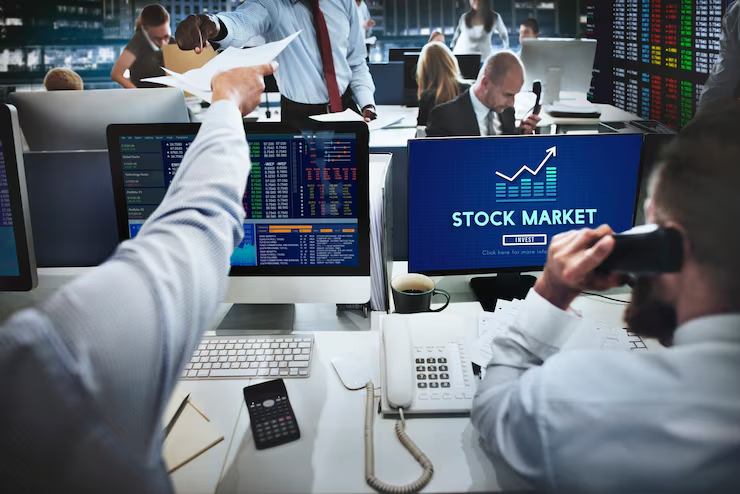
Every trader, from a retail investor to a hedge fund analyst, operates in a world shaped by uncertainty. Markets move not just because of numbers, but because of human behaviour, political decisions, and technological disruption. The art of trading is no longer just about predicting prices; it’s about understanding risk. Knowing how to factor risk into your financial decisions separates sustainable success from short-lived wins.
In the last five years alone, markets have faced unprecedented volatility. The pandemic-driven crash of 2020 saw the S&P 500 fall nearly 34% from February to March, while global equity markets lost over $30 trillion in value. Inflation shocks in 2022–2023 pushed U.S. consumer prices up by 9.1%, the highest in 40 years, and AI-fuelled rallies in 2024–2025 saw the Nasdaq 100 gain over 25% in just 12 months.
Each event has redefined what traders must watch, measure, and manage. For professionals today, the real question isn’t whether risk exists, but how to factor it intelligently before taking a position.
Understanding market risk in modern trading
Market risk refers to the potential loss a trader faces due to unfavourable market movements. It’s the heartbeat of every trading strategy, whether you’re holding equities, forex pairs, commodities, or crypto assets. Traders often mistake market risk for randomness. In truth, risk is measurable, predictable to some degree, and most importantly, manageable.
There are two major categories of market risk:
- Systematic risk, which affects the entire market, includes economic recessions, interest rate changes, or geopolitical conflicts.
- Unsystematic risk, which is specific to a company or sector, like a product failure, a regulatory fine, or a management scandal.
Modern trading systems have evolved to handle these through diversification, derivatives, and algorithmic tools.
Yet, the trader’s mindset remains central. The question always returns to: how to factor these risks in real time?
That means not just recognising potential triggers but assigning them probabilities, expected impacts, and recovery scenarios.
Today’s trading world is shaped by rapid data flow. Inflation reports, AI policy shifts, and currency fluctuations can move markets within seconds. Understanding the structure of risk, where it comes from, how it spreads, and when it peaks, gives traders an edge.
The main types of market risks every trader must recognise
Before deciding how to factor risk into a strategy, traders must know the risks they are dealing with:
- Interest Rate Risk: During the 2022–2023 tightening cycle, global bond portfolios lost trillions as yields rose sharply.
- Currency Risk: A U.S. investor holding Japanese stocks faces not only stock performance risk but also yen-dollar exchange rate changes.
- Inflation Risk: Persistent inflation erodes real returns. The US CPI peaked at 9.1% in 2022, prompting traders to hedge with gold or inflation-linked bonds.
- Geopolitical Risk: The Russia-Ukraine conflict in 2022 triggered oil prices to surge 45%, causing volatility across energy markets.
- Liquidity Risk: In low-volume markets, forced sales can magnify losses. During March 2020, some ETFs experienced bid-ask spreads widening by 200–300%.
- Market Sentiment Risk: Sudden shifts in trader psychology can trigger irrational market moves, as seen in meme stock rallies in 2021.
Recognising these risks is the first step; the next is applying structured thinking and understanding how to factor each into your daily trading framework.
Market risk metrics: Historical data & real impact
This table provides real metrics for traders to benchmark risk and understand the tangible impact of market events.
| Risk Type | Event / Year | Market Impact | Key Metric |
| Pandemic Crash | COVID-19, 2020 | Global equities lost ~$30 trillion | S&P 500 fell 34% (Feb–Mar) |
| Inflation Shock | 2022–2023 | US CPI rose 9.1%, equities and bonds corrected sharply | US Treasury yields +2.5% |
| Interest Rate Hike | 2022–2023 | Global bond portfolios lost trillions | 10Y Treasury yield +150 bps |
| Geopolitical Shock | Russia-Ukraine Conflict, 2022 | Energy markets volatile, oil prices spiked | Brent crude +45% |
| AI-Fuelled Rally | 2024–2025 | Tech stocks soared, Nasdaq 100 +25% | Nasdaq 100 12-month gain +25% |
How to factor in market volatility
Volatility is the pulse of every market. It tells traders how much and how fast prices move. While some see it as chaos, experienced traders view volatility as an opportunity, provided they know how to factor it correctly into their risk model.
The most common way to measure volatility is through the VIX index, often called the “fear gauge.” It reflects the expected volatility of the S&P 500 over the next 30 days. When the VIX rises, uncertainty grows; when it falls, markets are calm. But beyond the VIX, traders use tools such as Average True Range (ATR), Bollinger Bands, and historical volatility to gauge market conditions.
To manage volatility effectively:
- Adjust position sizes during high volatility periods to protect capital.
- Use trailing stops instead of fixed ones, allowing trades to breathe.
- Diversify exposure across asset classes that move differently during turbulent times.
For example, when global equities plunge, gold and U.S. Treasury bonds often rise. By learning how to factor these correlations and volatility levels together, traders can shield themselves from extreme drawdowns.
Volatility isn’t a signal to step back; it’s a signal to act with discipline and awareness. The traders who thrive are those who prepare for volatility before it happens, not after.
How to factor in economic indicators and global events
Macroeconomic data drives the rhythm of every market. GDP growth, employment numbers, inflation rates, and interest decisions all influence trader sentiment and asset performance. Knowing how to factor these signals into trading decisions separates reactive traders from strategic ones.
For instance:
- A rise in inflation often triggers central banks to tighten policy, pushing bond yields higher and equities lower.
- Strong employment data might boost currencies tied to economic growth, such as the U.S. dollar or Australian dollar.
- Weak manufacturing output could weigh on commodities like oil or copper.
Traders who align their strategies with macro trends — rather than fighting them — find themselves on the right side of momentum more often.
Here’s a practical process:
- Track economic calendars from sources like Trading Economics or Forex Factory.
- Watch central bank communications, as language shifts can signal future rate changes.
- Combine macro data with sentiment analysis, using AI-powered platforms that scan real-time news and social media for tone and frequency.
The goal isn’t to predict every outcome, it’s to prepare for plausible ones. A trader who knows how to factor major global events into their portfolio design is less likely to be blindsided by sudden shocks.
How to factor in asset correlations
One of the most overlooked aspects of market risk management is correlation — how different assets move in relation to one another. Many traders assume diversification automatically reduces risk. But diversification only works if assets aren’t moving in the same direction at the same time.
To understand how to factor correlation risk, consider this: during global crises, correlations often rise. Stocks, crypto, and commodities that usually behave independently can suddenly move together as investors rush to safety.
For example:
- When equities fall sharply, U.S. Treasury bonds and gold typically rise.
- Oil prices may move inversely to airline stocks.
- Bitcoin once moved opposite to traditional markets but has recently shown a higher correlation with tech stocks.
Professional traders monitor correlation matrices using portfolio analysis tools. By doing so, they can balance portfolios between risk-on and risk-off assets. A portfolio that includes equities, commodities, currencies, and defensive instruments like bonds or cash equivalents tends to weather volatility better.
Understanding how to factor correlations ensures your portfolio doesn’t collapse when markets move together unexpectedly. The goal isn’t to avoid correlation, it’s to control its impact through smart allocation and hedging.
How to factor in technical and fundamental analysis together
Trading success rarely comes from relying on one side of the analytical spectrum. Technical analysis and fundamental analysis are like two lenses; each reveals something different about market behaviour. Knowing how to factor both effectively helps traders build balanced, evidence-based decisions.
Technical analysis focuses on price action, patterns, and momentum. It answers the question: What is happening in the market right now?
Fundamental analysis, meanwhile, explores why the market is behaving a certain way — examining earnings, interest rates, macroeconomic data, and company performance.
Let’s take an example. Suppose gold prices are trending upward on technical charts, forming higher highs and higher lows. However, the Federal Reserve signals interest rate hikes, a fundamentally bearish factor for gold. A trader who understands how to factor both sides will avoid blind optimism. Instead, they might wait for confirmation from both technical momentum and macro data before committing capital.
In practice:
- Use technical indicators (e.g. RSI, MACD, moving averages) for entry and exit timing.
- Use fundamentals (e.g. economic data, earnings, and central bank guidance) to confirm the direction.
- Blend them within a risk-adjusted strategy that weighs both logic and probability.
The synergy between the two is what creates consistency. When technical setups align with strong fundamentals, trades have higher conviction — and lower risk exposure.
How to Factor Risk Management Tools into Your Trading System
Risk management is the foundation that holds every trading system together. Without it, even the most brilliant strategy can crumble under volatility. Knowing how to factor structured risk tools ensures long-term survival and sustainable growth.
Key tools and methods include:
- Stop-Loss and Take-Profit Orders: These act as automatic brakes, protecting profits and limiting losses without emotional interference.
- Trailing Stops: Ideal during trending markets. They lock in profit as price moves in your favour, while still giving trades breathing room.
- Position Sizing: Professional traders rarely risk more than 1–2% of capital per trade. This ensures that a losing streak doesn’t wipe out the account.
- Risk-to-Reward Ratio: Every trade should offer a minimum ratio of 1:2, risking one unit to gain two. Over time, this ensures profitability even with moderate win rates.
- Portfolio Diversification: Spread capital across instruments and sectors to avoid concentration risk.
- Regular Portfolio Review: Rebalance positions according to market changes, correlations, and new opportunities.
Traders who master how to factor these tools into a unified system don’t just react to risk; they anticipate it. This proactive approach transforms risk management from a safety net into a strategic advantage.
Conclusion: The art of factoring risk for smarter decisions
Trading isn’t just about chasing profits; it’s about managing probabilities. Every trade carries risk, and every risk carries lessons. By understanding how to factor volatility, macro trends, technology, and psychology together, traders can transform uncertainty into informed opportunity.
The smartest traders don’t avoid risk; they embrace it intelligently. They measure, monitor, and manage exposure with discipline. They build systems grounded in data yet guided by intuition. And most importantly, they never stop learning from the markets they operate in.
The next generation of trading success will belong to those who can balance logic with adaptability, those who see risk not as a threat, but as information. Mastering how to factor market risks isn’t just a skill; it’s a mindset. And it’s the mindset that defines smarter financial decisions in every market condition.

Shikha Negi is a Content Writer at ztudium with expertise in writing and proofreading content. Having created more than 500 articles encompassing a diverse range of educational topics, from breaking news to in-depth analysis and long-form content, Shikha has a deep understanding of emerging trends in business, technology (including AI, blockchain, and the metaverse), and societal shifts, As the author at Sarvgyan News, Shikha has demonstrated expertise in crafting engaging and informative content tailored for various audiences, including students, educators, and professionals.