
From the ancient barter system to Bitcoin’s blockchain revolution, finance has shaped empires, sparked crises, and fueled global growth! Did you know the stock market is now worth $128T, while crypto surged to $3.8T? What gave rise to the need for trading? What were the challenges that navigated the world of finance from traditional systems to the current digital economies, especially the rising trends of cryptocurrencies?

Have you ever wondered how we went from swapping goats and grains to trading stocks and crypto currencies.?
People have always been fascinated by money, so am I, not just the coin in my pocket but the story behind how we trade, invest and build fortunes.
The journey of finance and trading is nothing short of fascinating, full of bold innovations, spectacular failures, and game-changing ideas that have shaped the world as we know it.
Imagine, ancient merchants in Mesopotamia writing down debts on clay tablets, powerful bankers like the Medici in the Renaissance changing the future of Europe, and the fast-paced, intense world of today’s stock markets where computers trade in seconds.
Now, here we are today.
The stock market reached $128.2 trillion in 2025, with the United States housing 20 of the world’s largest exchanges, including the iconic New York Stock Exchange.
The cryptocurrency market has surged to a capitalisation of $3.8 trillion, largely driven by the rise of digital assets like Bitcoin.
Today, the financial services market is valued at over $33 trillion and is projected to grow at a steady rate of 7.4% annually, highlighting the crucial role finance plays in shaping both local and global economies.
But over time financial systems faced many challenges such as panics, wars and crashes. Each time new rules are created to fix things such as the central bank and the Basel III rule.
But how did we get here?
Why did financial systems develop the way they did, and what forces drove these changes?
The Origins of Banking Systems
Financial systems began to emerge in ancient civilisations as humans attempted to find ways to manage trade and resources. The earliest forms of finance were rooted in the barter system, where goods were exchanged directly. In Mesopotamia, as early as 2000 BCE, clay tablets were used to record transactions, debts, and promises. This laid the foundation for credit systems in early trading networks.
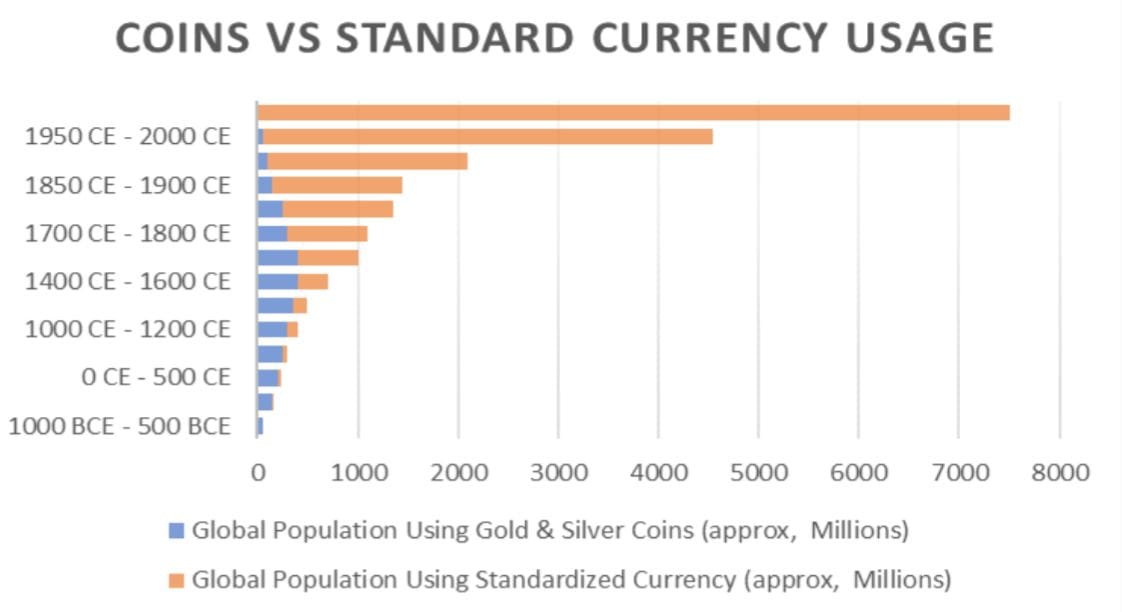
Around 600 BCE, the Lydians of Asia Minor revolutionised finance with the introduction of gold and silver coins. This invention standardised currency and facilitated more efficient transactions.
Raymond Goldsmith, in his work Financial Structure and Development, has emphasised the importance of these instruments, noting how they fostered the flow of capital across Europe and the Middle East.
Development of banking systems
Banking originated around 2000 BCE in ancient Mesopotamia, where temples and palaces served as early depositories for valuables like grain and metals. These institutions also offered loans, charging interest on commercial and agricultural activities. In Babylon, the Code of Hammurabi established some of the first laws governing lending and interest, forming the legal basis for early banking.
Banking in its early forms relied heavily on trust, often managed by priests or wealthy merchants. In Renaissance Italy, particularly in Florence, families like the Medici became pioneers of modern banking.
By the 18th century, the Bank of England, founded in 1694 to finance the British government’s military expenditures, became a model for central banking. The Bank of England’s success laid the groundwork for the modern financial system, establishing a crucial role in managing public debt and regulating credit.
The rise of stock exchanges
The early 18th century saw a dramatic shift in the way businesses raised capital. The Dutch East India Company, founded in 1602, was the world’s first joint-stock company, allowing investors to pool their resources and share the risks and rewards of long-distance trade. This model spread rapidly, facilitating large-scale enterprises and establishing the foundations for modern capitalism.
As more joint-stock companies emerged, the need for a market to trade shares became apparent. In 1602, the Amsterdam Stock Exchange was founded as the world’s first formal stock exchange, providing a structured platform for the buying and selling of shares.
The British followed suit in 1698 with the establishment of the London Stock Exchange, which soon became one of the largest and most influential financial markets in the world. As economic historian Ranald Michie observed, the history of stock exchanges is essentially a history of capitalism in action, marked by innovation, risk, and reward.
Financial crises: The dark side of speculation
The rise of stock exchanges and joint-stock companies also exposed markets to significant risks. Speculative bubbles, such as Tulip Mania in the 1630s Netherlands, revealed the dangers of unchecked speculation.
- The South Sea Bubble- The South Sea Bubble of 1720 serves as one of the most notorious examples of financial collapse. The South Sea Company, granted a monopoly on British trade with South America, became a speculative target. When its promises fell short, the bubble burst, ruining many investors. As financial historian Charles P. Kindleberger noted, “Financial crises are a recurring part of capitalist economies, where speculative bubbles always seek new heights only to collapse under their own weight.”
- The Panic of 1907 and the Birth of Central Banks- The Panic of 1907 in the United States, triggered by a loss of confidence in the banking system, led to widespread panic and financial instability. The creation of the Federal Reserve in 1913 was a direct response to this crisis, providing the U.S. with a central institution to act as a lender of last resort during times of financial instability.
The role of central banks and public finance
Central banks evolved from mere instruments of government to critical players in regulating economies. The Bank of England, originally set up to finance wars, became essential in managing the money supply and stabilising economies. The Federal Reserve, which came into existence following the Panic of 1907, has played a pivotal role in managing monetary policy, controlling inflation, and stabilising financial markets.
Peter Temin and Hans-Joachim Voth argue in their work on British monetary history that “Interest rates and money supply during the early industrial age had profound impacts on economic and political developments.”
The emergence of government bonds – During World War I, the U.S. and European nations issued war bonds to finance their military efforts. This marked a shift towards public involvement in government finance, where citizens participated in national financial matters. These bonds became a staple of sovereign debt, used by governments to manage fiscal deficits and stimulate economic growth.
Nathan Sussman, in his study of financial crises and trade, highlights that “Crises in finance have historically had ripple effects that transcend national borders, affecting trade, investment, and global stability.”
The growing interconnectedness of finance, trade, and politics meant that central banks and financial markets were no longer limited to domestic concerns but were part of an increasingly globalised financial system. This integration of global financial markets continues to shape economic stability and growth worldwide.
Globalisation of finance and the evolution of financial institutions
By the late 19th century, the global economy had begun to expand rapidly, spurred by the Industrial Revolution. The demand for capital to fund large-scale projects led to the rise of multinational corporations and the expansion of cross-border financial services.
The Bretton Woods Agreement- The Bretton Woods Conference of 1944 played a significant role in the development of the post-war global financial system. The establishment of the International Monetary Fund (IMF) and the World Bank helped coordinate international finance, fostering economic recovery and facilitating global trade. The Bretton Woods system also aimed to ensure exchange rate stability, which was crucial for the stability of global markets.
Some of the biggest transactions of IMF after World War II
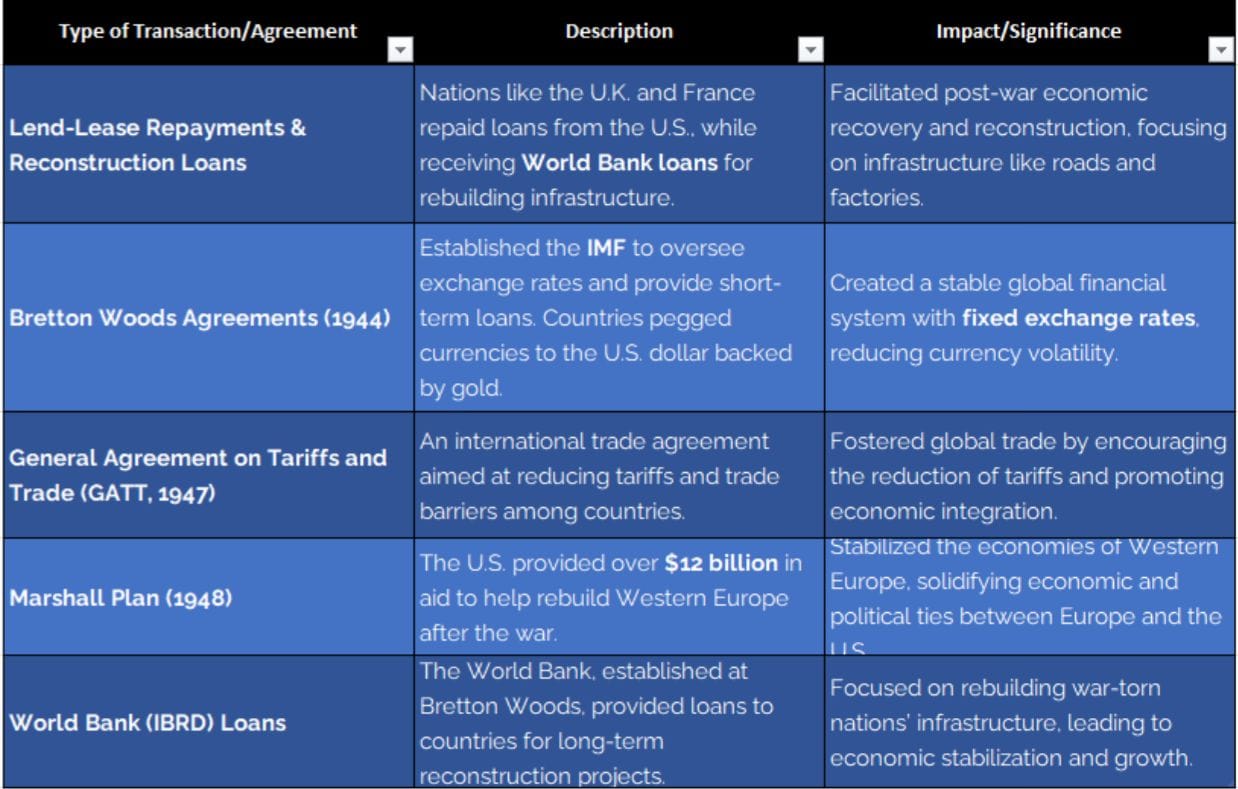
Today, the IMF provides short-term financial assistance to countries facing balance of payments problems, while the World Bank focuses on long-term economic development projects. Together, they aim to create a more stable and integrated global economy.
As globalisation progressed, the world saw a meteoric rise of multinational corporations and cross-border investments, ultimately leading to the integration of markets.
However, this made financial systems more susceptible to global shocks. Niall Ferguson, in his work The Cash Nexus, explores how finance has consistently been a lever of power in global affairs, arguing that “Money is not simply a medium of exchange; it’s a key lever of power, determining the fates of nations and empires.”
The Financial crises of the late 20th century
The 1997 Asian Financial Crisis and the 2008 Global Financial Crisis highlighted the vulnerabilities in an increasingly globalised financial system. The Global Financial Crisis, in particular, revealed the risks inherent in modern finance and led to significant changes in financial regulation.
Basel III Regulations
In response to the 2008 crisis, the Basel III framework was introduced to strengthen bank capital requirements and improve risk management. The framework included higher capital requirements, a leverage ratio to curb excessive borrowing, and a Liquidity Coverage Ratio (LCR) to ensure banks could handle short-term liquidity pressures. These measures aimed to prevent a repeat of the crisis and make the financial system more resilient.
Globalisation of finance
By the late 19th century, the world economy had entered a period of rapid globalisation, driven by the Industrial Revolution. This era saw the rise of multinational corporations and an increased demand for capital to fund large-scale production and trade. The globalisation of finance accelerated further during and after World War II, as countries sought to rebuild war-torn economies and finance large-scale public works.
The Bretton Woods Conference of 1944 laid the foundation for the post-war global financial system, establishing institutions like the International Monetary Fund (IMF) and the World Bank to coordinate international finance and economic development. These institutions played a key role in rebuilding economies and fostering financial cooperation across borders.
As globalisation progressed, the rise of multinational corporations and cross-border investments led to the integration of financial markets. However, this interconnectedness also made financial systems more vulnerable to global shocks, as demonstrated by the Asian Financial Crisis of 1997 and the Global Financial Crisis of 2008.
Electronic trading and market changes
One of the most significant transformations in finance occurred with the introduction of electronic trading in the 1980s and the rise of high-frequency trading (HFT) in the 21st century. As William N. Goetzmann, a financial historian, points out, these technological advancements reduced transaction costs and increased liquidity in financial markets.
The development of computerised trading platforms allowed investors to execute trades in milliseconds, dramatically reshaping market dynamics and creating new trading strategies.
However, the rise of electronic trading also introduced new risks. The most notable example of this was the Flash Crash of 2010, when HFT algorithms caused a sudden and dramatic drop in U.S. stock prices. This event raised serious concerns about the stability and fairness of modern markets, leading to increased regulatory scrutiny of trading practices.
The rise of electronic trading also gave birth to the concept of fintech, with innovations such as peer-to-peer lending, robo-advisors, and cryptocurrencies.
The Emergence of Cryptocurrencies
The rise of cryptocurrencies, particularly Bitcoin, has sparked debates about the future of money and finance. Cryptocurrencies operate on decentralised networks powered by blockchain technology, offering secure, transparent, and low-cost transactions without the need for traditional financial intermediaries.
While cryptocurrencies present opportunities for financial inclusion and innovation, they also pose challenges for regulators. As financial systems continue to evolve, the role of cryptocurrencies and blockchain technology remains uncertain, with potential risks and rewards that need to be carefully managed.
Finance and Trading: A story of evolution
The history of finance and trading is a story of innovation, risk, crisis, and recovery. From the early use of clay tablets and promissory notes to today’s digital trading platforms and global financial institutions, the evolution of finance has been all about managing uncertainty and helping trade happen across borders.
John R. Hicks, in his important work on economic history, said it best: “Economic history is a vital tool for understanding the dynamics of financial systems and their evolution over time.”
Looking ahead, with the rise of cryptocurrencies and blockchain technology, it’s clear that finance will keep evolving, adjusting to new challenges and opportunities. The lessons we’ve learned from the past—both the good and the bad—will be crucial as we navigate the complex world of modern finance.
In today’s world, where financial markets are more connected than ever, understanding the history of finance gives us valuable insights into how power, risk, and economic growth work together. As we move forward, we need to stay aware of the lessons history teaches us about the importance of regulation, transparency, and ethical conduct in financial markets.

Dinis Guarda is an author, academic, influencer, serial entrepreneur and leader in 4IR, AI, Fintech, digital transformation and Blockchain. With over two decades of experience in international business, C level positions and digital transformation, Dinis has worked with new tech, cryptocurrencies, drive ICOs, regulation, compliance, legal international processes, and has created a bank, and been involved in the inception of some of the top 100 digital currencies.
Dinis has created various companies such as Ztudium tech platform a digital and blockchain startup that created the software Blockimpact (sold to Glance Technologies Inc) and founder and publisher of intelligenthq.com, hedgethink.com, fashionabc.org and tradersdna.com. Dinis is also the co-founder of techabc and citiesabc, a digital transformation platform to empower, guide and index cities through 4IR based technologies like blockchain, AI, IoT, etc.
He has been working with the likes of UN / UNITAR, UNESCO, European Space Agency, Davos WEF, Philips, Saxo Bank, Mastercard, Barclays and governments all over the world.
He has been a guest lecturer at Copenhagen Business School, Group INSEEC/Monaco University, where he coordinates executive Masters and MBAs.
As an author, Dinis Guarda published the book 4IR: AI, Blockchain, FinTech, IoT, Reinventing a Nation in 2019. His upcoming book, titled 4IR Magna Carta Cities ABC: A tech AI blockchain 4IR Smart Cities Data Research Charter of Liberties for our humanity is due to be published in 2020.
He is ranked as one of the most influential people in Blockchain in the world by Right Relevance as well as being listed in Cointelegraph’s Top People In Blockchain and Rise Global’s The Artificial Intelligence Power 100. He was also listed as one of the 100 B2B Thought Leaders and Influencers to Follow in 2020 by Thinkers360.