
Looking to find the best trading system forex for 2026? The forex market is huge, and figuring out the right way to trade can feel overwhelming. It’s not about finding one magic bullet, but more about understanding different approaches and seeing what fits you. We’ll break down some of the most popular and effective forex trading strategies out there, helping you get a clearer picture of what might work best for your trading style. It’s about building a plan, not just guessing.
Key Takeaways
- The ‘best forex trading strategy’ isn’t a one-size-fits-all answer; it’s the one you can follow consistently with discipline.
- Trend trading, range trading, breakout trading, and scalping are core strategies that form the basis for many trading systems.
- Combining different strategies, like trend following with retracement levels, can refine your approach.
- Algorithmic trading offers emotion-free execution but requires technical skill and thorough testing.
- Solid risk management, including stop-losses and position sizing, is fundamental to any successful forex trading system.
1. Trend Trading
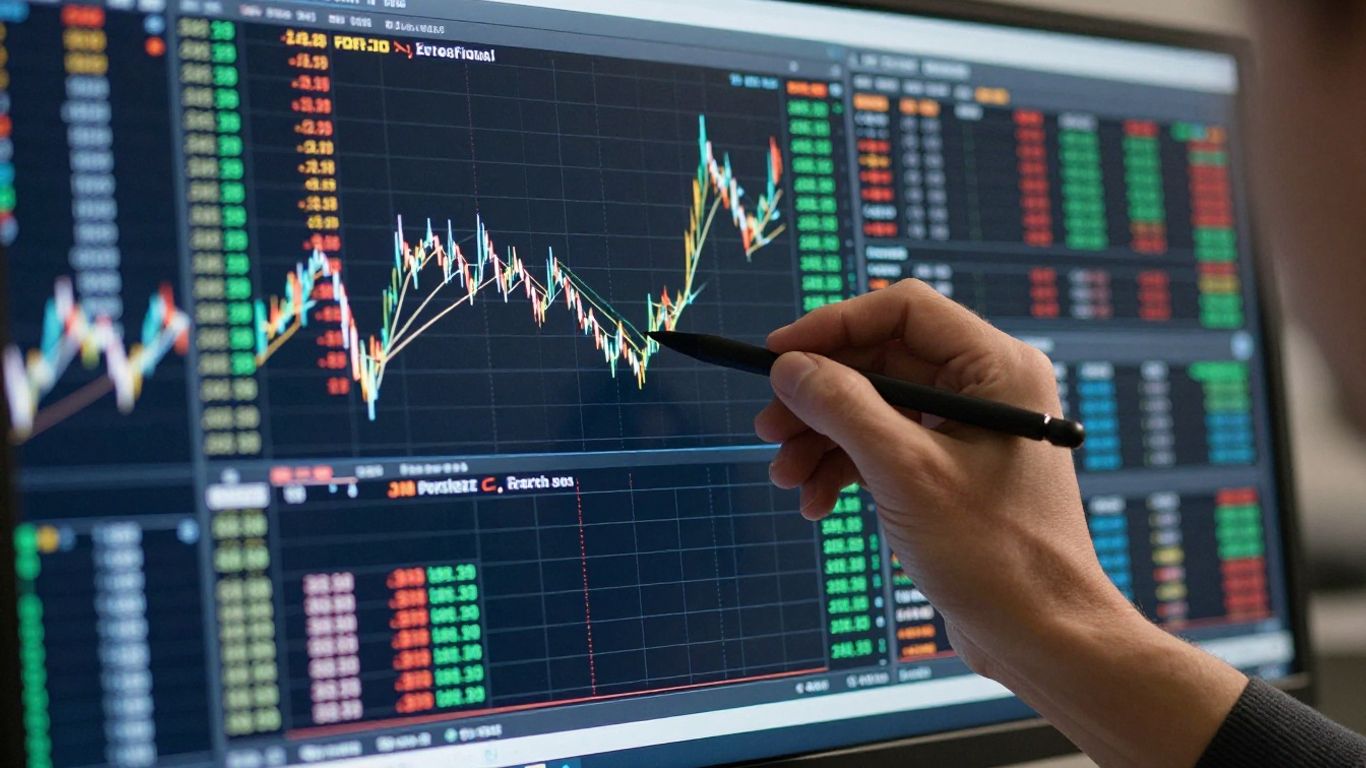
Trend trading is all about picking a direction and sticking with it for as long as the trend keeps rolling. The main idea is to buy when prices are showing higher highs, or sell when they’re hitting lower lows. Sounds pretty clear-cut, and honestly, that’s one of its biggest appeals for people who just want some structure. The most popular tools you’ll run into with trend trading are moving averages, the MACD, and the ADX—these help spot whether things really are moving in a particular direction or just wobbling sideways.
Most folks find trend trading helpful because it doesn’t ask you to guess what’ll happen next—it just has you going with the flow. Here’s what that usually looks like:
- You wait for the trend to show up, confirmed by your chosen indicator
- Enter the trade after a pullback or when a critical level breaks
- Set stop-losses based on key price levels or moving averages to avoid big surprises
- Let the trade ride until there are obvious signs the trend is fading
| Pros | Cons |
|---|---|
| Simple to understand | Can give false signals if the market chops sideways |
| Can capture big moves | Requires patience and solid nerves |
Market trends can last a lot longer than you expect, and that can mean decent wins with fewer trades—if you’re patient enough to sit tight and not jump ship too soon.
Trend trading isn’t foolproof, but it’s a steady approach for people who like having clear steps instead of constant guessing.
2. Range Trading
Sometimes, the market just isn’t moving in a clear direction. Prices can get stuck, bouncing back and forth between a high point and a low point for a while. This is where range trading comes in. The basic idea is pretty simple: buy when the price hits the bottom of its range and sell when it hits the top. You’re basically betting that the price will keep bouncing within these boundaries until something big happens to push it out.
Think of it like a ball bouncing between the floor and the ceiling. You know it’s going to come back down after hitting the ceiling, and it’ll go back up after hitting the floor. Range traders look for these predictable patterns.
Here’s a quick rundown of how it generally works:
- Identify the Range: First, you need to spot the support (the low boundary) and resistance (the high boundary) levels. These are price points where the currency pair has repeatedly stopped falling or stopped rising.
- Entry Points: When the price approaches the support level, a range trader might look to buy. Conversely, when the price nears the resistance level, they might consider selling.
- Exit Strategy: The goal is to exit the trade as the price moves towards the opposite boundary of the range. Stop-loss orders are usually placed just outside the identified range to limit losses if the price breaks out unexpectedly.
Tools like the Relative Strength Index (RSI) or Stochastic Oscillator can help. If the RSI is low (say, below 30), it might signal the price is oversold and due for a bounce up from the support. If it’s high (above 70), it could suggest the price is overbought and might fall from the resistance.
This strategy works best when the market is calm and not trending strongly in one direction. It requires patience and a good eye for spotting those horizontal price channels. The main risk is a breakout, where the price suddenly moves beyond the established range, potentially leading to losses if you’re caught on the wrong side.
While it sounds straightforward, successfully trading ranges requires careful observation and strict risk management. You can’t just assume the range will hold forever. Eventually, a breakout will happen, and you need to be prepared for that possibility.
3. Breakout Trading
Breakout trading is all about catching the start of a new move. The idea here is pretty straightforward: you wait for the price to move past a key level, like a support or resistance line, and then you jump in, expecting that move to keep going. It’s exciting because you’re trying to get in on the ground floor of a potential trend.
The core principle is that when price breaks through a defined boundary, it often carries momentum in that direction.
Here’s a quick look at how it generally works:
- Identify Key Levels: This involves spotting clear support and resistance zones, trendlines, or even chart patterns like triangles or flags.
- Wait for the Break: You don’t enter until the price actually closes beyond that identified level. Patience is key here.
- Enter the Trade: Once the breakout is confirmed, you enter a trade in the direction of the break.
- Set Stops: A stop-loss order is usually placed just on the other side of the broken level to limit losses if it turns out to be a false move.
Tools that traders often use to spot these opportunities include volume indicators (to see if the breakout has conviction), volatility meters (like the Average True Range or ATR), and simple price action analysis. Sometimes, traders will also use pivot points or Fibonacci levels to define these critical zones.
The biggest challenge with breakout trading is dealing with false breakouts. These are moments when the price briefly moves past a level but then quickly reverses, trapping traders who entered too early. Adding filters, like requiring a certain amount of volume or waiting for a specific time of day, can help reduce these false signals, but it’s never a perfect science.
4. Scalping
Scalping is all about making a lot of trades, really fast. The idea is to grab tiny profits, like a few pips here and there, over and over again throughout the day. You’re not looking to hit a home run; you’re looking to get a bunch of singles. This strategy demands extreme focus and quick decision-making.
Traders who scalp usually hang out on the 1-minute or 5-minute charts. They’re all about precision, using tight stop-losses to cut off any potential losses quickly and setting small profit targets. It’s a high-octane approach.
Here’s a quick look at what scalping involves:
- Timeframe: Typically 1-minute or 5-minute charts.
- Profit Target: Small, often 5-15 pips per trade.
- Stop-Loss: Very tight to manage risk on each quick trade.
- Frequency: Dozens, sometimes hundreds, of trades per day.
- Tools: Short-term moving averages, RSI, and momentum indicators are common.
Scalping really shines when the market is active, like during the London or New York trading sessions. That’s when you get the price swings you need to make those small profits.
The biggest hurdle with scalping is the transaction costs. With so many trades happening, the spread and any commissions can really add up. You need to be sure your winning trades are consistently bigger than these costs, or you’ll find yourself losing money even if you’re right about the price moves most of the time. Plus, you’ve got to have the nerves of steel to handle the constant action and make split-second calls.
It’s not for everyone, especially if you’re just starting out or prefer a more relaxed pace. But for those who thrive on action and can react instantly, scalping can be a way to stay busy and potentially rack up profits through sheer volume.
5. Retracement Trading
Retracement trading is all about catching a ride on a trend that’s already moving, but waiting for a little pause before jumping in. Think of it like this: a strong move happens, and then the price takes a short breath before continuing. That’s your chance. The goal is to enter a trade during this temporary pullback, expecting the original trend to pick back up. It’s a popular method because it often offers a better entry point than chasing a price that’s already moved a lot.
Here’s a basic idea of how it works:
- Identify a Trend: First, you need to see a clear trend. Is the price generally moving up (higher highs and higher lows) or down (lower highs and lower lows)?
- Wait for a Pullback: Don’t jump in immediately. Wait for the price to move against the trend for a bit. This is the retracement.
- Look for Entry Signals: This is where tools come in handy. Many traders watch for the price to pull back to specific Fibonacci levels, like 38.2%, 50%, or 61.8% of the previous move. Others look for candlestick patterns that suggest the pullback is over.
- Enter and Set Stops: Once you see signs the trend is resuming, you enter the trade. It’s smart to place a stop-loss order just beyond the low of the pullback (if you’re buying) or the high (if you’re selling) to limit potential losses.
Some traders like to use the Fibonacci retracement tool for this. It’s a set of horizontal lines that indicate potential support and resistance levels based on mathematical ratios. When a trend pulls back to one of these levels and shows signs of reversing, it can be a good entry signal.
This strategy works best when you can clearly see an established trend. Trying to catch a retracement in a choppy, directionless market can lead to a lot of frustration and losing trades. Patience is definitely key here; you have to wait for the right setup.
While it can offer a good risk-to-reward ratio because your entry is often closer to the start of the next leg of the trend, there’s always a risk the pullback isn’t just a pause but a full reversal. That’s why using stop-losses is so important.
6. Momentum Trading
Momentum trading is all about riding the wave. The idea here is pretty straightforward: you want to buy assets that are already moving up strongly and sell assets that are already moving down strongly. The core principle is that an asset that has been moving in a certain direction is likely to continue moving in that direction for a while. It’s not about predicting the future; it’s about identifying what’s happening now and jumping on board.
This strategy works best in trending markets, whether those trends are up or down. When a currency pair starts gaining steam, momentum traders aim to catch as much of that move as possible. They aren’t usually looking for the absolute top or bottom, but rather for the middle part of a strong move.
Here’s a quick look at how it often plays out:
- Identify a Strong Trend: Look for clear upward or downward movement on your charts. This could be indicated by higher highs and higher lows (for an uptrend) or lower highs and lower lows (for a downtrend).
- Use Momentum Indicators: Tools like the Relative Strength Index (RSI), MACD (Moving Average Convergence Divergence), or even a simple Rate of Change indicator can help confirm the strength of the current move. Readings that are consistently high (for an uptrend) or low (for a downtrend) can signal strong momentum.
- Enter the Trade: Once you see a trend confirmed by indicators, you enter the trade in the direction of the trend. Some traders wait for a small pullback within the trend before entering, while others jump in as soon as momentum is confirmed.
- Manage Your Exit: This is key. Momentum can fade quickly. Traders often use trailing stop-losses to protect profits as the trend continues, or they might exit when momentum indicators start showing signs of weakening or divergence.
Momentum trading can be exciting because you’re often in trades that are moving decisively. However, it also means you need to be quick. When the momentum stops, you need to get out fast, or you could see your profits disappear just as quickly as they appeared. It requires a good sense of timing and a disciplined approach to exits.
It’s a strategy that can be quite profitable when markets are trending strongly, especially after major news events that can kickstart a significant move. But be warned, in choppy or sideways markets, momentum strategies can lead to a lot of small losses as trends fail to materialize.
7. News Trading
News trading in forex is all about catching the price action that explodes right after major news releases—think interest rate decisions, GDP numbers, or big employment reports. Quick moves and volatility spikes are the name of the game here.
There’s no waiting around in news trading: you’ve got to be fast, decisive, and ready for sudden swings in both directions. Many traders keep economic calendars with all the important announcement times clearly marked. The goal is to either jump on the initial market reaction or, sometimes, try to catch a reversal once that wild first wave calms down.
Common steps for news trading:
- Identify key news events (central bank statements, inflation, NFP, etc.).
- Set up risk controls like tight stop-losses—protection is vital since spreads often widen massively during news.
- Watch the price reaction and either trade the breakout or wait for a pullback if things get too crazy.
| Major News Events | Typical Volatility (Pips) |
|---|---|
| US Non-Farm Payrolls | 50-100 |
| Central Bank Decisions | 40-90 |
| CPI / Inflation Reports | 30-60 |
| GDP Releases | 20-50 |
It’s wild, but that’s why some traders love it. You’ll also find that seasonal patterns in forex can sometimes add clues about whether big news will have even more impact than usual.
I can tell you, trading the news is unlike anything else in forex—it’s a rush, sometimes frightening, but when your plan works, there’s nothing more satisfying. Just remember: news trading is not for folks who hate chaos, and risk can spike in the blink of an eye.
8. Algorithmic Trading
Algorithmic trading, often called algo trading, is basically using computer programs to make trades for you. Instead of sitting there watching charts and clicking buttons, you set up rules, and the computer follows them. It’s pretty wild to think about, but these systems can process market data way faster than any human ever could, spotting opportunities across different currency pairs all at once.
The big draw here is consistency; algorithms don’t get tired, they don’t get emotional, and they don’t second-guess themselves. They just do what you told them to do, 24/5. It’s no wonder that research shows these automated systems are handling a huge chunk of all forex trading volume these days.
Here’s a quick look at how these systems generally work:
- Signal Generation: This is the brain. It looks at all the market info – prices, news, indicators – and figures out if there’s a trade to be made based on your strategy. It needs to be fast, often processing things in under 10 milliseconds.
- Risk Management: Before any trade happens, this part checks if it’s a good idea. It figures out how much to trade, sets stop-losses, and makes sure you’re not putting too much money into one single trade.
- Execution Module: This is the part that actually places the trade with your broker. It needs a really quick connection to the broker’s servers to avoid issues like slippage, especially for strategies that need exact entry points.
Think of it like this:
You define a set of conditions, like ‘if the 50-day moving average crosses above the 200-day moving average and the RSI is below 70,’ and the program automatically enters a buy order. It’s about removing the human element from the actual execution, which can be a huge advantage.
Getting started with algo trading can seem a bit daunting, but it’s becoming more accessible. You can build your own using languages like MQL, or you can find pre-built systems, often called Expert Advisors, that you can customize. For serious traders, using a Virtual Private Server (VPS) is pretty much a must. It keeps your algorithms running smoothly without relying on your home computer or internet connection, which is super important for consistent performance. If you’re looking to automate your trading and explore proven algorithmic trading strategies, this is definitely the way to go.
9. Mean Reversion Trading
Mean reversion trading is a strategy that operates on the idea that prices, after moving away from their average, tend to return to that average. Think of it like a rubber band; stretch it too far, and it snaps back. In forex, this means looking for currency pairs that have experienced a significant move in one direction, pushing them to extremes, and betting that they’ll reverse and head back towards their historical average price.
The core principle is that extreme price movements are often temporary.
How do you spot these opportunities? Traders often use technical indicators to identify when a currency pair might be overextended. Some common tools include:
- Bollinger Bands: When prices consistently hug the upper or lower band, it might signal an overbought or oversold condition, respectively. A move back towards the middle band (the moving average) is the expected reversion.
- Relative Strength Index (RSI): Readings above 70 are typically considered overbought, and below 30 are oversold. Divergence between price action and the RSI can also be a strong signal.
- Moving Averages: Observing how price behaves relative to a longer-term moving average can help. If price shoots far away from it, a return to the average might be on the cards.
This strategy works best in markets that aren’t trending strongly in one direction. Sideways or consolidating markets are often ideal because they naturally exhibit price oscillations around an average. When a strong trend is in play, prices can stay
10. Grid Trading
Grid trading is a strategy that aims to profit from price moving back and forth within a set range. Instead of trying to guess the direction of the market, it sets up a series of buy and sell orders at regular intervals above and below a central price point. Think of it like setting up a net to catch fish as they swim around.
Here’s how it generally works:
- Set a Range: First, you identify a currency pair that seems to be trading sideways, not making big moves in one direction.
- Place Orders: You then place buy orders at set price levels below the current price and sell orders at set price levels above it. For example, you might place a buy order every 20 pips down and a sell order every 20 pips up.
- Profit from Reversals: When the price moves down and triggers a buy order, you’ve bought low. If the price then bounces back up and triggers a sell order for that same amount, you’ve made a profit. The same logic applies if the price moves up and triggers a sell order, then reverses and triggers a buy order.
The goal is to make small, consistent profits from these price oscillations.
Grid trading can be quite effective when markets are choppy and moving sideways. However, it’s not without its risks. If a strong trend suddenly kicks in and the price moves decisively in one direction, you could end up with multiple open positions that are all losing money. It requires careful management of your capital and setting limits on how much loss you’re willing to take.
Grid trading systems are best suited for markets that are not trending strongly. They rely on the price returning to a mean or oscillating within defined boundaries. If the market breaks out of the grid, the strategy can lead to significant losses if not managed properly with stop-losses or other risk controls.
Wrapping It Up
So, we’ve looked at a bunch of ways to trade forex, from riding trends to playing the ranges and even using bots. The big takeaway here is that there’s no single ‘best’ strategy that works for everyone, all the time. What’s ‘best’ really depends on you – your style, how much risk you’re okay with, and how much time you can put in. Remember, sticking to a plan, managing your money carefully, and learning from every trade are the real keys to staying in the game. Building your own system, or adapting one of these, and testing it until you trust it is the path forward. Don’t chase some magic bullet; focus on building a solid, repeatable process that fits your life.
Frequently Asked Questions
What’s the easiest trading style for someone just starting out?
For newcomers to forex, strategies like trend trading or swing trading are often recommended. They’re easier to see and understand, and they help you learn to be patient, which is super important in trading.
Can I use more than one trading method at the same time?
Absolutely! Many traders mix different strategies. For instance, you could use trend trading and then use Fibonacci tools to find a really good spot to enter a trade.
Is there one single ‘best’ trading strategy that works for everyone, always?
Nope, there isn’t a magic strategy that fits everyone. The ‘best’ one is really the strategy you can stick to and follow with discipline, no matter what.
How long will it take me to get really good at a trading strategy?
Most traders need a good chunk of time, usually around 6 to 12 months. During this period, you’ll be testing, writing down your trades, and making your strategy better before you can trade consistently.
Do these trading strategies work in every market situation?
Not exactly. Some strategies work better when the market is moving in a clear direction (trending), while others are best when prices are just moving back and forth (ranging). You’ll need to adjust based on how the market is acting.
What’s the most important thing to remember for long-term success in trading?
The most crucial thing is consistency. This means sticking to your trading plan instead of making impulsive decisions, keeping track of all your trades, and learning from your mistakes rather than getting emotional about them.