
Finding the right tools for trading can feel like searching for a needle in a haystack, especially with so many options out there. For those using the MetaTrader 4 platform, picking the best MT4 indicator can really make a difference in how you approach the markets. This article looks at some popular indicators that traders use, hoping to help you find one that fits your trading style for 2026. We’ll go over what they do and why they might be worth checking out.
Key Takeaways
- Order Block Indicators help spot where big players might have placed their trades, often showing areas where price could reverse.
- The Relative Strength Index (RSI) measures the speed and change of price movements, useful for spotting overbought or oversold conditions.
- Bollinger Bands show price volatility and can help identify potential trading ranges or breakouts.
- Moving Average Convergence Divergence (MACD) uses moving averages to show changes in momentum and trend direction.
- Smart Money Concepts and ICT Order Block Detectors focus on identifying institutional trading patterns, aiming to trade with the ‘smart money’.
1. Order Block Indicator
Order block indicators play a different game than your usual technical tools on MT4. They’re all about showing you the places where big institutions – think banks or funds – have likely piled in with large orders and caused strong market reactions. You’re basically tracking the footprints that the so-called “smart money” leaves on the price chart, and that can mean spotting levels where price might bounce or stall next.
Key features of order block indicators:
- Automatically highlight areas with signs of strong institutional activity.
- Frequently used in strategies that want more accuracy than normal support/resistance.
- Identify high-probability zones for entering or exiting trades, since price often reacts there again in the future.
Here’s a simple way an order block is identified:
- The last bearish candle before a sharp price move up → Bullish order block.
- The last bullish candle before a sharp price drop → Bearish order block.
- These get marked as zones on your chart, often as colored rectangles.
| Feature | Supply/Demand Zone | Order Block |
|---|---|---|
| Basis | Broad area | Institutional |
| Accuracy | Moderate | High |
| Confirmation | Candlesticks/Volume | Liquidity/BOS |
Often, traders will pair order block indicators with something like RSI divergence, Fibonacci retracement, or moving averages for even stronger trade setups.
When you start using order block indicators, you’re aiming to spot the same zones as fund managers and big traders – it’s not a crystal ball, but it can show you where the price might pause, reverse, or pick up speed.
2. Relative Strength Index
The Relative Strength Index, or RSI, is a pretty popular momentum oscillator. It basically measures the speed and change of price movements. Think of it like a speedometer for your trades. It oscillates between 0 and 100, and it’s used to help identify overbought or oversold conditions in a market. When the RSI goes above 70, it’s generally considered overbought, meaning the price might be due for a pullback. If it dips below 30, it’s seen as oversold, and a bounce might be on the cards.
The RSI is particularly useful for spotting divergences, which can signal potential trend reversals. For example, if the price is making new highs, but the RSI is making lower highs, that’s a bearish divergence. Conversely, if the price is hitting new lows while the RSI is making higher lows, that’s a bullish divergence. These signals aren’t guarantees, of course, but they’re definitely worth paying attention to.
Here’s a quick rundown of how traders often use it:
- Overbought Signal: RSI above 70. Might indicate a good time to consider selling or exiting a long position.
- Oversold Signal: RSI below 30. Might suggest a good time to consider buying or exiting a short position.
- Divergence: Price makes new highs/lows, but RSI doesn’t confirm. This can be a strong warning sign.
- Centerline Crossover: A move above 50 can suggest bullish momentum, while a move below 50 can indicate bearish momentum.
While the standard levels are 70 and 30, some traders adjust these based on market conditions or their specific strategy. For instance, in a very strong trend, the RSI might stay in overbought or oversold territory for a while, so using 80/20 or even 90/10 might be more appropriate in those cases. It’s all about finding what works for you and the market you’re trading.
3. Bollinger Bands
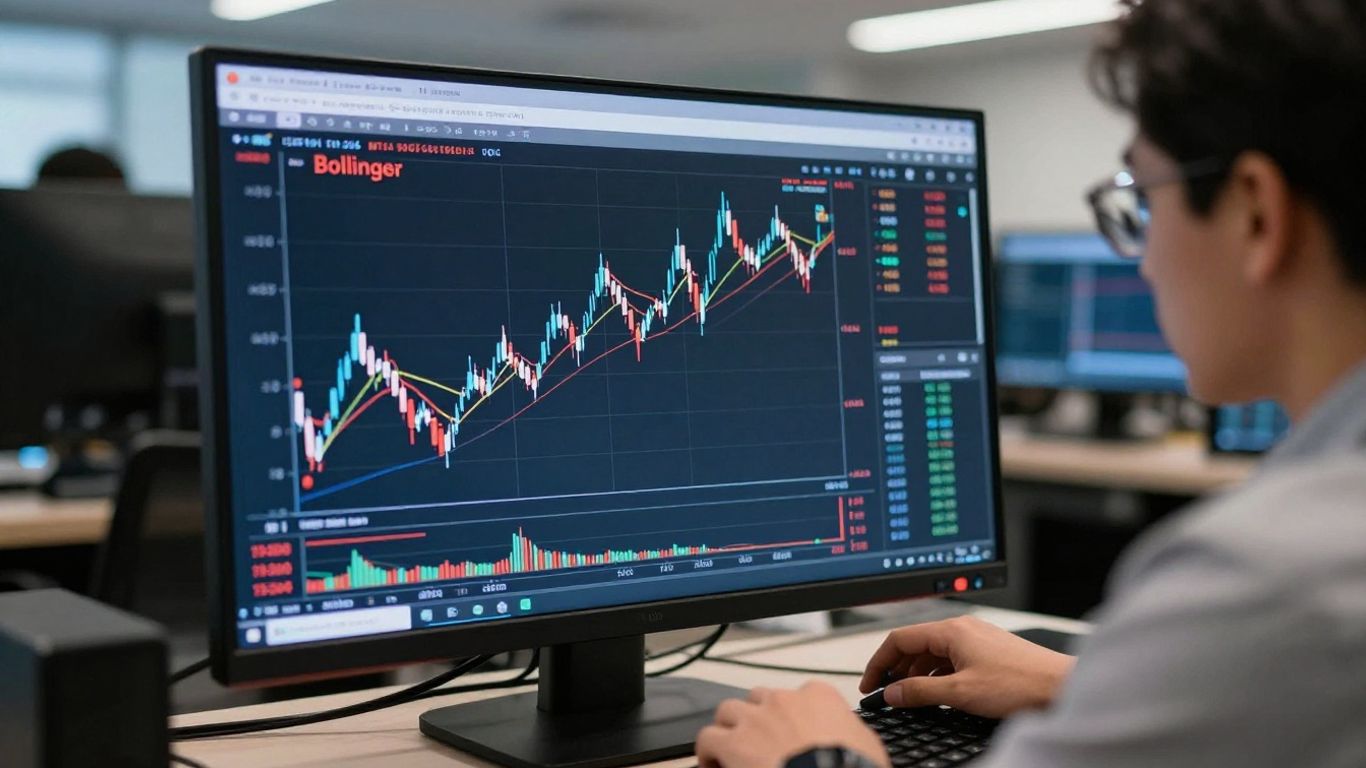
Bollinger Bands are a pretty neat tool for traders, and they’ve been around for a while. They basically show you how volatile the market is right now. You’ve got three lines: a middle one, which is usually a 20-period Simple Moving Average (SMA), and then two outer bands above and below it. These outer bands are set at a certain number of standard deviations away from that middle SMA.
When the bands get wider, it means the market’s moving a lot – lots of ups and downs. If they squeeze closer together, things are pretty calm, and the price isn’t moving much. This squeeze often signals that a bigger price move might be coming soon.
Here’s a quick rundown of what the bands can tell you:
- Price Touching Upper Band: This might suggest the asset is getting a bit overbought, or at least that there’s strong upward momentum. It doesn’t automatically mean sell, though.
- Price Touching Lower Band: This could indicate the asset is oversold, or there’s strong downward momentum. Again, not an automatic buy signal.
- Band Squeeze: As mentioned, when the bands get really tight, it often precedes a significant price breakout in either direction.
- Band Walk: If the price consistently rides along the upper or lower band for a while, it can indicate a strong trend.
Traders often use Bollinger Bands alongside other indicators, like RSI or MACD, to get a clearer picture. For example, if the price hits the upper band and the RSI shows it’s overbought, that’s a stronger signal than just the band alone. They’re great for spotting potential reversals or continuations, especially when you see them in combination with other chart patterns.
Bollinger Bands help traders gauge market volatility and identify potential price extremes. They are not standalone signals but work best when combined with other technical analysis tools to confirm trading ideas.
4. Moving Average Convergence Divergence
The Moving Average Convergence Divergence, or MACD, is a pretty popular tool for traders. It’s a trend-following momentum indicator, meaning it shows the relationship between two moving averages of a security’s price. It’s made up of three parts: the MACD line, the signal line, and the histogram.
Basically, the MACD line is calculated by subtracting the 26-period Exponential Moving Average (EMA) from the 12-period EMA. The signal line is a 9-period EMA of the MACD line itself. The histogram shows the difference between the MACD line and the signal line.
When the MACD line crosses above the signal line, it’s often seen as a bullish signal, suggesting prices might go up. Conversely, when the MACD line crosses below the signal line, it’s usually interpreted as a bearish signal, indicating prices might fall.
Here’s a quick rundown of how traders use it:
- Crossovers: The most common signal is when the MACD line crosses the signal line. A bullish crossover can be an entry signal, and a bearish crossover can be an exit signal or a short-selling opportunity.
- Divergence: This happens when the price of an asset is moving in one direction, but the MACD is moving in the opposite direction. For example, if the price makes a new high, but the MACD makes a lower high, that’s bearish divergence and could signal a trend reversal.
- Centerline Crossovers: When the MACD line crosses above the zero line, it suggests that the shorter-term moving average is above the longer-term moving average, indicating upward momentum. Crossing below the zero line suggests downward momentum.
Traders often use MACD in conjunction with other indicators, like RSI or Bollinger Bands, to get a clearer picture of market conditions. It’s especially useful for identifying potential trend changes and momentum shifts.
While MACD is a powerful indicator, it’s not foolproof. It can generate false signals, especially in choppy or sideways markets. It’s always a good idea to confirm its signals with other analysis methods before making any trading decisions.
5. Swing Index Indicator
The Swing Index Indicator is a tool traders use to get a feel for the market’s momentum and potential turning points. It’s not about predicting exact prices, but more about understanding the underlying strength of price movements over a medium-term timeframe. Think of it as trying to gauge the ‘swing’ or energy in the market.
This indicator often looks at things like the high, low, open, and close prices of a trading period. By analyzing these, it helps traders spot when a trend might be losing steam and a reversal could be on the horizon. It’s particularly useful for those who aren’t looking to hold trades for weeks or months, but rather for a few days or a couple of weeks.
Here’s a simplified look at what it helps identify:
- Potential Reversal Points: Spotting when a strong upward or downward move might be tiring out.
- Momentum Strength: Gauging how much force is behind the current price action.
- Entry/Exit Signals: Providing cues for when to consider entering or exiting a trade based on market sentiment.
It’s a good idea to combine the Swing Index Indicator with other tools to confirm its signals. For instance, looking at price action on charts or using other momentum indicators can give you a more complete picture. It’s one of many helpful trading indicators for forex traders available in 2026.
While the Swing Index Indicator is great for medium-term analysis, remember that markets are always changing. What works today might need tweaking tomorrow. Always test your strategies and stay adaptable.
6. Stochastic Oscillator
The Stochastic Oscillator is a momentum indicator that compares a specific closing price of a security to a range of its prices over a certain period. Think of it as a way to see where the price is currently sitting relative to its recent trading range. It’s particularly useful for spotting overbought or oversold conditions, which can sometimes signal a potential price reversal.
This indicator uses two lines, %K and %D, to show this relationship. The %K line is the main one, showing the current closing price’s position within the lookback period. The %D line is a moving average of the %K line, acting as a smoother signal.
Here’s a quick breakdown of what the lines can tell you:
- Overbought Zone: When both %K and %D lines are above 80, it suggests the asset might be overbought and could be due for a price drop.
- Oversold Zone: When both lines dip below 20, it indicates the asset might be oversold and could be poised for a price increase.
- Divergence: When the price makes a new high or low, but the Stochastic Oscillator doesn’t confirm it with a similar move, this is called divergence. It can be a strong signal that the current trend is losing steam.
Traders often look for crossovers between the %K and %D lines within these overbought or oversold zones as potential entry or exit signals. For example, a bullish crossover (where %K crosses above %D) in the oversold area might suggest a buying opportunity.
While the Stochastic Oscillator is great for identifying potential turning points, it’s not a standalone solution. It works best when you combine it with other tools, like support and resistance levels or trend indicators, to confirm its signals. Relying solely on the oscillator, especially in strong trending markets, can sometimes lead to false signals.
7. Fibonacci Retracement
Fibonacci retracement levels are a popular tool for traders looking to identify potential support and resistance areas. They’re based on the idea that markets tend to retrace a predictable portion of a prior move before continuing in the original direction. You’ll often see these levels used in conjunction with other indicators for confirmation.
The core idea is that after a significant price move, the market will often pull back to a specific percentage of that move before resuming its trend. These percentages are derived from the Fibonacci sequence: 23.6%, 38.2%, 50%, 61.8%, and 78.6%. The 50% level isn’t technically a Fibonacci ratio, but it’s widely used because traders often expect a price to retrace half of its previous move.
Here’s how you might use them:
- Identify a significant price swing: This could be a major uptrend or downtrend. Mark the high and low points of this swing.
- Apply the Fibonacci retracement tool: Most trading platforms have this built-in. It will automatically draw horizontal lines at the key Fibonacci levels between your chosen high and low.
- Look for confluence: See if these Fibonacci levels line up with other support or resistance areas on your chart, like previous highs/lows, moving averages, or even order blocks. This confluence can strengthen the signal.
- Watch for price action: Observe how the price reacts when it reaches a Fibonacci level. Does it bounce off it? Does it break through? This price action is key to confirming a potential trade.
While Fibonacci levels can be powerful, they aren’t magic. They work best when combined with other forms of analysis. Think of them as potential zones where a price might pause or reverse, not guaranteed turning points. It’s always wise to use them as part of a broader trading strategy.
Traders often use these levels to set stop-loss orders or take-profit targets. For example, if you’re in a long trade and the price starts to retrace, you might place your stop loss just below a key Fibonacci support level. Conversely, if you’re looking to enter a trade, you might wait for the price to pull back to a Fibonacci level that aligns with your strategy before entering.
8. Moving Average Crossover
The Moving Average Crossover is a pretty straightforward strategy that traders use to spot potential trend changes. It basically involves watching two moving averages – a fast one and a slow one – plotted on your chart. When the fast moving average crosses over the slow moving average, it can signal a shift in momentum.
This indicator tracks the intersection of two moving averages to generate clear entry and exit signals for trend-following trades, eliminating guesswork.
Here’s how it generally works:
- Bullish Signal: When the shorter-term moving average crosses above the longer-term moving average, it suggests that prices are rising and could indicate a good time to buy.
- Bearish Signal: Conversely, when the shorter-term moving average crosses below the longer-term moving average, it implies that prices are falling and might be a signal to sell.
- Confirmation: Many traders don’t rely on the crossover alone. They often look for confirmation from other indicators, like candlestick patterns or volume, to make sure the signal is solid.
It’s a popular choice because it’s easy to understand and implement, especially for those who are just getting started with technical analysis. You can adjust the periods for the moving averages to suit your trading style, whether you’re looking for quicker signals or a more smoothed-out trend indication. Finding the right moving average settings can make a big difference.
While the moving average crossover is a solid tool for identifying trends, it’s not foolproof. It can sometimes generate false signals, especially in choppy or sideways markets where prices are fluctuating without a clear direction. That’s why combining it with other analytical tools is usually the way to go for more reliable trading decisions.
9. Smart Money Concepts Indicator
Alright, let’s talk about Smart Money Concepts, or SMC for short. This isn’t your typical indicator that just draws lines on a chart. Instead, it’s more about trying to figure out what the big players—the banks, the hedge funds, you know, the ‘smart money’—are doing. They move huge amounts of capital, and their actions can really shape where the market goes.
Think of it like this: retail traders often see a price move and jump in. But smart money often sets up those moves. They’re looking for liquidity, which is basically where a lot of buy or sell orders are waiting. An SMC indicator tries to spot these areas. It looks for patterns that suggest big institutions have entered or exited positions, creating what are called ‘order blocks’.
These order blocks are essentially zones where a lot of trading activity happened, often causing a significant price change. The idea is that price might come back to these zones later because there’s still unfinished business there. So, when you see an SMC indicator highlight an order block, it could be a signal that price might react there.
Here’s a quick rundown of what SMC indicators often look for:
- Market Structure Breaks: When the price clearly breaks through previous highs or lows, showing a shift in control.
- Liquidity Grabs: When price briefly moves to take out stop-loss orders before reversing.
- Fair Value Gaps (FVG): Areas where price moved very quickly, leaving an imbalance that might get filled later.
- Order Blocks: The last opposing candle before a strong move, indicating institutional entry.
The main goal is to align your trades with the direction smart money is likely heading. It’s about trading smarter, not just harder, by trying to get on the right side of those big institutional moves. It takes some practice to get the hang of it, but many traders find it gives them a clearer picture of potential turning points.
Using SMC indicators means you’re trying to see the market from a different perspective. Instead of just following trends, you’re looking for the underlying forces that create those trends. It’s about understanding the ‘why’ behind price movements, not just the ‘what’.
It’s important to remember that no indicator is perfect. SMC is a concept, and indicators are tools to help visualize it. Combining it with other forms of analysis, like price action and volume, can really help confirm signals and build a more robust trading plan.
10. ICT Order Block Detector
When you’re looking at charts, you’ll notice that price doesn’t always move in a straight line. It tends to pull back, consolidate, and then continue. The ICT Order Block Detector is designed to help you spot these turning points, specifically where big players might have placed their trades. Think of it as finding the ‘footprints’ of institutional money.
These indicators look for specific patterns on the chart. They scan for areas where there was a strong push in one direction, often followed by a quick reversal. This suggests that a large amount of buying or selling happened at that exact spot, creating what’s called an ‘order block’. The idea is that price often comes back to test these zones before moving on.
Here’s a simplified breakdown of what these detectors look for:
- Strong Price Movement: A series of candles showing a clear, fast move in one direction.
- Market Structure Shifts: A change in the pattern of highs and lows, indicating a potential trend reversal.
- Imbalance Zones: Areas where price moved very quickly, leaving a gap that might be filled later.
Using an ICT Order Block Detector can help you identify potential entry and exit points that align with institutional activity. It’s not about predicting the future perfectly, but about understanding where significant orders might have been placed and how price might react to those areas again.
While many indicators show you what price has done, order block indicators try to show you where significant orders were placed. This can give you a different perspective on potential support and resistance levels.
It’s often recommended to use these detectors alongside other tools, like Fibonacci retracements or moving averages, to confirm your trade ideas. Setting your stop losses just beyond the identified order block can also be a common strategy, aiming for a good risk-to-reward ratio.
Wrapping It Up
So, we’ve looked at a bunch of different ways to trade using MT4 indicators. Remember, there’s no single ‘best’ one out there for everyone. What works for one trader might not work for another, and that’s totally fine. The key is to test things out, see what fits your style and your risk tolerance, and stick with it. Don’t jump around too much. Find an indicator, or maybe a couple that work well together, and really learn them inside and out. Trading is a journey, and finding the right tools is a big part of that. Good luck out there!
Frequently Asked Questions
What is the best MT4 indicator for beginners in 2026?
For new traders, the Relative Strength Index (RSI) is a great place to start. It’s easy to use and helps you see if a market is overbought or oversold, which can signal good times to buy or sell.
How does the Order Block Indicator help in trading?
The Order Block Indicator shows areas where big traders, like banks, have placed large orders. These spots are important because the price often reacts to them, making them useful for finding entry and exit points.
Can I use more than one indicator at the same time?
Yes, combining indicators can make your strategy stronger. For example, you might use Bollinger Bands with a Moving Average Crossover to confirm signals before making a trade.
What is the difference between a lagging and a leading indicator?
A lagging indicator follows price changes and shows trends after they start, like the Moving Average. A leading indicator tries to predict where the price will go next, like the Stochastic Oscillator.
Are these MT4 indicators free to use?
Most basic MT4 indicators, like RSI and Moving Averages, are free. Some advanced tools, like the Smart Money Concepts Indicator or ICT Order Block Detector, may cost money or need a subscription.
How do I avoid using indicators that repaint?
Choose indicators with a good reputation and reviews. Repainting indicators change past signals, which can be confusing. Always test new indicators on a demo account before trading with real money.